
Introduction
What is an ESOP under the Companies Act, 2013?
Who is eligible for ESOPs, and who is excluded?
| Eligible under Rule 12 | Excluded under Rule 12 |
| Permanent employees working in India or abroad | Independent directors |
| Directors, whether whole-time or not | Promoters and members of the promoter group |
| Employees and directors of a holding or subsidiary company | Directors holding more than 10% of equity directly, through relatives, or through a body corporate |
| -- | Consultants, advisors and anyone not on the payroll |
What approvals does a private company need to issue ESOPs?
What is the step-by-step procedure to issue ESOPs?
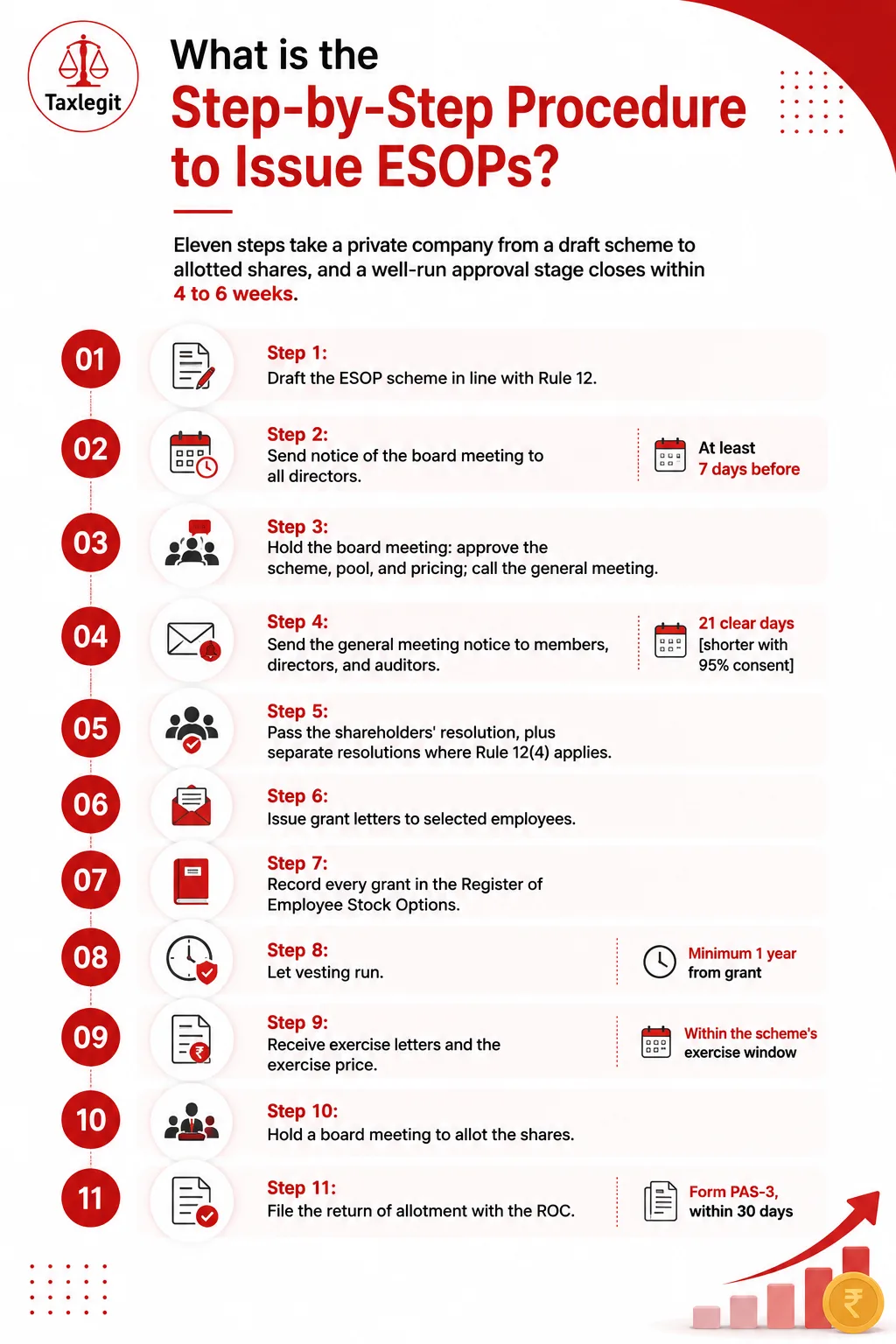
- Step 1: Draft the ESOP scheme in line with Rule 12.
- Step 2: Send notice of the board meeting to all directors. ( At least 7 days before )
- Step 3: Hold the board meeting: approve the scheme, pool, and pricing; call the general meeting.
- Step 4: Send the general meeting notice to members, directors, and auditors. ( 21 clear days [shorter with 95% consent] )
- Step 5: Pass the shareholders' resolution, plus separate resolutions where Rule 12(4) applies.
- Step 6: Issue grant letters to selected employees.
- Step 7: Record every grant in the Register of Employee Stock Options.
- Step 8: Let vesting run ( Minimum 1 year from grant )
- Step 9: Receive exercise letters and the exercise price. ( Within the scheme's exercise window )
- Step 10: Hold a board meeting to allot the shares
- Step 11: File the return of allotment with the ROC. ( Form PAS-3, within 30 days )
What rules govern vesting, exercise price, and lock-in?
- The one-year floor counts from the grant date. Where new options replace those held in a company that merged into yours, the earlier holding period is adjusted against the minimum.
- The company sets the exercise price freely, and it can differ from employee to employee through grant letters but never below face value, since discounted issues are barred by Section 53.
- Option holders earn no dividends and cast no votes until shares are actually allotted.
- The scheme must spell out lapse and forfeiture typically, unvested options return to the pool when an employee exits.
| You will need a defensible fair value twice: for the books at grant and a merchant banker valuation of FMV at exercise to compute perquisite TDS. TaxLegit's valuation team handles both. |
What compliance continues after allotment?
Set Up Your ESOP Scheme the Right Way
From drafting the scheme to filing Form MGT-14 and PAS-3, TaxLegit handles the resolutions, valuations, and post-allotment compliance so your ESOP pool holds up in your next funding round instead of becoming a diligence flag.

Frequently Asked Questions
1Can consultants or advisors receive ESOPs?
No, Rule 12 limits options to payroll employees and directors; advisor equity needs a different route, such as a direct share issue.
2Can an employee who already holds shares get options?
Yes, as long as they are not a promoter and, if a director, do not cross the 10% holding test.
3Can the exercise price differ between employees?
Yes, Grant letters can set different prices for different people, but never below the face value of the share.
4What happens to options when an employee resigns?
Whatever the scheme says. The usual design: unvested options lapse back to the pool, and vested options must be exercised within a defined window.
5Can the company help employees fund the exercise?
Yes, The scheme can build in a company loan or a cashless mechanism, and the exercise window can be extended with the required approvals.
6Is fresh shareholder approval needed for every grant?
No, One approval covers grants within the sanctioned pool. Go back to shareholders only to expand the pool, vary scheme terms, or for the Rule 12(4) cases above.
About the Author

Content Writer
Srijita is a legal and financial content specialist with 5+ years of experience in the Indian corporate sector. She simplifies MCA regulations and tax compliance into clear, actionable insights for entrepreneurs, working closely with Chartered Accountants and legal experts to ensure accuracy and compliance. Reviewed by Vipul Sharma, Co-Founder, Taxlegit.