- SOP Standardization: Establishes clear, step-by-step operational workflows so processes run seamlessly, regardless of staff absence or turnover.
- Audit-Ready Compliance: Automatically generates Risk Control Matrices (RCM) and ICFR documentation.
- Working Capital Optimization: Eliminates delays in customer follow-ups and reconciliations to protect cash flow.
- Your team grows, and the person who "just knows how things work" becomes a single point of failure.
- An audit finds inconsistencies because two people were doing the same task two different ways.
- Errors in expense processing or accounts payable cost real money and most are preventable.
- Nearly 60% of financial institutions struggle with outdated or inconsistent procedural documentation, according to a Deloitte survey.
The 5 Financial SOPs Every Business Needs
| SOP Type | What It Covers | Why It Matters |
| Accounts Payable | Invoice receipt, approval, and payment | Prevents duplicate payments, late fees, and vendor disputes |
| Accounts Receivable | Invoice creation, delivery, and follow-up | Improves cash flow and reduces bad debt |
| Expense Management | Submission, review, and reimbursement | Controls costs and prevents policy abuse |
| Bank Reconciliation | Matching bank statements to accounting records | Catches errors and fraud early |
| Financial Reporting | Preparing P&L, balance sheet, and cash flow | Ensures accurate, timely management information |
How to Write a Financial SOP ( Step by Step )
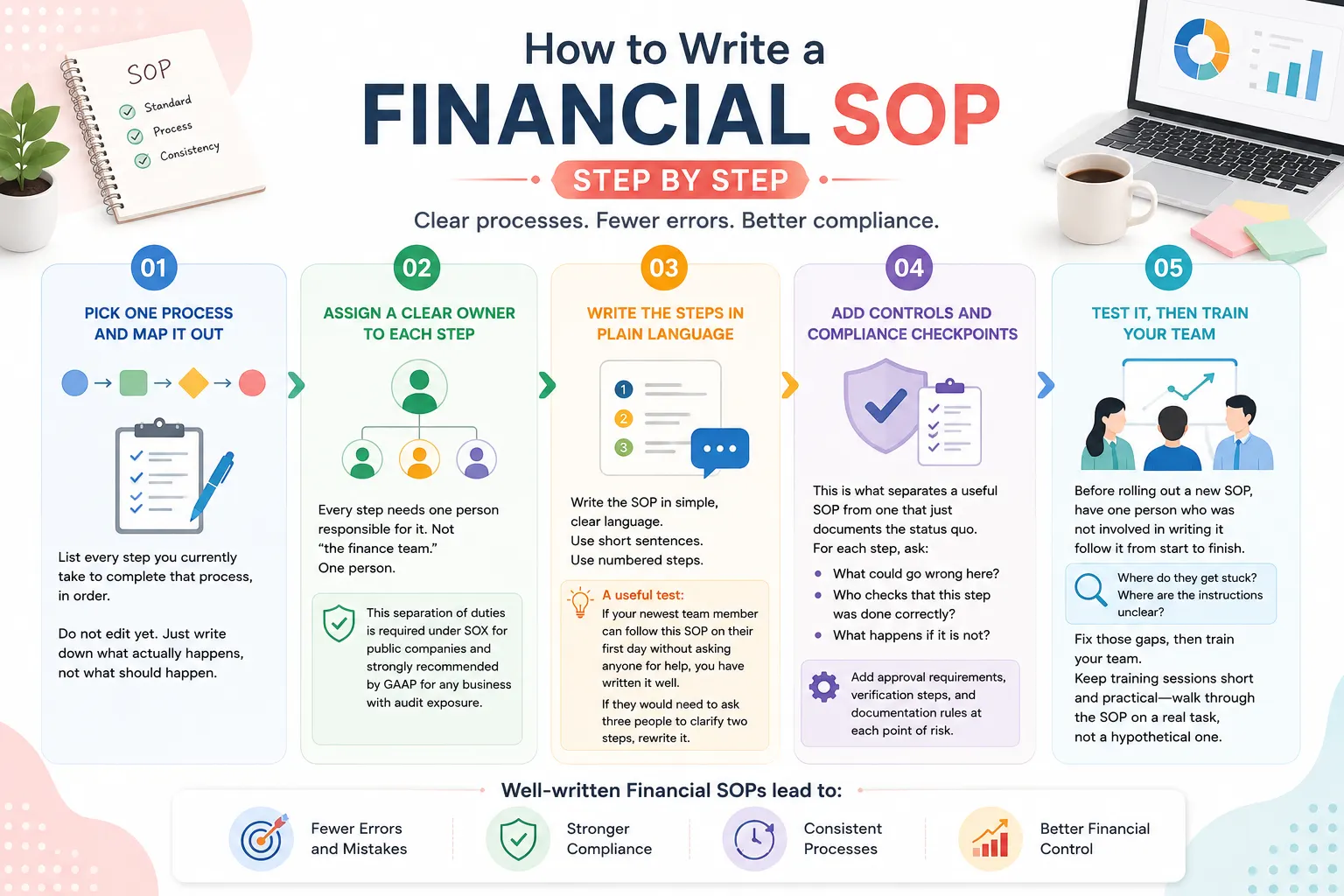
Step 1: Pick One Process and Map It Out
Step 2: Assign a Clear Owner to Each Step
Step 3: Write the Steps in Plain Language
Step 4: Add Controls and Compliance Checkpoints
- What could go wrong here?
- Who checks that this step was done correctly?
- What happens if it is not?
Step 5: Test It, Then Train Your Team
Financial SOP Checklist: What Every SOP Should Include
Structure checklist
- Process name and version date clearly stated
- Purpose of the SOP explained in one or two sentences
- Roles and responsibilities listed by name or title, not "the team"
- Steps numbered in clear sequence with no ambiguous language
- Approval checkpoints identified at each risk point
- Tools and software referenced by name (QuickBooks, Xero, etc.)
- Documents required at each step listed explicitly
- What to do when something goes wrong escalation path included
Compliance checklist
- GAAP or IFRS requirements referenced where applicable
- Separation of duties enforced no single person controls all steps
- Document retention rules specified (how long to keep records)
- Review date set at minimum every 6 months or after any regulatory change
- Last reviewed date and reviewer name recorded on the document
The Most Common SOP Mistakes and How to Avoid Them
| Mistake | What Happens | How to Fix It |
| Writing the SOP for the ideal process, not the real one | Nobody follows it because it does not match reality. | Map what actually happens first, then improve it. |
| No clear ownership at each step | Tasks fall through the cracks; no one is accountable. | Assign one name to every step. |
| Keeping the SOP only as a document in a shared folder | Team members do not read it and do not know it exists. | Embed SOPs in your accounting software, onboarding, and training. |
| Not updating SOPs when rules or tools change | The team follows outdated steps; compliance gaps appear. | Set a 6-month review calendar and assign an owner to each SOP. |
| Missing an escalation path | Nobody knows what to do when something goes wrong. | Every SOP must include a "what to do if this fails" step |
When to Get Outside Help With Financial SOPs
Where we can help
- Monthly close processes that are currently inconsistent or slow
- Accounts payable and receivable processes with recurring errors
- Expense approval processes without clear controls
- Financial reporting processes that produce late or unreliable results
Final Thoughts
Frequently Asked Questions
1What is a financial SOP and why does my business need one?
A financial SOP (Standard Operating Procedure) is a written set of instructions that defines how a specific finance task should be completed, who does it, in what order, using which tools, and with which checks in place.
2How long does it take to write a financial SOP?
A basic SOP for a single process like bank reconciliation or expense reimbursement takes between 2 and 4 hours to draft if you have someone who knows the process well.
3How often should financial SOPs be reviewed and updated?
At minimum, every 6 months and immediately after any of the following: a change in accounting software or tools, a change in tax laws or compliance requirements, a significant change in team structure, a new product or revenue stream that changes your financial processes, or an audit finding that reveals a process gap.
4What is separation of duties in a financial SOP?
Separation of duties means that no single person controls all the steps in a financial transaction. For example, the employee who requests a payment should not also be the person who approves it. The person who creates invoices should not also be the person who reconciles the accounts.
5Can a small business benefit from financial SOPs?
Yes, Small businesses often benefit more than large ones because they have fewer people covering more tasks, which increases the risk that a single person creates and hides errors. A two-person finance team without SOPs is highly dependent on those two people's memory and habits. If one person leaves, the institutional knowledge leaves with them.
About the Author

Content Writer
Srijita is a legal and financial content specialist with 5+ years of experience in the Indian corporate sector. She simplifies MCA regulations and tax compliance into clear, actionable insights for entrepreneurs, working closely with Chartered Accountants and legal experts to ensure accuracy and compliance. Reviewed by Vipul Sharma, Co-Founder, Taxlegit.