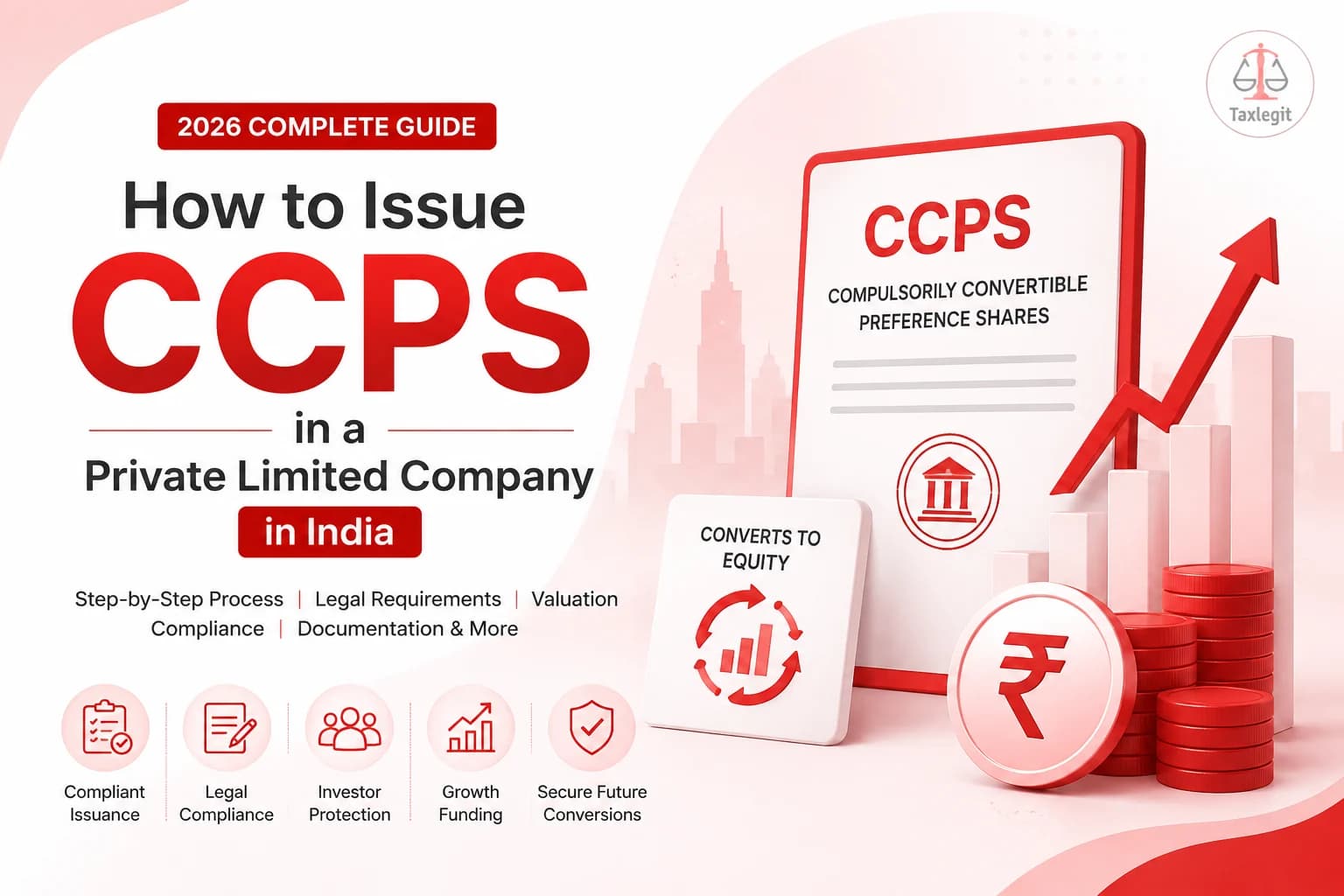
What are Compulsorily Convertible Preference Shares (CCPS)?
Statutory Framework
- Section 55 of the Companies Act, 2013: Regulates the issue and redemption of preference shares.
- Section 42 & Section 62(1)(c) of the Companies Act, 2013: Govern the issuance of securities on a private placement basis and preferential allotment.
- Companies (Share Capital and Debentures) Rules, 2014 (Rule 9): Sets out procedural requirements for preference share issuances.
- Companies (Prospectus and Allotment of Securities) Rules, 2014 (Rule 14): Governs private placement procedures and offer documents.
- FEMA (Non-Debt Instruments) Rules, 2019: Govern foreign direct investment (FDI) inflows, valuation rules, and pricing caps when issuing CCPS to non-resident entities.
Why Companies Issue CCPS Instead of Equity
| Feature / Benefit | Investor Perspective | Founder / Company Perspective |
| Valuation Protection | Defers hard valuation mechanics until future growth milestones or Series A/B pricing rounds. | Prevents severe initial equity dilution before the company achieves critical scale. |
| Liquidation Preference | Grants priority over equity shareholders during a liquidation event, bankruptcy, or asset distribution. | Provides an attractive capital structure to secure institutional venture capital. |
| Dividend Priority | Ensures preferential rights over common equity whenever dividend distributions are declared. | Minimizes immediate cash flow drain by issuing non-cumulative low-coupon CCPS. |
| Voting Autonomy | Generally carries no voting rights except on matters affecting preference shareholder rights. | Prevents investor interference in day-to-day business operations and governance. |
| Foreign Capital Inflow | Recognized as eligible FDI under foreign direct investment guidelines. | Enables seamless access to global venture capital, private equity, and offshore funds. |
Step-by-Step Procedure to Issue CCPS
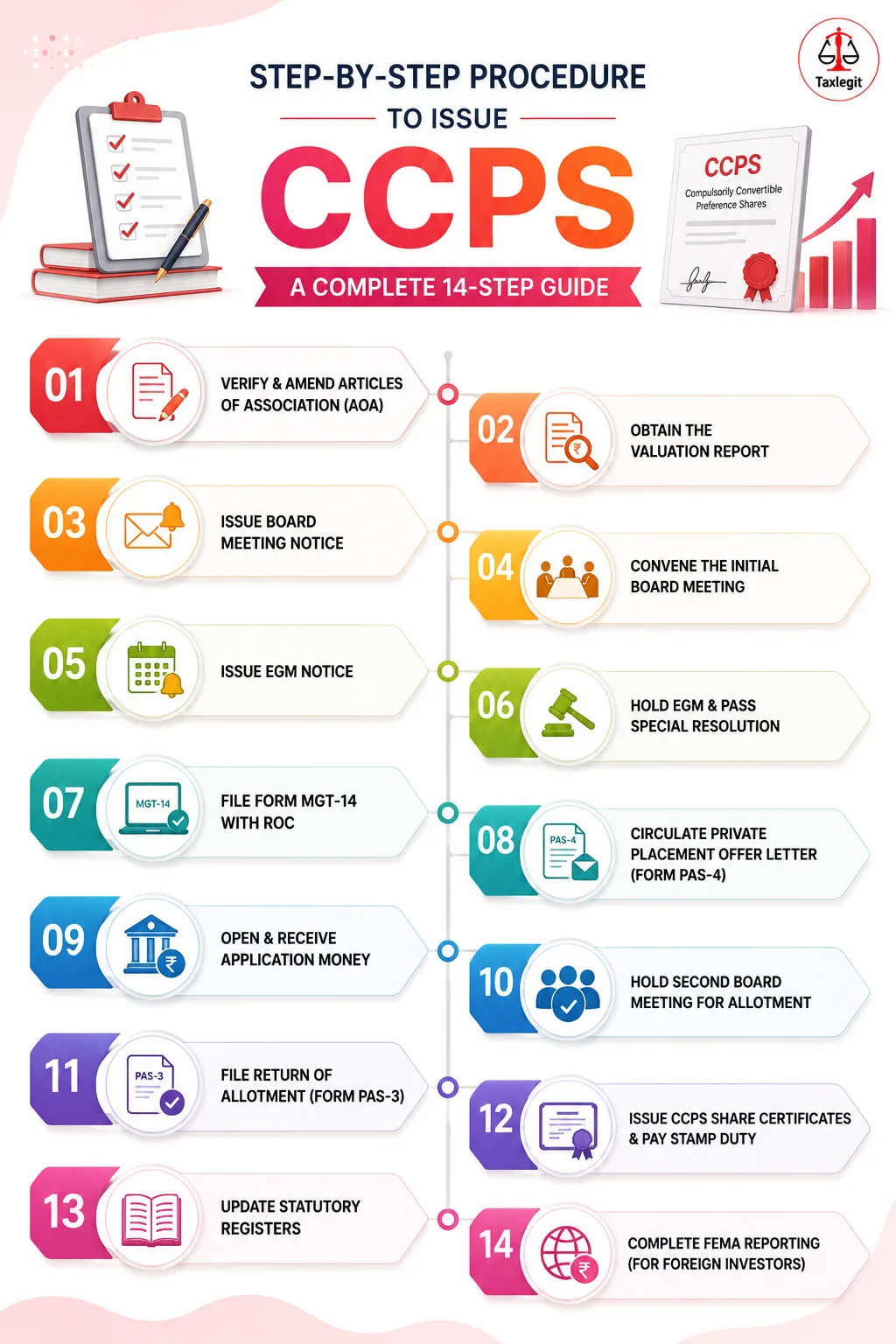
Step 1: Verify & Amend Articles of Association (AOA)
Step 2: Obtain the Valuation Report
Step 3: Issue Board Meeting Notice
Step 4: Convene the Initial Board Meeting
- Approve the CCPS issuance quantum, conversion price, and coupon rate.
- Approve the draft Private Placement Offer Letter (Form PAS-4).
- Fix the date, time, and venue for the Extraordinary General Meeting (EGM) to seek shareholder sanction.
- Authorize a Company Secretary to issue EGM notices.
Step 5: Issue EGM Notice
Step 6: Hold EGM & Pass Special Resolution
Step 7: File Form MGT-14 with ROC
Step 8: Circulate Private Placement Offer Letter (Form PAS-4)
Step 9: Open & Receive Application Money
Step 10: Hold Second Board Meeting for Allotment
Step 11: File Return of Allotment (Form PAS-3)
Step 12: Issue CCPS Share Certificates & Pay Stamp Duty
Step 13: Update Statutory Registers
Step 14: Complete FEMA Reporting (For Foreign Investors)
Documents Required for CCPS Issuance
| Document | Primary Purpose | Prepared / Certified By |
| Articles of Association (AOA) | Enables authority to issue preference shares. | Practicing Company Secretary (PCS) |
| Valuation Report | Establishes conversion floor pricing and FMV. | Registered Valuer / Merchant Banker |
| Board Notices & Minutes | Records corporate approvals for the offer and allotment. | Company Secretary / Director |
| EGM Notice & Explanatory Statement | Provides full disclosure to shareholders under Sec 102. | Corporate Secretarial Team |
| Form PAS-4 | Formal Private Placement Offer Letter sent to investors. | Directors / Legal Counsel |
| Form PAS-5 | Master record listing all targeted private placement offers. | Company Secretary |
| Bank Certificate (FIRC & KYC) | Validates international inward foreign exchange remittances. | Authorised Dealer (AD) Bank |
| Shareholders' Agreement (SHA) | Governs rights, milestones, and conversion formulas. | Legal Counsel / VC Firm |
Step-by-Step Timeline Overview
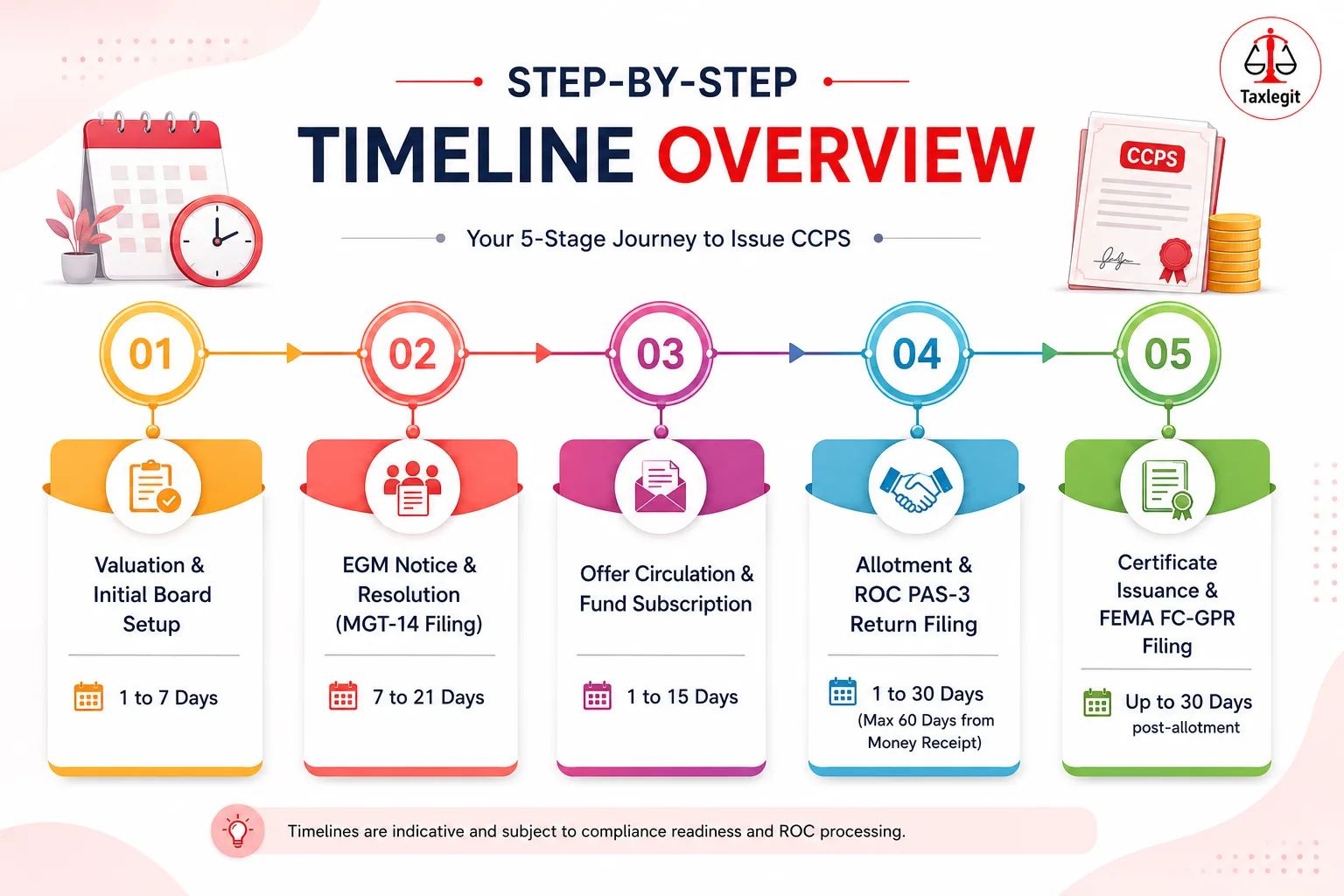
- Valuation & Initial Board Setup: 1 to 7 Days
- EGM Notice & Resolution (MGT-14 Filing): 7 to 21 Days
- Offer Circulation & Fund Subscription: 1 to 15 Days
- Allotment & ROC PAS-3 Return Filing: 1 to 30 Days (Max 60 Days from Money Receipt)
- Certificate Issuance & FEMA FC-GPR Filing: Up to 30 Days post-allotment
Common Mistakes to Avoid When Issuing CCPS
- Issuing Without AOA Authorization: Issuing preference shares when the AOA only provides for equity capital makes the entire allotment ultra vires (void).
- Using Invalid Valuations: Using valuation reports from non-certified accountants for FEMA or Angel Tax transactions can lead to penalty notices.
- Mixing Subscription Funds: Depositing private placement money into regular operational bank accounts instead of a dedicated account violates Section 42(6).
- Late Form PAS-3 Filing: Missing the 30-day deadline triggers daily recurring penalties under Section 42(9).
- Omitting Form MGT-14 Filings: Issuing Private Placement Offer Letters (PAS-4) before filing Form MGT-14 violates Secretarial Standards.
- Neglecting Foreign Investment Reporting: Missing FC-GPR filings on the FIRMS portal leads to RBI compounding penalties for FEMA non-compliance.
Compliance Checklist for CCPS Issuance
- [ ] Verify that the AOA explicitly permits the issuance of preference shares / CCPS.
- [ ] Obtain a formal Valuation Report from an IBBI-Registered Valuer / Merchant Banker.
- [ ] Execute a Shareholders' Agreement (SHA) / Share Subscription Agreement (SSA).
- [ ] Issue a 7-day Board Meeting notice to consider the CCPS issuance proposal.
- [ ] Hold the Board Meeting to approve draft PAS-4 offer documents and set the EGM date.
- [ ] Issue a 21-day clear-day EGM notice accompanied by a Section 102 Explanatory Statement.
- [ ] Pass the Shareholders' Special Resolution at the EGM.
- [ ] File Form MGT-14 with the ROC within 30 days of passing the Special Resolution.
- [ ] Open a separate, dedicated bank account in a scheduled bank for subscription funds.
- [ ] Issue Form PAS-4 offer letters to identified investors and maintain Form PAS-5.
- [ ] Receive subscription funds via direct bank transfer into the dedicated account.
- [ ] Hold a Board Meeting within 60 days of fund receipt to formally allot CCPS.
- [ ] File Form PAS-3 (Return of Allotment) with the ROC within 30 days of allotment.
- [ ] Pay applicable State Stamp Duty on CCPS share allocations within statutory limits.
- [ ] Issue Share Certificates (Form SH-1) within 2 months of share allotment.
- [ ] Update the statutory Register of Members (Form MGT-1).
Frequently Asked Questions
1Can CCPS be issued without a Valuation Report?
No, Section 42 and Section 62(1)(c) of the Companies Act, 2013, alongside Rule 11UA of the Income Tax Rules, mandate a Valuation Report from an IBBI-Registered Valuer (or a SEBI-registered Merchant Banker for foreign investors under FEMA) to establish the conversion floor price.
2Can early-stage startups issue CCPS to investors?
Yes, CCPS is a widely used investment instrument for early-stage startups because it defers definitive equity pricing decisions to subsequent valuation rounds while providing downside risk protection for investors.
3Can foreign investors or offshore venture funds subscribe to CCPS?
Yes, Under the FEMA (Non-Debt Instruments) Rules, 2019, CCPS are treated as equity instruments and are eligible for Foreign Direct Investment (FDI) under the 100% Automatic Route across permitted sectors.
4Is filing Form PAS-3 mandatory after allotting CCPS?
Yes, Form PAS-3 (Return of Allotment) must be filed with the Registrar of Companies (ROC) within 30 days of share allotment. Failure to file triggers daily financial penalties under Section 42.
5Is filing Form MGT-14 mandatory for CCPS issuance?
Yes, Form MGT-14 must be filed with the ROC within 30 days of passing the Special Resolution at the EGM, as required under Section 117 of the Companies Act, 2013.
6Can CCPS be redeemed for cash instead of converted into equity?
No, Compulsorily Convertible Preference Shares (CCPS) must be fully converted into Equity Shares within the pre-agreed timeframe or upon reaching designated milestones. They cannot be redeemed for cash.
About the Author

Content Writer
Srijita is a legal and financial content specialist with 5+ years of experience in the Indian corporate sector. She simplifies MCA regulations and tax compliance into clear, actionable insights for entrepreneurs, working closely with Chartered Accountants and legal experts to ensure accuracy and compliance. Reviewed by Vipul Sharma, Co-Founder, Taxlegit.