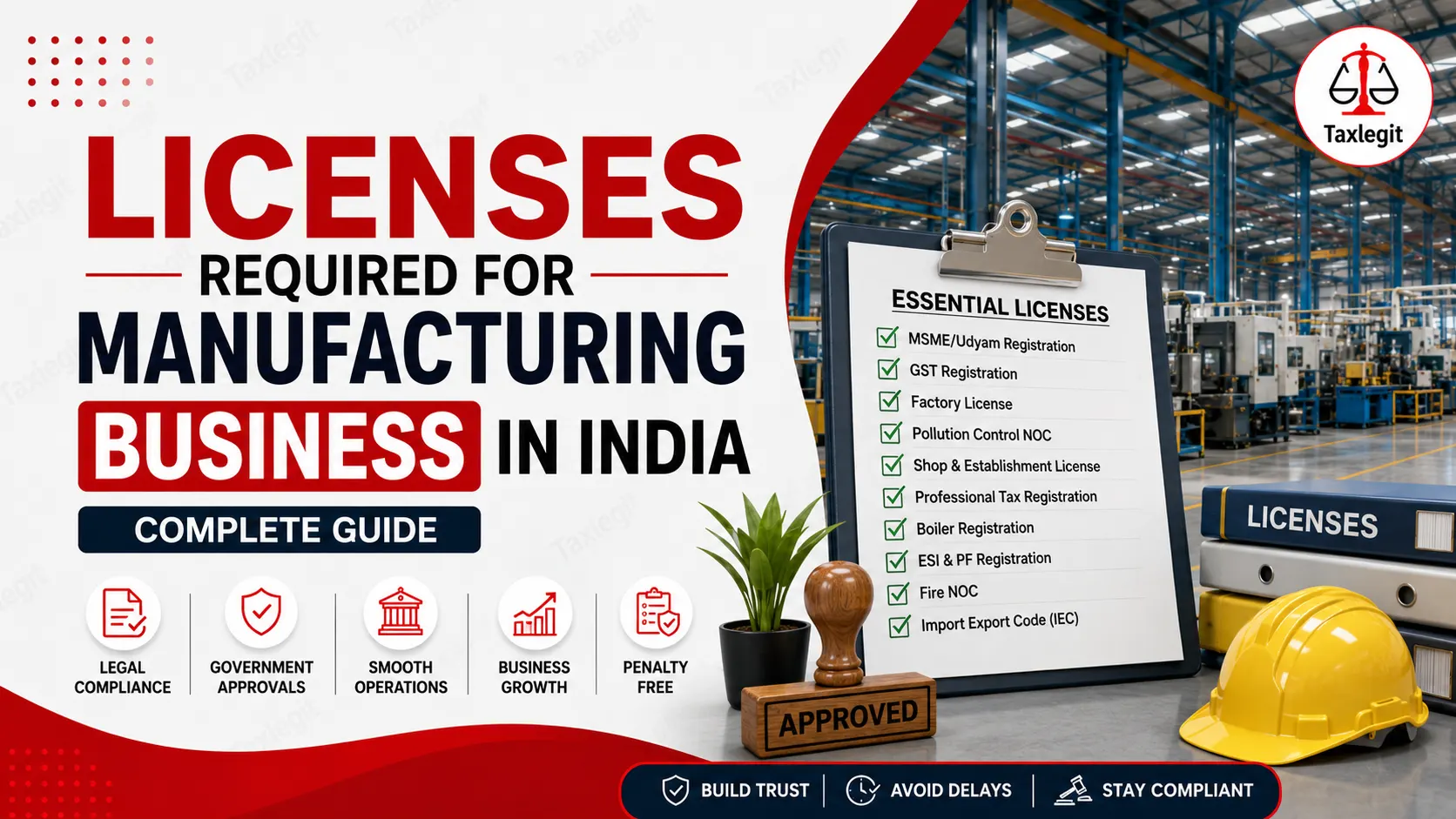
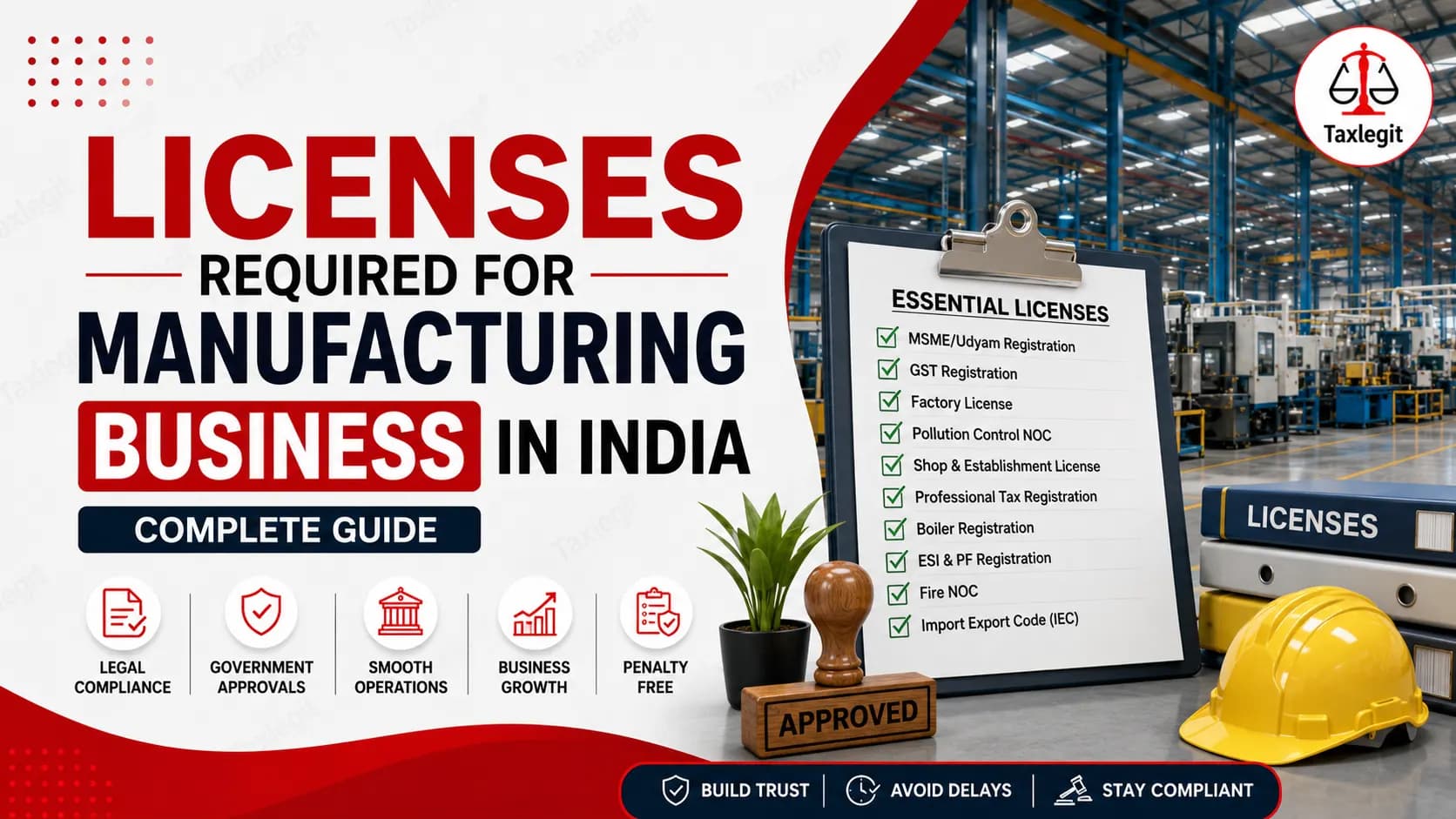
Launching a manufacturing business in India is a capital-intensive venture with immense potential under the "Make in India" initiative. However, setting up a factory requires navigating a complex web of legal clearances, environmental norms, and municipal approvals. Without securing the correct licenses before commissioning your plant, your business risks severe legal penalties, operational halts, and financial distress. This Taxlegit’s guide breaks down the mandatory licenses, regulatory checkpoints, and step-by-step registration processes needed to launch a legally compliant manufacturing business in India.
Table of Contents
- Quick Key Facts
- Why Licensing Matters for Manufacturing Businesses
- Who Needs to Apply for Manufacturing Licenses Carefully?
- Top Licensing Categories Compared
- The 4 Pillars of Manufacturing Compliance
- Step-by-Step Licensing Process for Manufacturers
- Crucial Documents & Data Sources Needed
- Common Mistakes to Avoid
- Practical Tips for Industrial Entrepreneurs
- FAQs
- Conclusion
Quick Key Facts
- Regulatory Complexity: A manufacturing setup in India typically requires between 7 and 15 distinct central, state, and local government approvals before operations can begin.
- Environmental Mandates: All manufacturing units must secure Consent to Establish (CTE) and Consent to Operate (CTO) from the State Pollution Control Board (SPCB) based on their industrial color-coding (Red, Orange, Green, White).
- MSME Benefits: Registering under Udyam Registration unlocks critical priority sector lending, capital subsidies, and protection against delayed payments.
- Penalties of Non-Compliance: Operating a factory without a valid Factory License or SPCB consent can lead to immediate closure orders, disconnection of power/water utilities, and heavy financial fines.
- Single Window Systems: Most Indian states now offer online Single Window Clearance Systems (SWCS) to streamline the submission of industrial license applications.
Why Licensing Matters for Manufacturing Businesses
When launching an industrial unit, your equipment procurement and land acquisition plans are only as solid as your legal permits. For any manufacturing venture, the accuracy of your licensing directly impacts:
- Uninterrupted Operations: Prevents surprise inspections from local authorities that can result in immediate operational shutdowns or equipment seizures.
- Access to Capital: Banks, institutional lenders, and investors strictly mandate valid regulatory clearances (like Factory Licenses and Pollution Consents) before disbursing term loans.
- Employee Safety & Welfare: Adherence to statutory acts ensures your factory maintains the required fire safety, labor welfare, and environmental standards.
- Brand Credibility: Holding valid quality standards (like BIS or ISO) makes your products eligible for government tenders and international export markets.
- Tax and Subsidy Claims: Proper registration is a prerequisite to avail yourself of GST input tax credits and industrial incentives under state policies.
Who Needs to Apply for Manufacturing Licenses Carefully?
- New Startups setting up their very first physical factory or assembly line in India.
- Existing Companies expanding their manufacturing operations into new states or adding new product lines.
- Foreign Wholly Owned Subsidiaries establishing an industrial base in India under automated or government approval routes.
- MSME Entrepreneurs transitioning from small-scale workshops to commercial manufacturing facilities.
- Exporters manufacturing specialized components, electronics, or pharmaceuticals for global supply chains.
Top Licensing Categories Compared
Selecting the right registrations depends on your product type, location, and scale of operations. The table below compares the key licensing frameworks:
| License Type | Why It's the Top Choice | Key Metrics Analyzed | Best Suited For | Practical Note |
| Pollution Consent (CTE/CTO) | Mandated by environmental laws; regulates emissions and waste disposal | Effluent levels, air emission limits, hazardous waste generation | Chemical, electronics, processing, and heavy industries | Classification depends entirely on your industry's color-coding (Red, Orange, Green, White) |
| Factory License | Ensures compliance with the Factories Act, 1948; covers worker welfare | Number of employees, machine power (HP), industrial safety layout | All manufacturing units with 10+ workers (with power) or 20+ workers (without power) | Must be renewed periodically; needs fire safety clearance |
| BIS / ISI Certification | Validates product safety and standards for consumers | Product testing, quality control parameters, manufacturing hygiene | Consumer goods, electronics, chemicals, auto parts | Mandatory for over 450 specific product categories before commercial sale |
The 4 Pillars of Manufacturing Compliance
To build an investor-grade compliance framework, your factory must secure approvals across four specific areas:
| Compliance Pillar | What It Specifically Maps | Primary Objective | Typical Processing Time | Common Mistakes to Avoid |
| Business Identity & Land | Company Incorporation, PAN, TAN, Land Use conversion (CLU) | Ensures your company is legally registered to operate on the specific industrial land parcel | 10 to 15 days | Attempting to build a factory on agricultural land without getting a CLU permit first |
| Environmental Approvals | Consent to Establish (CTE) and Consent to Operate (CTO) | Validates that your industrial emissions and waste management processes meet SPCB guidelines | 30 to 45 days | Commencing physical construction before getting your initial CTE approval |
| Operational Permits | Factory License, Fire NOC, Power/Water connections | Ensures your facility's physical safety, employee welfare, and infrastructure are up to code | 20 to 30 days | Forgetting to align the actual plant layout with the approved factory blueprint |
| Tax & Product Norms | GST Registration, IEC (Import Export Code), BIS/FSSAI certifications | Validates your legal right to sell your products domestically and internationally | 7 to 15 days | Operating without product-specific quality licenses (like FSSAI for food products) |
Step-by-Step Licensing Process for Manufacturers
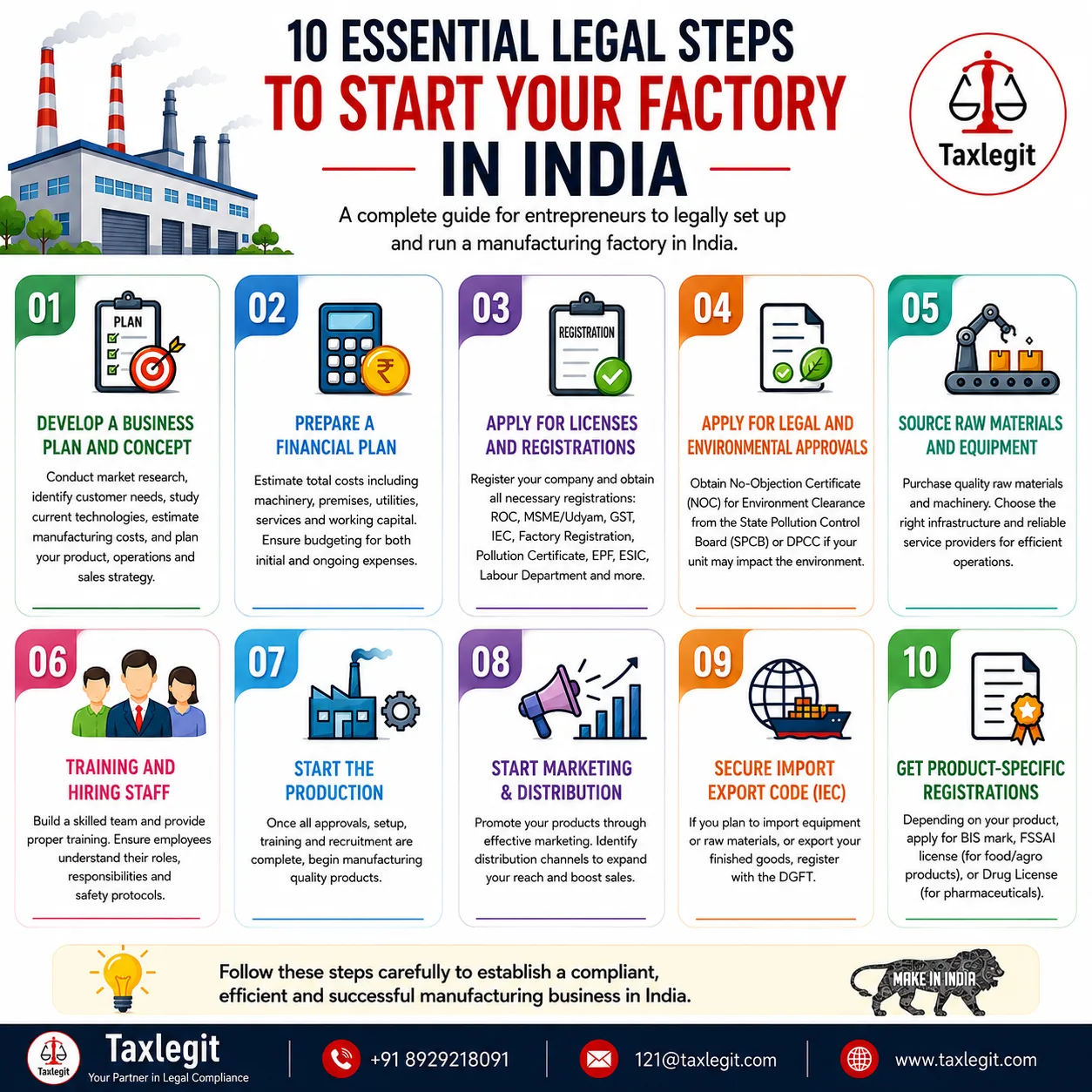
Step 1: Incorporate Your Entity: Register your business as a Private Limited Company, LLP, or Partnership. Obtain your PAN and TAN.
Step 2: Secure Land Use Permission (CLU): Ensure your plot sits within an industrial zone. If it’s outside an active industrial estate, apply for a Change of Land Use (CLU) from local authorities.
Step 3: Apply for Consent to Establish (CTE): Submit your plant layout, manufacturing process details, and waste treatment plans to the State Pollution Control Board before starting any construction.
Step 4: Obtain Fire Department NOC: Submit your industrial site plans to the local fire department to confirm you have adequate emergency exits, fire hydrants, and safety alarms.
Step 5: Apply for Power and Water Utility Links: Use your incorporation documents, land records, and initial clearances to secure high-tension power lines and industrial water connections.
Step 6: Secure a Factory License: File your building layout plans and machinery configurations with the Directorate of Factories to confirm worker safety standards.
Step 7: Obtain Consent to Operate (CTO): Once the factory is built but before regular production starts, apply for a CTO from the SPCB after a successful physical inspection.
Step 8: Register for GST and MSME (Udyam Aadhaar): Apply for GST to start invoicing and get your Udyam registration to access valuable government subsidies.
Step 9: Secure an Import Export Code (IEC): If you plan to import any equipment or raw materials, or export your finished goods, register with the DGFT.
Step 10: Get Product-Specific Registrations: Depending on your product, apply for a BIS mark, FSSAI license (for food/agro products), or a Drug License (for pharmaceuticals).
Crucial Documents & Data Sources Needed
| Document/Source | Description | Notes |
| Land Ownership Documents/Lease Deed | Proves your legal right to occupy and build on the manufacturing site | Critical for all applications, from pollution consent to utility connections |
| Industrial Plant Layout Blueprint | Detailed drawings showing exits, equipment placement, and safety zones | Must be approved by a certified architect before applying for a Factory License |
| State Pollution Board (SPCB) Manuals | Color-category rules and emission benchmarks specific to your state | Guides your waste treatment setup and effluent plant investments |
| Udyam MSME Registration Certificate | Your digital ID as a micro, small, or medium enterprise in India | Mandatory to access lower interest rates and MSME loan options |
| Project Report & Machinery Quotations | Detailed technical data on your equipment and production methods | Required for getting both your power load approvals and bank funding |
Common Mistakes to Avoid
- Starting Construction Without a CTE: Breaking ground before the State Pollution Control Board grants your Consent to Establish can lead to immediate heavy fines and construction halts.
- Using Agricultural Land Without Conversion: Setting up operations on rural or agricultural land without a formal Change of Land Use (CLU) certificate is highly illegal.
- Ignoring the Exact Power Load: Applying for lower power capacities than your heavy machinery actually draws can lead to persistent supply cuts and equipment damage.
- Filing the Wrong Pollution Category: Misclassifying a Red Category industry (high pollution potential) as Orange or Green to speed up approvals can cause major legal disruptions later.
- Missing the Factory Plan Approval Phase: Ordering machinery before your physical plant layout is officially approved by the Directorate of Factories can force costly renovations.
Practical Tips for Industrial Entrepreneurs
- Leverage State Single Window Systems: Use your state’s online portal (such as MAITRI in Maharashtra or TS-iPASS in Telangana) to submit applications to multiple departments at once.
- Build an Effluent Treatment Plant Early: If your industry generates liquid waste, invest in your effluent treatment plant (ETP) early to secure your Consent to Operate (CTO) without delays.
- Apply for Your Udyam Certificate Early: Do this as soon as you have your corporate identity. It opens doors to early-stage credit schemes and direct subsidies.
- Secure Proper Fire Hydrant Permissions: Work directly with certified fire-safety engineers to map your factory floor, as this is the most common reason for Factory License delays.
- Partner with Compliance Specialists: Work with experienced legal and tax consultants to track your filings, manage renewals, and prevent non-compliance notices.
Frequently Asked Questions
Q1. Is a trade license the same as a factory license?
No. A Trade License is granted by local municipal corporations to allow general commercial activities in a specific area. A Factory License is issued by the state's Directorate of Factories and explicitly regulates worker safety, machine power, and health standards inside a manufacturing plant.
Q2. What is the difference between CTE and CTO from the pollution board?
Consent to Establish (CTE) is the approval you need before you start physical construction of your factory. Consent to Operate (CTO) is the approval you need after construction is finished but before you start commercial production.
Q3. Do all manufacturing units need a BIS or ISI certification?
No. While it is highly recommended for all products to build consumer trust, a BIS certification is mandatory only for over 450 specific items, including electronics, batteries, cement, steel, and food products.
Q4. What happens if I operate my factory without an active factory license?
Operating without a valid license is a major violation of the Factories Act, 1948. It can lead to immediate closure of the facility, utility disconnections, severe financial penalties, and even criminal liability for the company's directors.
Q5. Can I apply for manufacturing licenses if my company operates out of a rented building?
Yes. You can apply using a valid, registered lease agreement along with a No Objection Certificate (NOC) from the property owner, instead of land ownership deeds.
Q6. How does the industrial color-coding system work?
The Ministry of Environment, Forest and Climate Change classifies industries into four color categories based on their pollution potential: Red (High), Orange (Medium), Green (Low), and White (Non-polluting). White category industries do not need pollution consents, just simple registration.
Q7. How does Taxlegit help with my manufacturing licensing process?
Taxlegit simplifies the entire process. From helping with corporate incorporation and MSME registration to securing pollution consents and factory licenses, we handle your regulatory paperwork so you can focus entirely on your manufacturing line.
Conclusion
Setting up a manufacturing plant in India is an exciting venture, but your operational success hinges directly on getting your licensing right. Without valid permits like your pollution consents, factory licenses, and industry-specific certifications, your facility risks serious legal delays, costly fines, and unexpected operational halts.
At Taxlegit, we eliminate the guesswork. We handle your data collection, draft your documentation, file applications with the respective state and central portals, and manage your renewals. Let us take care of the regulatory paperwork, while you focus on scaling your production capacity.
About the Author

Srijita
Content Writer
Srijita is a legal and financial content specialist with 5+ years of experience in the Indian corporate sector. She simplifies MCA regulations and tax compliance into clear, actionable insights for entrepreneurs, working closely with Chartered Accountants and legal experts to ensure accuracy and compliance. Reviewed by Vipul Sharma, Co-Founder, Taxlegit.