
Starting a new venture is an exciting journey, but the technicalities of legal setup can often lead to costly setbacks. This spread has become more simplified but heavily regulated in 2026, with the Ministry of Corporate Affairs (MCA) employing AI-powered verification. Many beginners rush into the process without realizing that a single error in documentation or tax categorization can lead to heavy penalties or even the cancellation of their license
If you are a freelancer or a small business owner, understanding the pitfalls of company registration and GST compliance is vital for long-term survival. This guide, inspired by Taxlegit’s expert insights, breaks down the critical traps first-time founders fall into and outlines the necessary steps to maintain a smooth company registration process from Day 1.
The True Cost of “Small” Errors
In India, a business’s legal structure is like a digital footprint; once it’s out there, it can’t be erased. Most beginners think they can “fix it later.” But by the time “later” arrives, the costs in penalties and legal fees have often quadrupled. Then the first big test as a CEO is to understand the nuances of registering a company.
The Export Rule (Crucial for Freelancers)
If you provide services to foreign clients (export of services), the turnover limit does not apply to you. In this scenario, company registration and GST filing are mandatory from the very first invoice. This is required to facilitate the filing of a Letter of Undertaking (LUT), which allows you to export services without paying IGST upfront.
5 Big Mistakes Beginners Make During Company Registration
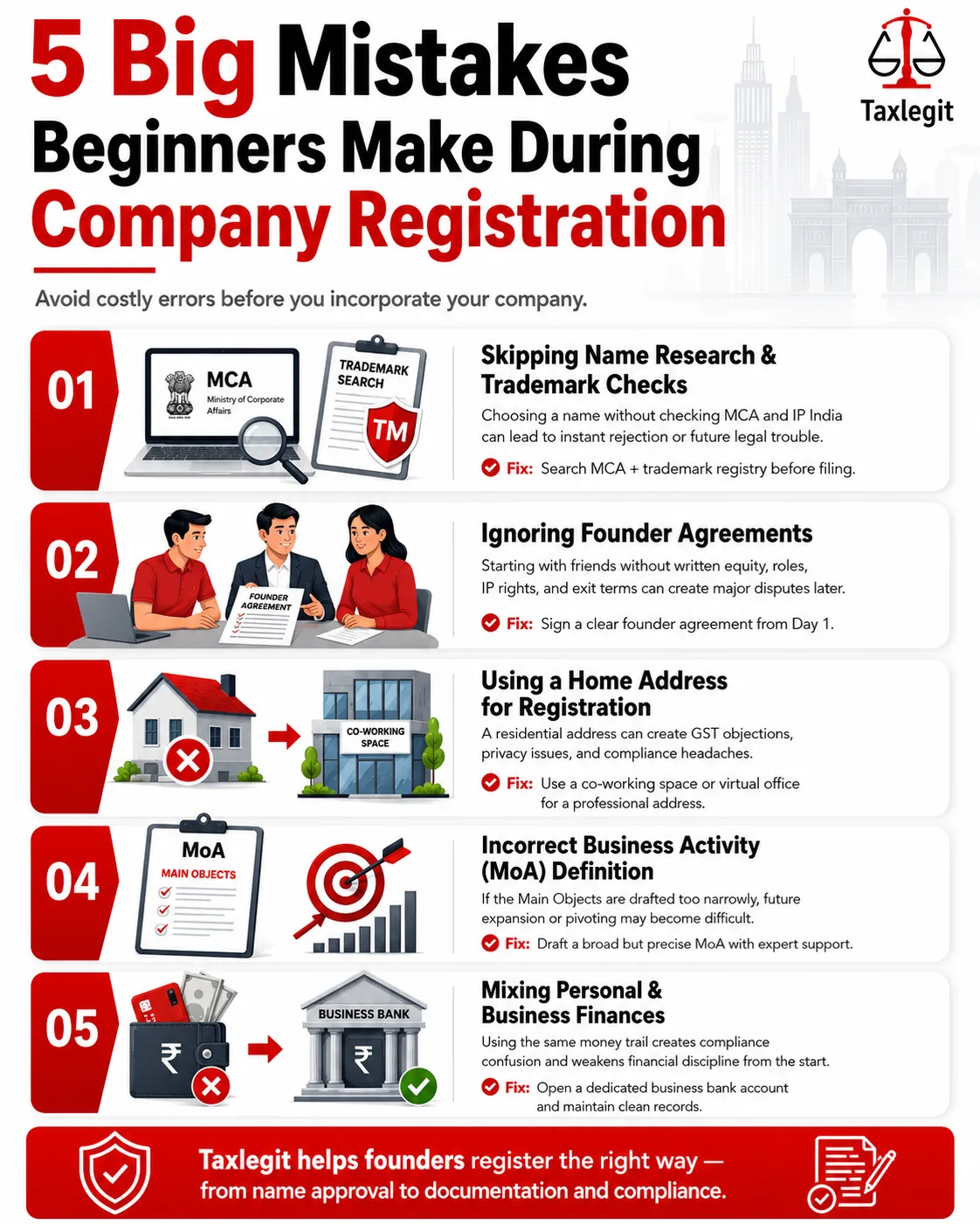
1. Skipping Name Research & Trademark Checks
Founders often pick a name based on emotion rather than availability. If your chosen name is similar to an existing brand or trademark, the MCA will reject your application instantly.
The Fix: Conduct a thorough search on both the MCA portal and the IP India trademark registry. Your name must be unique, relevant, and "trademark-friendly" to avoid a legal battle six months down the line.
2. Ignoring Founder Agreements
Many startups begin with friends, leading to the mistake of not defining shareholding in writing. If a partner leaves or a dispute arises, without a founder agreement, your company registration could become a liability.
The Fix: Establish a clear agreement from Day 1. It must explicitly cover equity splits, roles and responsibilities, intellectual property (IP) rights, and exit clauses.
3. Using a Home Address for Registration
While it seems cost-effective, registering your company at your residential address is a high-risk move in 2026:
- GST Challenges: Authorities often object to commercial activities in residential zones, leading to rejected GST applications.
- Privacy & Compliance: Your home address becomes public record. If a government notice regarding non-compliance is issued, it lands on your doorstep, not an office desk.
The Fix: Use a co-working space or a virtual office service to ensure a professional business address.
4. Incorrect Business Activity (MoA) Definition
During company registration, you must define your "Main Objects" in the Memorandum of Association (MoA). Beginners often make these too narrow. If you pivot your business later, you might find your legal documents don't allow for your new revenue stream.
The Fix: Work with an expert to draft a broad yet precise MoA that allows for future scalability.
5. Mixing Personal and Business Finances
Using a personal bank account for business transactions post-registration is a compliance nightmare. It makes auditing impossible and puts your personal assets at risk if the company faces legal trouble.
The Fix: Immediately after getting your Certificate of Incorporation (COI), open a dedicated Current Account and apply for your corporate PAN and TAN.
Best Practices for a Smooth Launch in 2026
To ensure your company registration stands the test of time, follow these professional guardrails:
- Digital Signature Certificate (DSC): Ensure all directors have updated, Class 3 DSCs to avoid submission failures on the MCA portal.
- Virtual Office Solutions: If you don't have a physical office, a virtual office provides a legitimate commercial address, NOC, and utility bill required for both MCA and GST.
- Professional Consultation: Don't DIY your legal foundation. A single mistake in the SPICe+ form can result in multiple resubmissions and extra government fees.
Have Questions?
Professional Help and Growth
As your operations scale, the complexities of company registration and tax laws grow with you. While you can manage basic filings initially, hiring a professional GST consultant or using a platform like Taxlegit ensures that you stay compliant with the latest 2026 amendments.
Professional oversight helps you identify tax-saving opportunities and ensures that your company registration remains in good standing with the Ministry of Corporate Affairs (MCA) and the GST department.
Frequently Asked Questions (FAQs)
Q1. Is GST mandatory for freelancers earning less than ₹20 lakh?
A: Yes, but only if you are exporting services to clients outside India. For domestic services, you only need it after crossing the ₹20 Lakh threshold.
Q2. What happens if I make a mistake during company registration?
A: Minor errors can often be rectified through "Amendment Fields" on the portal, but major errors in the "Object Clause" or "Address Proof" might require a fresh application.
Q3. Can I file my own GST returns?
A: Yes, the GST portal is designed for self-filing. However, for RCM calculations and LUT filings, many beginners prefer professional assistance to avoid errors.
About the Author

Srijita
Content Writer
Srijita is a legal and financial content specialist with 5+ years of experience in the Indian corporate sector. She simplifies MCA regulations and tax compliance into clear, actionable insights for entrepreneurs, working closely with Chartered Accountants and legal experts to ensure accuracy and compliance. Reviewed by Vipul Sharma, Co-Founder, Taxlegit.