Disclaimer: This article is for informational and educational purposes
only. The cost figures, profit estimates, salary ranges, and government
scheme details mentioned are indicative and based on publicly available
data at the time of writing (April 2026). They do not constitute financial,
legal, tax, or business advice. Regulatory requirements, scheme eligibility,
and cost benchmarks may vary by state and are subject to change. Fill up the form or Contact Us, and we’ll connect you with a Chartered Accountant, legal advisor, or MSME consultant to review and assist with your query.
India added over 1.2 lakh new manufacturing MSMEs in the last fiscal year alone (Source: MSME Ministry Annual Report 2024-25) , and the ones that succeeded shared one thing: they started small, chose the right product, and registered correctly from day one. Profit margins for small manufacturing units typically range from 25% to 55%, depending on the product. Most well-planned units achieve break-even within 12–24 months.
Focus on Udyam registration, pick a high-demand niche like sustainable packaging, and leverage government subsidies to keep your initial costs low. If you are planning to start a small factory in India in 2026, this guide gives you the exact costs, steps, and licenses you need.
Why Is Starting a Small Factory in India a Smart Business Move in 2026?
With the Make in India initiative, the benefits of starting a small manufacturing business in India are currently at an all-time high because of the global shift toward "China Plus One" supply chain strategies:
- Government Support: 15% capital subsidy was introduced for processing critical minerals (like lithium and nickel), which are essential for green energy technology
- Domestic Demand: With a growing middle class, the demand for locally produced goods, from processed foods to eco-friendly packaging, is skyrocketing.
- Infrastructure: New industrial corridors and factory models have reduced the time it takes to get started.
- Labour costs: Compared to other countries, India has relatively low labour costs.
- Low taxation levels: The 15% concessional tax rate under Section 115BAB is no longer available to companies incorporated after March 31, 2024. If you are setting up a new unit in 2026, consult a CA to determine your applicable corporate tax rate.
- Large market size: India has the world's second-largest population and is expected to be the largest consumer market by 2030.
- Educated Workforce: India produces over 1.5 million engineering graduates annually, giving manufacturers access to one of the world's largest and most affordable technical talent pools.
Above all, the real advantage is that small factories do not always need massive capital to start. A well-chosen low-volume, high-demand product can help you achieve a faster break-even period and a clearer path to expansion.
What Types of Small Factories Can You Start in India?
You don't need a massive plant to be profitable. Some of the best small factory ideas with high profit in India involve niche products.
- Eco-Friendly Packaging: Manufacturing biodegradable plates, cups, or paper bags.
- Agro-Processing: Small-scale spice grinding, honey processing, or cold-pressed oil units.
- EV Components: Producing small parts like connectors or wire harnesses for the booming Electric Vehicle market.
- Personal Care: Herbal soaps or organic skincare products.
Profitable factory businesses under ₹10 lakhs include candle making, customised gift manufacturing, and spice packaging units.
How Much Investment Do You Need to Start a Small Factory in India?
The cost to start a small factory in India in 2026 depends on your product, the city, the level of machinery, and whether you rent or buy land. For a basic setup, a budget of ₹5 lakh to ₹10 lakh may be enough for a very small unit, but a more realistic small manufacturing business startup cost in India often falls between ₹10 lakh and ₹25 lakh.
Here is the comparison in a simple way:
| Budget Range | Best For | Typical Setup |
| ₹5 lakh–₹10 lakh | Micro units | Small rented space, basic machinery, limited staff |
| ₹10 lakh–₹25 lakh | Small factory | Better machinery, higher production, and working capital |
| ₹25 lakh+ | Growing unit | Stronger automation, higher output, wider product range |
The budget required for a small-scale industry setup also changes if you are buying machinery instead of leasing or purchasing used equipment. That is why your first decision should always be product selection, not rent or branding.
What is the Complete Cost Breakdown for Setting Up a Factory in India?
A proper factory setup cost breakdown in India usually includes land or rent, machinery, labour, raw material, and registration fees. These are the five biggest spending buckets, and ignoring any one of them usually creates cash-flow problems later.
Land and Rent Cost
Factory rent costs per square foot in India vary by city, industrial zone, and unit size. Let's see a comparison:
| City / Zone | Industrial shed rent (per sq ft/month) | Typical unit size | Monthly rent Estimate |
| Tier-1 (Delhi NCR, Mumbai) | ₹18–₹35 | 1,000–1,500 sq ft | ₹18,000–₹52,500 |
| Tier-2 (Jaipur, Surat, Nagpur) | ₹8–₹18 | 1,000–1,500 sq ft | ₹8,000–₹27,000 |
| Tier-3 / Rural industrial belt | ₹3–₹8 | 500–1,000 sq ft | ₹1,500–₹8,000 |
Machinery and Equipment Cost
It is usually smarter to buy only the machinery you need for the first 6–12 months instead of over-investing too early:
| Factory type | Basic machinery cost | Semi-auto upgrade |
| Spice grinding / agro-processing | ₹1.5L–₹4L | ₹6L–₹12L |
| Eco-friendly packaging (paper/bag) | ₹3L–₹8L | ₹12L–₹25L |
| Herbal soap / personal care | ₹1L–₹3L | ₹5L–₹10L |
| Candle / gifting unit | ₹50K–₹1.5L | ₹3L–₹6L |
Labour and Staffing Cost
Labour costs for a small manufacturing unit in India depend on skill level, shift timing, and region:
| Role | Monthly salary range (2025–26) |
| Unskilled helper/floor worker | ₹8,000–₹12,000 |
| Semi-skilled machine operator | ₹12,000–₹18,000 |
| Skilled technician/supervisor | ₹18,000–₹28,000 |
| Accountant/admin (part-time) | ₹6,000–₹10,000 |
Raw Material Cost
The cost of raw materials for a factory in India is often the biggest recurring expense. In many businesses, for a spice processing unit, raw materials (whole spices) typically cost ₹60–₹150/kg, depending on the variety. A unit processing 200 kg/day will spend ₹12,000–₹30,000/day on raw materials alone. If raw material prices move sharply, your margins can shrink quickly unless you negotiate good supplier terms.
Licenses and Registration Fees
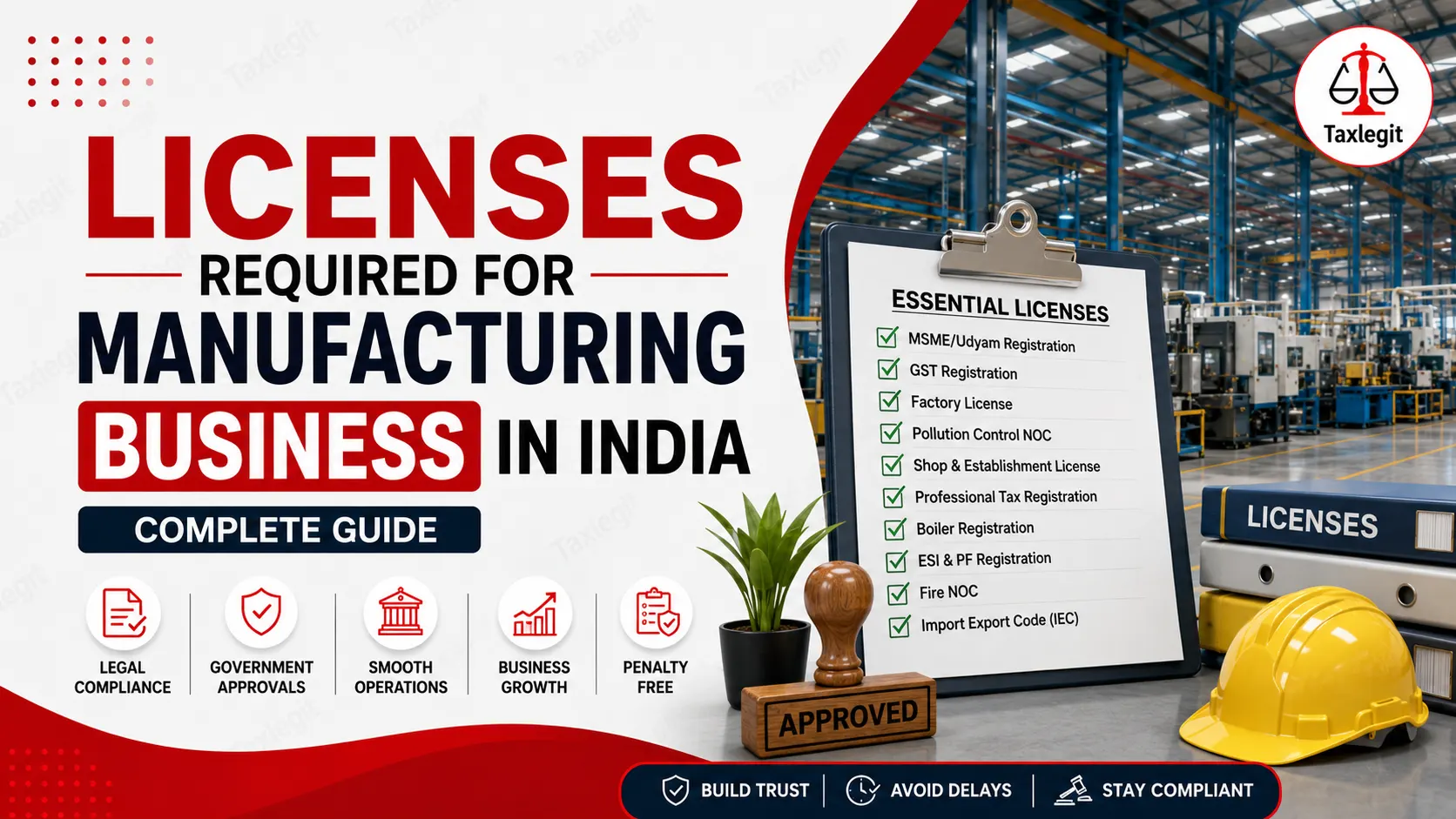
Licenses required for factory setup in India may include Udyam registration, GST Registration, factory license, pollution NOC,FSSAI and trade license, depending on scale and product type. Udyam registration itself is free, which helps reduce the first layer of setup cost.
Step-by-Step Process to Start a Small Factory in India
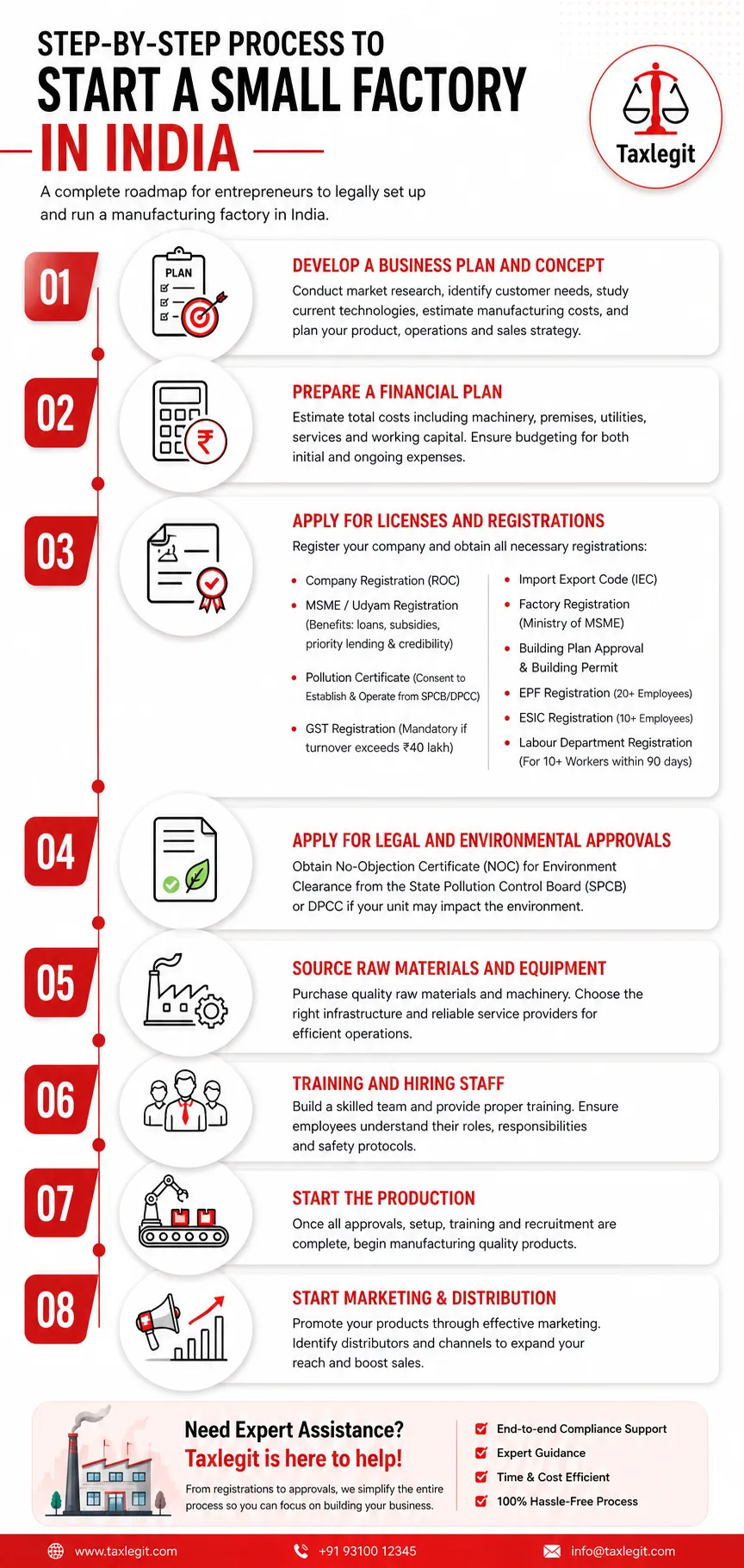
Steps Involved In The Process Of Setting Up A New Manufacturing Factory In India: To set up a manufacturing factory in India, the following steps shall be taken:
Step 1: Develop a business plan and concept:
Entrepreneurs need a clear, unambiguous idea of the product they will manufacture before starting their manufacturing facility. To this end, comprehensive market research and identification of customer needs for the proposed product can be conducted. Entrepreneurs can also consider current technologies and operations, as well as manufacturing costs and sales strategies they intend to use when designing their product.
Step 2: Prepare a financial plan:
The financial requirements for establishing the manufacturing factory, including the costs of services, production equipment, premises, energy, and working capital, need to be assessed by the entrepreneurs. When setting up the factory, it is important to ensure that the initial costs and ongoing costs are properly budgeted and accounted.
Step 3: Apply for licenses and registrations:
Register a company under the correct legal structure. After that, register the company with all relevant authorities and agencies, including the Registrar of Companies (ROC), the Goods and Services Tax (GST), and others. You need to complete several registrations before starting operations. Here is each one explained simply:
- MSME registration benefits for manufacturing are especially useful because Udyam can improve access to loans, subsidies, and priority lending. It also helps establish your business credibility with banks, distributors, and government buyers.
- A pollution certificate for a factory in India usually involves applying to the relevant state pollution control board for Consent to Establish and later Consent to Operate if your unit falls under regulated categories. In Delhi, for example, pollution NOCs are handled by the Delhi Pollution Control Committee(DPCC), and units that generate emissions, effluents, or hazardous waste typically require approval.
- Goods and Services Tax (GST) Registration: All businesses must obtain GST registration from the Excise and Customs Department in each State where the goods are to be sold. GST registration is done online at gst.gov.in. You will need your PAN, Aadhaar, bank account details, and proof of business address. Most manufacturing units cross the ₹40 lakh annual turnover threshold and must register.
- Obtain an Import-Export Code (IEC): All manufacturing factories involved in the import or export of goods require an IEC. The right to transnational trade goods, with no customs duties or taxes, is conferred on the company by an IEC code. You may also register online.
- Factory Registration: An application for factory registration of a manufacturing factory must be submitted to the Regional Office of the Ministry of Micro, Small, and Medium Enterprises (MSME)
- Building Plans and Building Permit: Building plans must be submitted to the local Urban Development Authority (UDA) or Municipal Corporation for necessary approvals
- Register your Udyam: Udyam is a 12-digit unique identifier issued by the Ministry of MSME, Government of India, to small and medium enterprises. The official website of the Ministry for Micro, Small, and Medium Enterprises shall be used to complete this registration.
- Register for the Employees Provident Fund: EPF registration is mandatory once your workforce reaches 20 or more employees. ESIC registration is required once you employ 10 or more workers.
- Register for Employees State Insurance Corporation: Businesses employing over 10 employees must register with the State's Employees State Insurance Corporation (ESIC) within 15 days of the employee's registration at the register, and the registration must be completed.
- Labour Department registration: If your factory employs workers, register with your State's Labour Department within 90 days of starting operations. This is required under the Factories Act for units with 10+ workers.
Step 4: Apply for legal and environmental approvals:
Before starting production, contractors must meet legal requirements and obtain official approvals. Obtaining NOC for Environment Clearance. Any manufacturing factory that is likely to hurt the environment must obtain a No-Objection Certificate from the State Pollution Control Board (SPCB).
Step 5: Source raw materials and equipment:
To begin production operations, entrepreneurs can focus on purchasing raw materials and machinery after all necessary legal and environmental authorisations are in place. To operate efficiently, they should consider selecting the best equipment, infrastructure, and service providers.
Step 6: Training and hiring staff:
Join the team, and manage business development, operations, and financial management. Provide them with adequate training to improve their skills, so that they are aware of their tasks and responsibilities.
Step 7: Start the production:
Entrepreneurs will be able to begin manufacturing quality products as soon as all training and recruitment have been completed
Step 8: Start Marketing & Distribution:
To boost sales, emphasise marketing and product promotion. Entrepreneurs can also identify potential distributors and distribution channels to market and distribute products
Which Government Schemes & Subsidies Can Small Factory Owners Avail in India?
The government subsidy for small manufacturing businesses in India can come from schemes such as PMEGP, MUDRA, Startup India, and state-specific industrial incentives.
| Scheme | Max loan/subsidy | Who qualifies |
| PMEGP | ₹50L (manufacturing); 15–35% subsidy | New businesses, 18+ years, no prior govt loan |
| Mudra – Shishu | Up to ₹50,000 | Very early-stage micro units |
| Mudra – Kishor | ₹50,000–₹5L | Existing businesses needing growth capital |
| Mudra – Tarun | ₹5L–₹10L | Established micro businesses |
| Startup India Seed Fund | Up to ₹20L | DPIIT-recognised startups |
Challenges in Starting a Small Factory & How to Overcome Them
Common problems in the manufacturing business in India include poor cash flow, machine downtime, fluctuations in raw material prices, labour shortages, and delays in compliance. These challenges are normal, but they can be managed with planning and discipline.
One of the biggest challenges in factory setup in India is underestimating working capital. Many founders spend too much on machinery and forget to set aside money for salaries, rent, raw materials, and electricity.
To reduce factory costs in India, start with a smaller product line, negotiate supplier credit where possible, and avoid over-hiring in the early stage. A lean, focused setup is usually more profitable than a big but inefficient one.
Conclusion
Starting a small factory in India is a practical business idea if you begin with the right product, realistic capital planning, and complete legal compliance. The businesses that win are usually the ones that keep costs low, choose demand-driven products, and build trust with buyers early.
If you are planning to start a small manufacturing business in India, Taxlegit can help you with MSME registration, factory setup compliance, GST, pollution approvals, and business documentation so you can launch with clarity and confidence.
Frequently Asked Questions ( FAQs )
Q1: Can I start a factory without land in India?
A:Yes, it is common: many beginners start in rented industrial sheds or factory spaces instead of buying land.
Q2: Which factory business is most profitable in India?
A: Profitability depends on your product and raw material control. Food processing and herbal goods typically yield 25–40% gross margins. Eco-friendly packaging yields 20–30%. Well-run units in these categories break even within 12–20 months.
Q3: How long does it take to set up a factory in India?
A: A simple small factory typically takes 4–12 weeks to set up, depending on approvals. Udyam and GST registration can be done in 2–5 days. A pollution NOC from the state board may take 4–8 weeks and is often the longest step.
Q4: What licenses are required for factory setup in India?
A: Common registrations include Udyam, GST, factory license, pollution NOC, and trade license, depending on the activity and state rules.
Q5: Is MSME registration useful for manufacturing businesses?
A: Generally, yes, it can help with loans, subsidies, procurement preference, and easier access to government support.
Q6: How do I get a loan for a small factory in India?
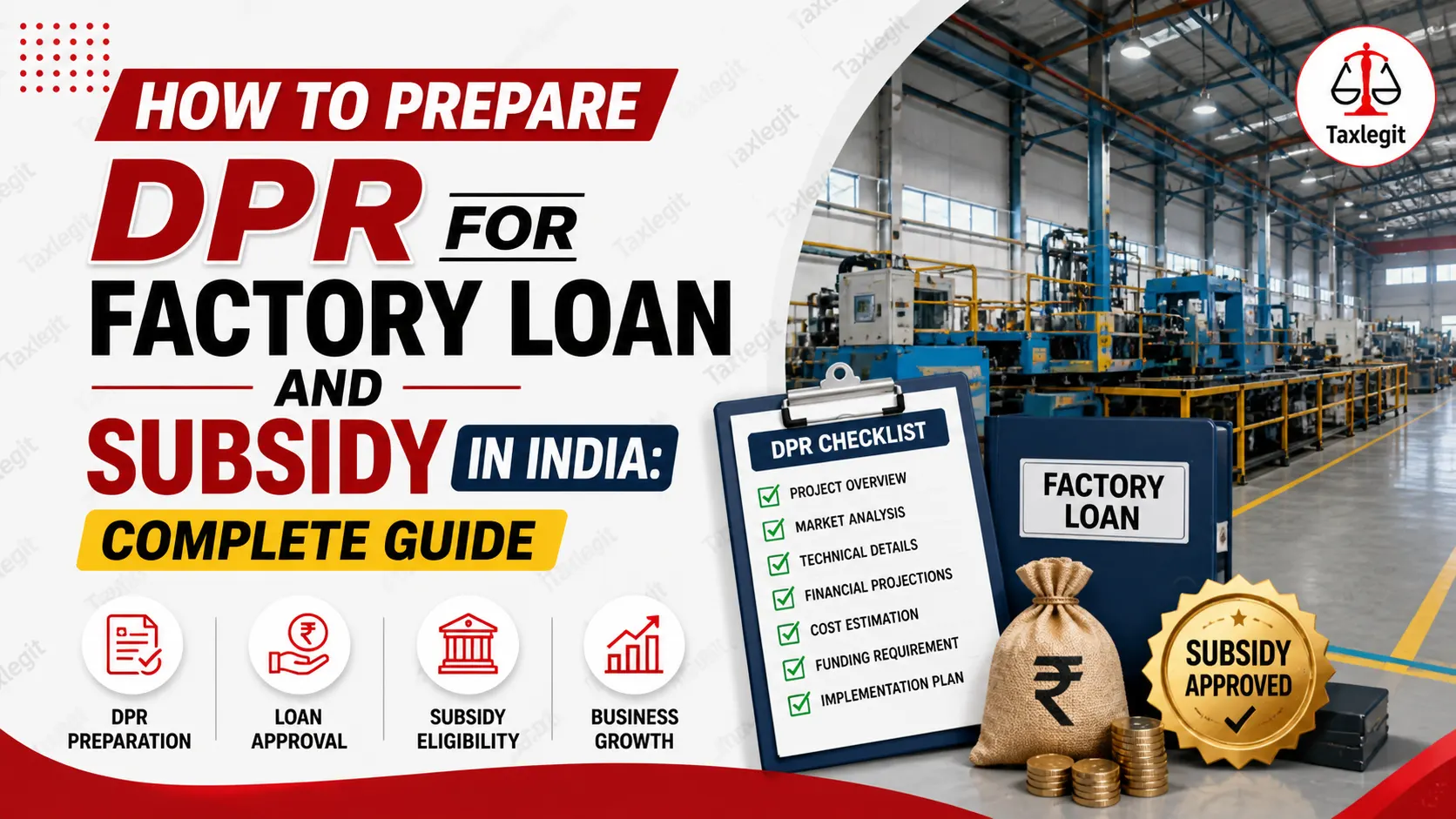
A: Prepare a project report, register the business properly, and explore Mudra, PMEGP, or bank- or MSME-linked financing options.
About the Author

Aabha Garg
Content Writer
Aabha Garg is a TESOL-certified trainer and Lead Content Strategist at Taxlegit with 5+ years of experience. She simplifies complex topics like company registration, GST, and compliance into clear, practical insights for businesses. Reviewed by Vipul Sharma, Co-Founder, Taxlegit.