
What does "worth" actually mean when there is no share price?
Need an audit-proof valuation for your next deal? Secure your IBBI and FEMA registered certificates with TaxLegit today.
Which valuation method fits your company?
| Method | What it measures | Best suited to | Main weakness |
| Net Asset Value | Total assets minus total liabilities | Manufacturing, real estate, asset-backed firms, liquidation scenarios | Ignores brand, IP, and earning power |
| Discounted Cash Flow | Present value of projected free cash flows | Businesses with stable, forecastable cash flows | Small changes in growth or discount rate swing the answer hard. |
| EV/EBITDA multiple | Operating profit against comparable deal pricing | Established firms in sectors with visible transaction data | Comparables are rarely truly comparable. |
| PAT (earnings) multiple | Bottom-line profit against a sector multiple | Mature, consistently profitable companies | Distorted by tax planning and depreciation policy |
| Revenue multiple | Topline against a sector multiple | High-growth SaaS, D2C, and tech firms are not yet profitable | Says nothing about margins or cash burn |
How do you actually calculate it?
- Normalise earnings: Strip out the promoter salary above the market rate, one-off legal costs, and personal expenses in the P&L. Assume EBITDA settles at ₹1.8 crore.
- Apply the multiple: Comparable deals in the sector clear at roughly 8× EBITDA, giving an enterprise value of ₹14.4 crore.
- Adjust for net debt: ₹2.4 crore of debt less ₹40 lakh of cash is ₹2 crore, so equity value is ₹12.4 crore.
- Discount for marketability: Unlisted shares cannot be sold on demand, so valuers apply a discount for lack of marketability commonly 15–30% in Indian practice, depending on size and buyer pool. At 20%, equity value lands near ₹9.9 crore.
When does the law require a formal valuation report?
Companies Act, 2013
FEMA
Income tax
Raising funds or selling equity? Book a 1-on-1 strategy call with TaxLegit to maximize your deal value.
What quietly reduces your valuation?
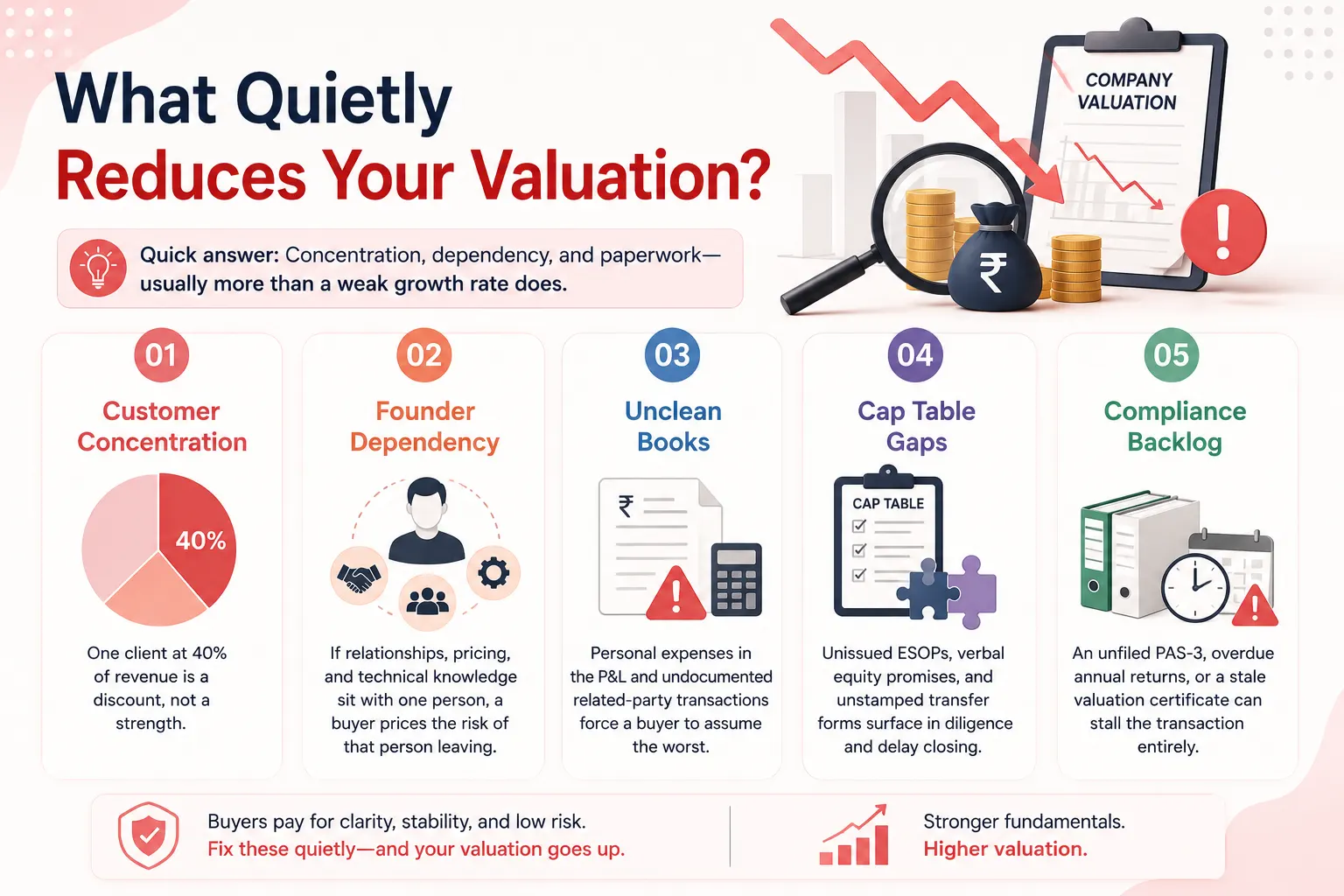
- Customer concentration: One client at 40% of revenue is a discount, not a strength.
- Founder dependency: If relationships, pricing, and technical knowledge sit with one person, a buyer prices the risk of that person leaving.
- Unclean books: Personal expenses in the P&L and undocumented related-party transactions force a buyer to assume the worst.
- Cap table gaps: Unissued ESOPs, verbal equity promises, and unstamped transfer forms surface in diligence and delay closing.
- Compliance backlog: An unfiled PAS-3, overdue annual returns, or a stale valuation certificate can stall the transaction entirely.
What should you fix before commissioning a valuation?
- Finalise three years of audited financials, with normalisation adjustments documented rather than argued verbally.
- Reconcile your cap table to the register of members and every PAS-3 filed.
- Prepare a defensible forecast with written assumptions on growth, margin, and working capital.
- Confirm the valuer's asset class registration before engaging them securities or financial assets, not land and buildings.
Need a defensible number?
TaxLegit works with founders and CFOs on valuation, share issue documentation, and the filings that follow. If you are pricing a round, planning an exit, or bringing a non-resident investor onto the cap table, talk to us before the price is agreed not after.
Frequently Asked Questions
1How do I calculate the valuation of my private limited company myself?
Take normalised EBITDA or PAT for the last full year, apply a multiple from comparable deals in your sector, adjust for net debt, and then apply a marketability discount. Use net asset value alongside it as a floor. That gives you a planning range, not a substitute for a statutory report.
2Is a registered valuer mandatory for every share issue?
No, It is required for preferential allotments, private placements, sweat equity, allotments for consideration other than cash, buybacks, and schemes of arrangement. A rights issue offered proportionately to existing shareholders at face value does not need one.
3Can a chartered accountant sign my valuation report?
It depends on the law. Under the Companies Act, only an IBBI-registered valuer in the relevant asset class can sign. Under FEMA Rule 21, a CA in practice, a SEBI-registered merchant banker, or a practicing cost accountant can certify. Under income tax rules, it depends on the instrument.
4Does angel tax still apply to a share premium?
No, Section 56(2)(viib) was withdrawn by the Finance (No. 2) Act, 2024, from assessment year 2025-26. Open assessments for earlier years continue under the old provisions, and source-of-funds documentation still matters for unexplained cash credits.
5Why is my company's book value so much lower than the price investors quote?
Book value records what you have spent and retained; investors price what you are expected to earn. In a service or software business, most of the value sits in recurring revenue, contracts, and team capability none of which appear on the balance sheet.
6How long is a valuation report valid?
It depends on the purpose. FEMA-linked transactions work to a limited window between the valuation date and the allotment, and a delay usually means a fresh certificate rather than an extension. Confirm the window with your valuer before setting a closing date.
About the Author

Content Writer
Srijita is a legal and financial content specialist with 5+ years of experience in the Indian corporate sector. She simplifies MCA regulations and tax compliance into clear, actionable insights for entrepreneurs, working closely with Chartered Accountants and legal experts to ensure accuracy and compliance. Reviewed by Vipul Sharma, Co-Founder, Taxlegit.