

Quick Summary
Starting a business in India can be a game-changer for UK entrepreneurs looking to expand in one of the world’s fastest-growing markets. However, navigating the legal and regulatory framework in India can be complex without clear guidance. Delays or mistakes in company registration can lead to penalties, missed opportunities, and operational hurdles that affect your business decisions and growth plans.
This guide breaks down the entire process of company registration in India, including eligibility, required documents, common pitfalls, and practical tips to ensure smooth and timely registration.
Quick Key Facts
- India offers multiple company structures: Private Limited, LLP, Branch Office, Liaison Office.
- Registration usually takes 1 to 3 weeks with complete documents.
- The Ministry of Corporate Affairs (MCA) governs company registration.
- Foreign Direct Investment (FDI) policies affect UK entrepreneurs.
- PAN and TAN registration is mandatory post-company incorporation.
- Delays can attract penalties or affect operational licenses.
What is Company Registration
Company registration is the legal process of incorporating a business entity under Indian law. It provides your business with a distinct legal identity, allowing you to operate, enter into contracts, open bank accounts, and comply with tax regulations.
How to Register a Company in India for UK Entrepreneurs?
For UK entrepreneurs, registering a company in India enables local market access, eligibility for government contracts, and easier compliance with Indian tax and labour laws.
To register a company in India, you need to choose the company type, obtain Digital Signature Certificates (DSC), apply for Director Identification Number (DIN), reserve the company name with MCA, file incorporation documents, and complete PAN/TAN registration. The process typically takes 1-3 weeks with proper documentation.
Who Can Register a Company in India?
- UK entrepreneurs planning to establish a physical presence in India.
- Businesses seeking to sell products/services in India directly.
- Investors want control over operations rather than working through distributors.
- Startups looking to tap into Indian talent and innovation ecosystems.
- NGOs or non-profits with Indian operations (note different registration rules).
Eligibility Criteria for UK Entrepreneurs
Setting up in India as a UK citizen is straightforward, provided you satisfy these foundational eligibility criteria:
- At least one director must be an Indian resident (staying in India for 182+ days annually).
- Minimum two directors for a Private Limited Company.
- Minimum two shareholders (can be a UK resident or entity).
- Valid passport and proof of address (UK and Indian, if applicable).
- Comply with Foreign Exchange Management Act (FEMA) regulations.
- Fulfil FDI requirements under the automatic route or government approval route.
Stepwise Guide to Register a Company in India for UK Entrepreneurs
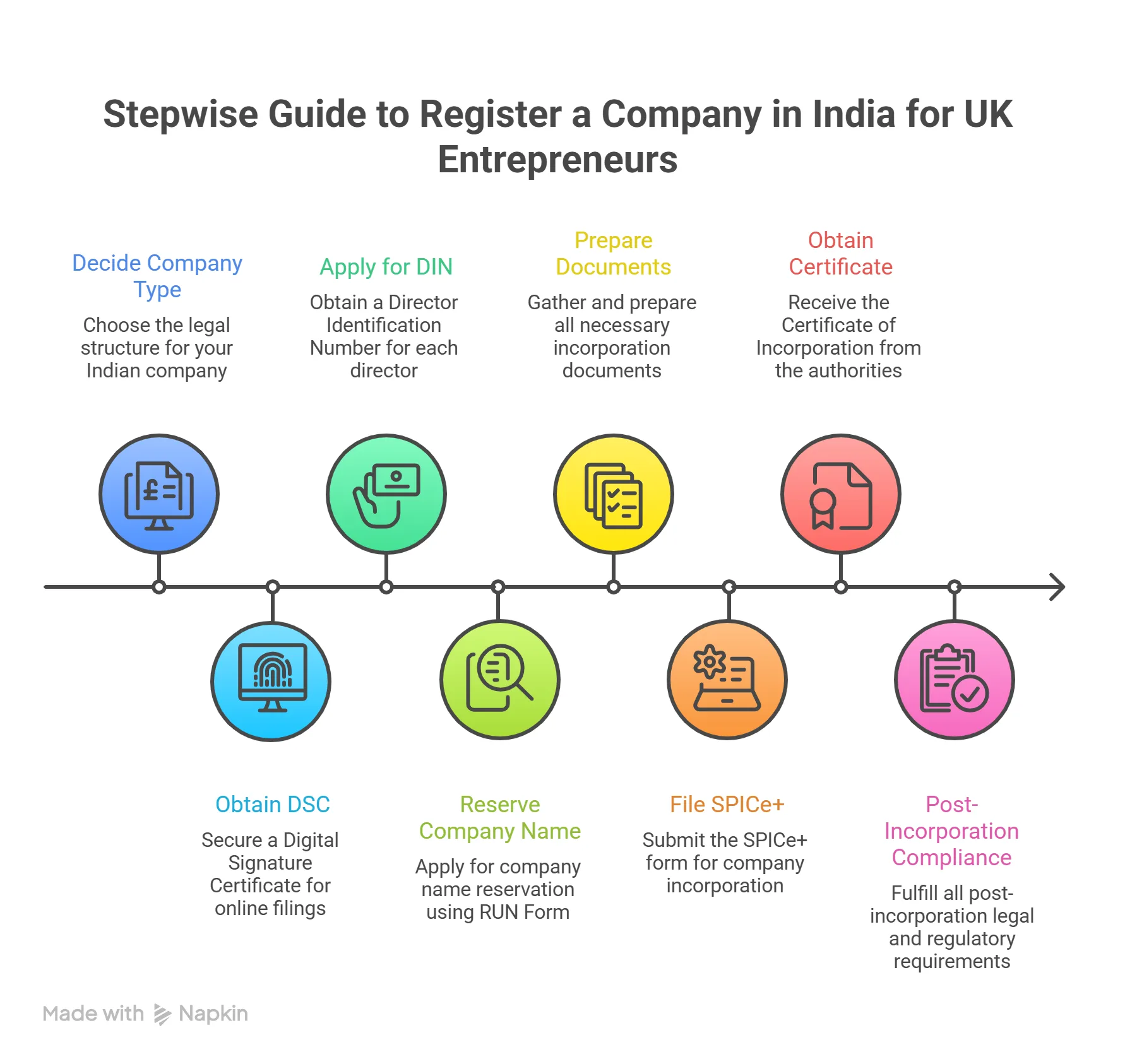
Thinking of India for your next business venture? Learn how to register your company by understanding the stepwise Indian company setup process for UK entrepreneurs.
Step 1: Decide Company Type
- Private Limited Company: Most common for startups and SMEs. Limited liability and separate legal entity.
- Limited Liability Partnership (LLP): Combines partnership flexibility with limited liability.
- Branch Office: For UK companies wanting a branch without a separate legal entity.
- Liaison Office: For market research or liaison activities, no commercial operations allowed.
Step 2: Obtain Digital Signature Certificate (DSC)
- Required for all directors to sign documents electronically.
- Apply through MCA-approved certifying authorities.
- Usually takes 1-3 days.
Step 3: Apply for Director Identification Number (DIN)
- Mandatory for all directors.
- Submit Form DIR-3 with proof of identity and address.
- Typically approved within 1-2 days.
Step 4: Reserve Company Name (RUN Form)
- Propose up to two names in order of preference.
- Names should be unique and comply with MCA guidelines.
- Approval usually within 1-3 days.
Step 5: Prepare Incorporation Documents
- Memorandum of Association (MoA)
- Articles of Association (AoA)
- Proof of registered office address
- Identity and address proof of directors and shareholders
- NOC from the property owner if the office is rented
Step 6: File Incorporation Form (SPICe+)
- Submit SPICe+ form with all annexures on the MCA portal.
- Includes PAN and TAN application for the company.
- Process generally takes 7-15 days.
Step 7: Obtain Certificate of Incorporation
- MCA issues the certificate confirming company registration.
- The company can now open bank accounts, enter contracts, and start operations.
Step 8: Post-Incorporation Compliance
- Apply for GST registration if turnover exceeds the threshold.
- Register for Professional Tax as applicable by state.
- Open current bank accounts in India.
- File annual returns and maintain statutory records.
Documents Required for Company Registration in India UK Entrepreneurs
| Document Type | Details | UK Entrepreneur Specifics |
| Proof of Identity | International Passport | Must be a valid UK Passport (scanned in high resolution). |
| Proof of Address | Utility Bill or Bank Statement | Must be a recent UK bill (Electricity, Gas, or Bank) not older than 2 months. |
| Photographs | Passport-sized Photos | Recent digital copies of all UK-based directors and shareholders. |
| Registered Office Proof | Rent Agreement or Ownership Proof | A physical address in India is required. Shared spaces/coworking are often acceptable. |
| No Objection Certificate | NOC from Property Owner | A formal letter from the Indian landlord granting permission to register the business. |
| Digital Signature (DSC) | Electronic Filing Token | Required for all directors; must be obtained from an MCA-approved agency. |
| DIN Application | Form DIR-3 | Your Director Identification Number is linked to your UK identity documents. |
| Charter Documents | MOA & AOA | Drafted as per the Indian Companies Act, 2013, but reflecting UK parentage (if applicable). |
Common Mistakes to Avoid
- Not appointing at least one Indian resident director.
- Submitting incomplete or incorrect documents.
- Choosing a company name conflicting with existing names or trademarks.
- Ignoring FDI approval requirements under FEMA.
- Delaying PAN and TAN registration post-incorporation.
- Neglecting post-incorporation compliance like GST registration.
Key Strategy Insights for the UK Entrepreneurs:
- It is highly recommended that UK tech firms choose the Private Limited route. It is the only structure that allows you to issue ESOPs (Employee Stock Options) to your Indian team.
- LLP Warning: While LLPs have lower compliance, they are often less "investor-friendly" if you plan to raise venture capital later.
- Tax Efficiency: Under the UK-India DTAA (Double Taxation Avoidance Agreement), a Private Limited structure often provides the most profitable path for UK-based investors.
- Engage a local professional or consultant to navigate Indian legal language and procedural nuances.
- Maintain a checklist of documents and deadlines to avoid delays.
- Start the name reservation and DIN/DSC process early to save time.
- Understand India’s FDI policy updates to ensure compliance.
- Plan for at least 3 weeks from start to finish to accommodate government processing times.
Comparison Table: Company Types for UK Entrepreneurs
| Feature | Private Limited (Subsidiary) | LLP (Limited Liability Partnership) | Branch Office (BO) | Liaison Office (LO) |
| Legal Status | Separate Legal Entity; distinct from the UK parent. | Separate Legal Entity; hybrid of company & partnership. | Extension of UK Parent; not a separate entity. | Representative Office; not a separate entity. |
| Liability | Limited to the share capital invested. | Limited to the agreed contribution. | Unlimited; UK Parent is fully liable for debts. | Unlimited; UK Parent is fully liable. |
| Governance | Min. 2 Directors (1 must be an Indian Resident). | Min. 2 Designated Partners (1 must be Resident). | No Directors; requires a Local Representative. | No Directors; requires a Local Representative. |
| FDI Policy | 100% Automatic Route for most tech sectors. | Allowed in sectors with 100% Automatic Route. | Requires RBI/Government approval. | Strictly no commercial activity allowed. |
| Revenue Generation | Can generate and invoice revenue in India. | Can generate and invoice revenue in India. | Can conduct full trade in India. | Cannot earn revenue; funded by UK parent. |
| Taxation | ~25% Corporate Tax (plus surcharges). | 30% Tax; no Dividend Distribution Tax. | Higher rate (~40%) as a "Foreign Company." | N/A (as no income is generated). |
| Best For | Scaling Tech Startups & VC-backed firms. | Professional Service Firms & lean teams. | Project-specific work or manufacturing. | Market research & brand presence only. |
Conclusion
Registering a company in India as a UK entrepreneur is a strategic move that requires a clear understanding and careful planning. By following the stepwise process outlined here, you can avoid common pitfalls, comply with regulatory requirements, and position your business for success in India’s dynamic market.
Remember, timely and accurate documentation is key to avoiding penalties and delays that can impact your business decisions. When in doubt, seek professional guidance like Taxlegit to ensure your company setup is smooth and compliant.
Frequently Asked Questions ( FAQs )
Q1. How long does it take to register a company in India for UK entrepreneurs?
Usually, 1 to 3 weeks, depending on document readiness and MCA processing times.
Q2. Can a UK resident be a sole director of an Indian company?
No, at least one director must be an Indian resident staying 182+ days annually.
Q3. Is Foreign Direct Investment (FDI) approval needed?
Most sectors allow automatic FDI, but some require government approval under FEMA.
Q4. What is the cost of company registration in India?
Government fees vary but typically range from INR 7,000 to INR 15,000 plus professional fees.
Q5. Can I register a branch office instead of a private limited company?
Yes, but branch offices have operational restrictions and are not separate legal entities.
Q6. Do I need a local Indian address for registration?
Yes, a registered office address in India is mandatory.
Q7. What post-registration compliances should I be aware of?
PAN/TAN registration, GST registration (if applicable), annual returns, and tax filings.
About the Author

Srijita
Content Writer
Srijita is a legal and financial content specialist with 5+ years of experience in the Indian corporate sector. She simplifies MCA regulations and tax compliance into clear, actionable insights for entrepreneurs, working closely with Chartered Accountants and legal experts to ensure accuracy and compliance. Reviewed by Vipul Sharma, Co-Founder, Taxlegit.