In India’s "Make in India" era, your legal structure is as important as your factory floor. Choosing between a Private Limited Company (Pvt Ltd) and a Limited Liability Partnership (LLP) isn't just about paperwork; it affects your ability to raise capital, claim government subsidies, and manage taxes. For a manufacturing business involving heavy machinery and high operational risks, the wrong choice can lead to personal liability or missed investment opportunities.
This Taxlegit guide breaks down the critical differences to help you decide which structure will power your manufacturing growth in 2026.
Table of Contents
- Quick Key Facts
- The Manufacturing Context
- Why Structure Matters in 2026
- Comparison: Pvt Ltd vs. LLP
- Choosing Based on Business Goals
- Core Requirements for Registration
- Common Pitfalls to Avoid
- The Taxlegit Advantage
- FAQs
- Conclusion
Quick Key Facts
- Pvt Ltd is the gold standard for startups seeking VC funding or high-value bank loans.
- LLPs offer a lower compliance burden and no Dividend Distribution Tax (DDT).
- FDI (Foreign Direct Investment) is easier to manage in a Pvt Ltd due to established "automatic routes."
- Manufacturing Subsidies (like PLI) are often more accessible to Companies than LLPs.
- External Commercial Borrowings (ECB) are restricted for LLPs but open for Companies.
Manufacturing Context
Manufacturing is capital-intensive and involves complex supply chains. Unlike a service business, a manufacturing unit requires factory licenses, pollution clearances, and significant debt:
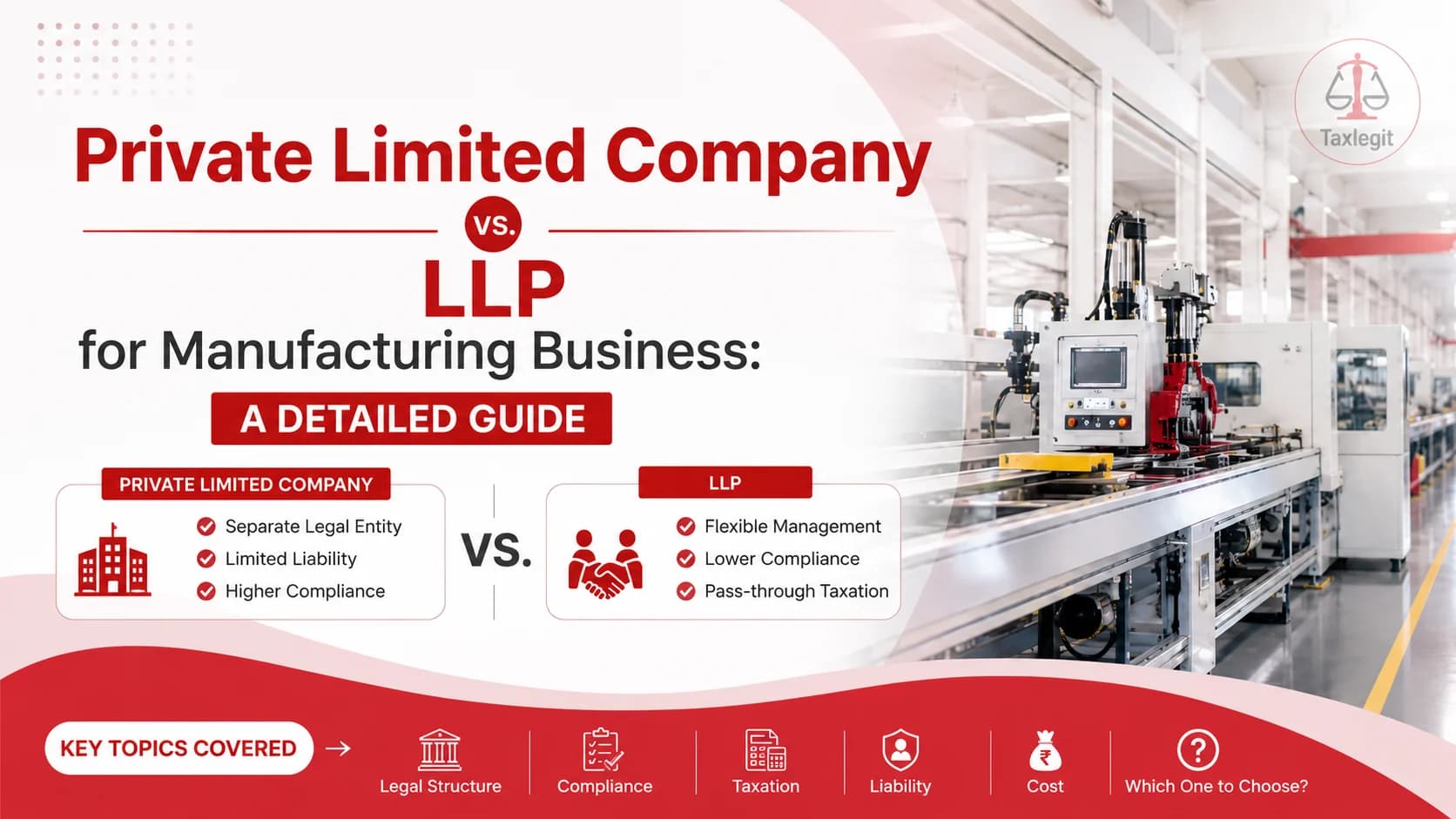
- Pvt Ltd: Functions as a separate legal entity with a rigid structure. It is governed by the Companies Act, 2013.
- LLP: A hybrid between a traditional partnership and a company. It offers the flexibility of a partnership with the benefit of limited liability.
Why Structure Matters in 2026
In the current economic climate, your choice affects:
- Fundability: Banks have a higher "Trust Score" for Private Limited companies because their financial data is transparently available on the MCA portal.
- Scalability: If you plan to issue ESOPs to your plant managers or bring in foreign equity, a Pvt Ltd is the only viable path.
- Government Schemes: Many state-level industrial subsidies specifically look for "Incorporated Companies" for high-value grants.
Comparison: Pvt Ltd vs. LLP
| Feature | Private Limited Company | Limited Liability Partnership (LLP) |
| Legal Status | Separate Legal Entity | Separate Legal Entity |
| Ownership | Shares (Easy to transfer) | Partnership Interest (Harder to transfer) |
| FDI Policy | 100% via Automatic Route in most sectors | Permitted, but with stricter "Owner/Control" conditions |
| Compliance | High (Statutory audits, annual filings, board meetings) | Low (No audit required unless turnover > ₹40 Lakhs) |
| Taxation | 15% for new manufacturing units (u/s 115BAB) | Standard 30% + Surcharge |
| Raising Capital | Venture Capital & PE friendly | Limited to bank loans and partners' capital |
Choosing Based on Business Goals
When to Choose Private Limited:
- You plan to scale globally and seek Foreign Investment.
- You want to leverage the 15% Corporate Tax benefit for new manufacturing units.
- You need to take large Bank Loans or Project Finance.
- You intend to go for an IPO in the future.
When to Choose LLP:
- You are a Small-Scale or boutique manufacturer (e.g., specialized components).
- The business is Family-Run with no plans to bring in outside investors.
- You want to minimize Compliance Costs and annual audit hassles.
- You prefer a flexible management structure without mandatory board meetings.
Core Requirements for Registration
| Document/Step | Private Limited | LLP |
| Min. Members | 2 Directors / 2 Shareholders | 2 Designated Partners |
| Identification | PAN, Aadhaar, DIN | PAN, Aadhaar, DPIN |
| Address Proof | Utility Bill + NOC for Registered Office | Utility Bill + NOC for Registered Office |
| Constitution | Memorandum & Articles of Association (MOA/AOA) | LLP Agreement |
Common Pitfalls to Avoid
- The "Tax Trap": Choosing an LLP for "low compliance" but losing out on the 15% preferential tax rate available to new manufacturing companies.
- FDI Confusion: Foreign investors often find the "Downstream Investment" rules for LLPs confusing, leading to regulatory delays.
- Audit Oversight: Even if an LLP doesn't need an audit at the start, once your turnover crosses ₹40 Lakhs or contribution crosses ₹25 Lakhs, a statutory audit becomes mandatory.
The Taxlegit Advantage: Your Growth Partner
Choosing a structure is a one-time decision with lifetime consequences. At Taxlegit, we help manufacturers navigate this choice with precision:
- Structural Consultation: We analyze your 5-year roadmap to recommend the most tax-efficient model.
- Seamless Incorporation: From DSC and DIN to your Certificate of Incorporation, we handle the bureaucracy.
- Incentive Alignment: We ensure your entity is structured to qualify for PLI, MSME, and Startup India benefits.
Frequently Asked Questions (FAQs)
Q1. Can I convert my LLP into a Private Limited Company later?
A: Yes, the Companies Act allows for the conversion of an LLP into a Company, but the process is document-heavy and involves fresh tax valuations. It is always better to choose the right structure from Day 1.
Q2. Which structure is better for getting an MSME registration?
A: Both are eligible for MSME (Udyam) registration. However, a Private Limited Company often finds it easier to access MSME-specific bank credit.
Q3. Is the 15% tax rate still available for manufacturing companies in 2026?
Tax laws are subject to annual budget updates. As of current trends, the government continues to incentivize "New Manufacturing" through lower tax brackets, but specific sunset clauses apply. (Contact Taxlegit for the latest 2026 update).
Q4. Are LLPs allowed to have foreign directors?
A: Yes, but at least one Designated Partner must be a resident of India.
Q5. Which is cheaper to maintain annually?
A: The LLP is significantly cheaper because it lacks the requirement for mandatory Board Meetings, internal audits, and rigorous secretarial filings required for a Pvt Ltd.
Conclusion
In 2026, the Indian manufacturing sector is a race. Your choice between a Private Limited Company and an LLP is essentially choosing between a "Heavy-Duty Engine" (Pvt Ltd) for high-speed growth or a "Flexible Utility Vehicle" (LLP) for steady, low-maintenance operations.
Don't let legal jargon stall your factory's engine. Contact Taxlegit today for a professional consultation and get your manufacturing unit registered with the structure that fits your vision.
About the Author

Srijita
Content Writer
Srijita is a legal and financial content specialist with 5+ years of experience in the Indian corporate sector. She simplifies MCA regulations and tax compliance into clear, actionable insights for entrepreneurs, working closely with Chartered Accountants and legal experts to ensure accuracy and compliance. Reviewed by Vipul Sharma, Co-Founder, Taxlegit.