
Introduction
In a strategic initiative to ease the compliance burden on Indian corporates, the Ministry of Corporate Affairs (MCA) has introduced the Companies Compliance Facilitation Scheme, 2026 (CCFS-2026) through General Circular No. 01/2026 dated 24 February 2026. If your company has missed filing Annual Returns or Financial Statements for one or more years, this is a golden opportunity you simply cannot afford to miss. From April 15 to July 15, 2026, companies of every size can use this three-month window to update their records or close their business. Read on to understand what the scheme covers, who qualifies, the exact fee relief on offer, and a practical action plan to make the most of this three-month window.
What Is CCFS-2026?
Under Section 403 of the Companies Act, 2013, every company is required to file its Annual Return and Financial Statements within the prescribed timelines. For a company that has not filed for even three to four years, this penalty can amount to lakhs of rupees, creating a severe financial burden. To reduce this burden, particularly on MSMEs, startup entities, and dormant private companies, the MCA has periodically introduced these concessional filing windows. The window remains active from 15 April to 15 July 2026. The consequences of missing it include escalating penalties, ROC action, and potential strike-off proceedings.
Key Fact: A company that last filed in FY 2020-21 could owe over ₹1.5 lakh in late fees on each pending form before CCFS-2026. Under the scheme, this penalty drops by 90%, requiring only 10% of the original fee
Scheme Period and Operative Dates
CCFS-2026 will be in force for exactly three months:
- Opening Date: 15 April 2026
- Closing Date: 15 July 2026
No extension has been indicated in the circular, and the MCA has explicitly noted that Registrars of Companies will initiate penal action against continuing defaulters after 15 July 2026. This makes early preparation essential for companies in default.
Who are Eligible to Avail CCFS-2026?
The scheme is open to all companies registered under the Companies Act, 2013, subject to the following exclusions.
Companies NOT eligible under CCFS-2026:
- Companies against which the Registrar has already issued a final notice for strike-off under Section 248 of the Companies Act, 2013
- Companies that have already applied for strike-off before the scheme opening
- Companies that had applied for and obtained dormant status under Section 455 before the scheme
- Companies dissolved under a scheme of reconstruction
- Vanishing companies (those where neither promoters nor their whereabouts can be traced)
Note: Be informed that the other companies, including active companies with pending filings, companies not yet active but not formally closed, and foreign companies with Indian branch offices, may avail themselves of one or more options under CCFS-2026.
Options Available Under this Scheme:
Option 1: Filing Pending Annual Documents at Concessional Fees
Companies with overdue Annual Returns and Financial Statements can now file these documents by paying the normal prescribed filing fee plus only 10% of the additional fee that would otherwise be payable for the delay.
For instance, if a company owes ₹2,00,000 in late fees accumulated at ₹100 per day over several years, it will pay only ₹20,000 in additional fees under the scheme, making a saving of ₹1,80,000 on that form alone.
Forms covered under this option include:
- MGT-7: Annual Return for companies other than OPCs and small companies
- MGT-7A: Annual Return for One Person Companies and small companies
- AOC-4: Financial Statements (all variants including AOC-4 CFS and AOC-4 XBRL)
- ADT-1: Appointment of Statutory Auditor
- FC-3 and FC-4: Annual Accounts and Annual Return for foreign companies
- Legacy forms under the Companies Act, 1956: Forms 20B, 21A, 23AC, 23ACA and related XBRL variants
Option 2: Obtaining Dormant Company Status (Section 455)
Inactive companies that wish to pause operations without complete closure can apply for Dormant Status under Section 455 of the Companies Act, 2013, by filing e-Form MSC-1. Under CCFS-2026, the normal filing fee for MSC-1 is reduced to 50%, giving a significant incentive for companies that are not yet ready to wind up.
Once declared dormant, a company is exempt from many annual compliance requirements and can remain dormant for up to five consecutive financial years (extendable under certain circumstances)
Option 3: Voluntary Closure (Form STK-2)
For companies that wish to permanently close and remove their name from the Register of Companies, the voluntary strike-off route via e-Form STK-2 is available under CCFS-2026 at only 25% of the normally applicable filing fee, giving a 75% discount.
Importantly, this route is available even to companies that have pending annual filings, provided they are not already under a strike-off or dissolution notice.
CCFS-2026 Fee Structure at a Glance
| Particulars | Fee Concession | Effective Savings |
| Annual Return (MGT-7/7A) & Financial Statements (AOC-4) | Only 10% of the additional fees are payable | 90% savings on late fees |
| Dormant Status Application (Form MSC-1) | 50% of the normal filing fee | 50% savings |
| Strike-Off Application (Form STK-2) | 25% of the normal filing fee | 75% savings |
How to Get Immunity from Penalties?
One of the best features of CCFS-2026 is that it protects companies from legal action under the Companies Act, 2013. However, your level of protection depends on your current compliance status.
1. Annual Returns & Financial Statements (Sections 92 & 137):
You get full immunity from penalties if:
- You file before the government issues an official penalty notice.
- OR you file within 30 days of receiving a notice from the Adjudicating Officer.
Note: If a penalty order has already been passed, or if your 30-day window has expired, you must still pay the full penalty. The scheme cannot cancel completed legal proceedings.
2. Other Forms (ADT-1, FC-3, FC-4, etc.)
You are protected from future legal action only if you file under the scheme before: Any prosecution has started.
- A "Show Cause Notice" has been issued.
Important: Check Before You File
If your company has already received an Adjudication Notice or a Show Cause Notice, do not file blindly. Consult a Company Secretary (CS) or Chartered Accountant (CA) first to see if you still qualify for immunity.
What Happens After 15 July 2026?
According to the MCA, Registrars of Companies across the country will initiate action against all companies that continue to remain in default, as soon as the scheme window closes. This will include initiation of adjudication proceedings for penalties under Sections 92 and 137, strike-off proceedings under Section 248 for companies that appear defunct, and prosecution proceedings in appropriate cases of prolonged non-compliance.
Given the MCA's increasingly digital enforcement infrastructure through the MCA21 V3 portal, identifying and tracking defaulters has become far more efficient. However, the post-scheme enforcement environment is expected to be significantly stricter than in previous years.
Practical Action Plan for Your Company
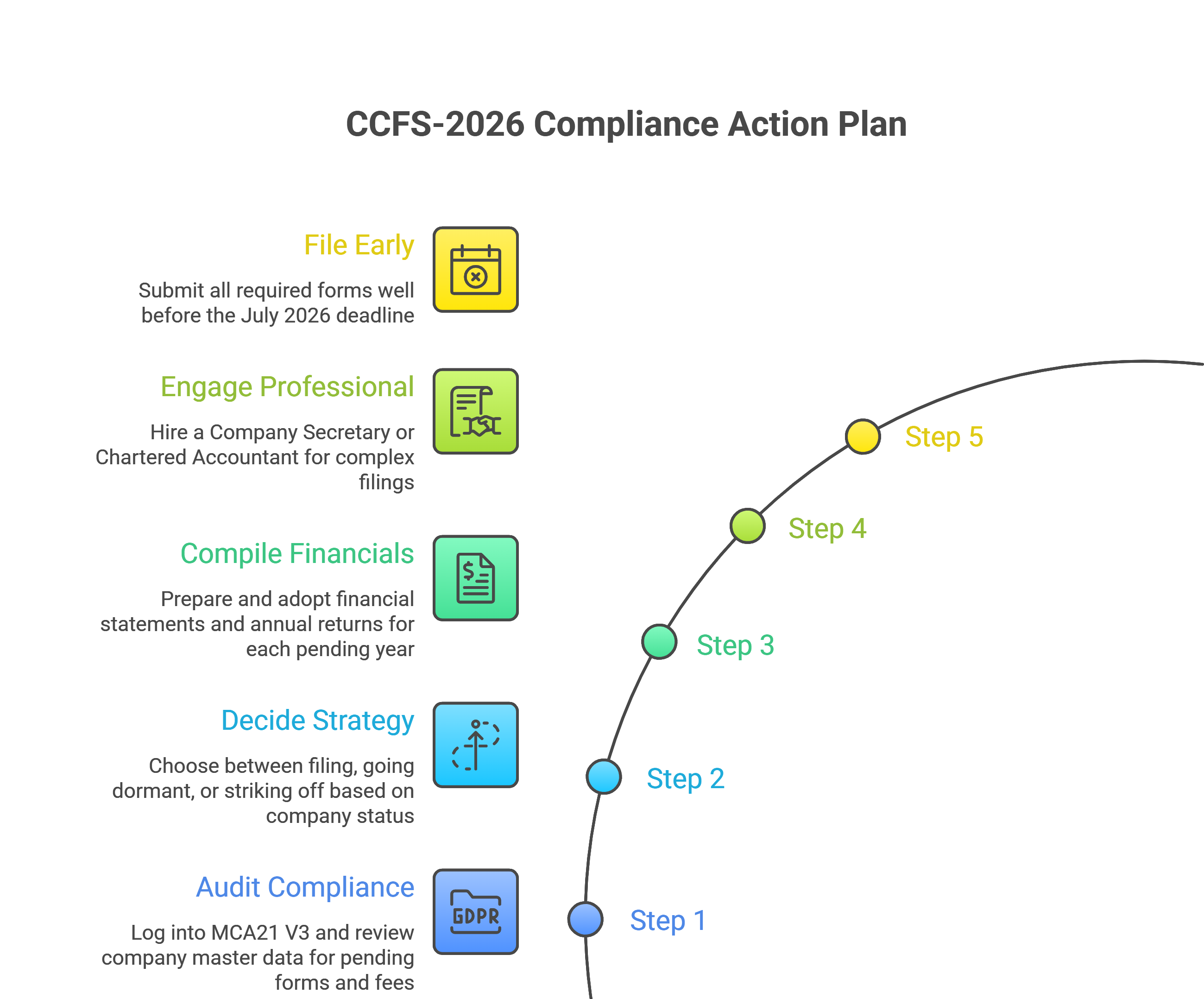
Given that the scheme opens on 15 April 2026, companies have roughly seven to eight weeks to prepare. Here is a practical checklist to ensure you are ready.
Step 1: Audit Your Compliance Status
Log into the MCA21 V3 portal (mca.gov.in) and review the Master Data of your company. Identify all pending forms, the financial years they relate to, and the outstanding additional fees accumulated to date.
Step 2: Decide Your Strategy: File, Go Dormant, or Strike Off
Based on the operational status and plans, decide which option under CCFS-2026 best applies to your company. This decision should factor in existing assets, pending liabilities, ongoing contracts, and director obligations.
Step 3: Compile Financial Statements and Annual Returns
For each pending financial year, ensure that financial statements are prepared and, where applicable, audited and adopted at the Annual General Meeting. Rushing this step can be a common cause of last-minute errors, so don't waste time and act before!
Step 4: Engage a Professional
Filing under CCFS-2026 for multiple years of defaults involves navigating complex form relationships, accurate fee calculations, and careful immunity assessment. Engaging a qualified Company Secretary or Chartered Accountant can prevent costly mistakes.
Step 5: File Well Before the Deadline
Do not wait until July 2026. Technical glitches on the MCA portal, document preparation delays, and professional availability parameters are all predictable at the very end of any amnesty scheme.
India's Broader Corporate Compliance Drive
CCFS-2026 is part of a broader MCA initiative to modernise and clean up India's corporate registry. In parallel, MCA has completed the full migration of company filings to the MCA21 V3 portal with all active forms now exclusively available on V3, proposed reforms to the Director KYC requirement moving from annual to a triennial verification cycle, and signalled through official statements that a comprehensive Corporate Amendment Bill covering both the Companies Act, 2013 and the LLP Act may be introduced with further decriminalisation of procedural offences.
Taken together, these reforms signal a clear policy direction: India is actively trying to reduce the compliance cost for honest businesses while simultaneously tightening enforcement against chronic defaulters and vanishing entities. CCFS-2026 is a one-time bridge between these two objectives.
How Taxlegit Can Help You Under CCFS-2026
At Taxlegit, our experienced team of Company Secretaries and Chartered Accountants offers end-to-end assistance for companies seeking to avail CCFS-2026. Our services include:
- Free compliance health-check on the MCA portal
- Computation of pending fees under the scheme
- Preparation and filing of Annual Returns and Financial Statements for multiple pending years
- Dormant status application (Form MSC-1) assistance
- Voluntary strike-off application (Form STK-2) assistance
- Advisory on immunity eligibility and penalty management
Contact Taxlegit today to assess your company's position and plan your filings before the window opens on 15 April 2026.
Conclusion
CCFS-2026 is evidently one of the most significant corporate compliance amnesty schemes India has seen in recent years. With 90% relief on late fees for annual filings, 50% discount on dormancy applications, and 75% savings on voluntary strike-off fees, the MCA has made it financially and practically compelling for defaulting companies to come forward and regularise.
Begin your compliance audit today, engage a Legal/Advisory professional, and ensure your filings are done well before the deadline. Do not let a one-time opportunity pass by.
Frequently Asked Questions (FAQs)
Q1. What is the MCA Companies Compliance Facilitation Scheme 2026 (CCFS-2026)?
The CCFS-2026 is a one-time "amnesty" window introduced by the Ministry of Corporate Affairs (MCA). It allows defaulting companies to file long-pending annual returns and financial statements with a 90% waiver on additional fees, helping them regularise their status without heavy financial penalties.
Q2. What are the start and end dates for CCFS-2026?
The scheme is strictly time-bound. It opens on 15 April 2026 and will remain active until 15 July 2026. Companies must complete their filings within this three-month window to avail of the benefits.
Q3. How much can a company save on late fees under this scheme?
Under normal rules, late filings attract a penalty of ₹100 per day with no upper limit. Under CCFS-2026, companies only pay 10% of the additional fee otherwise due. This represents a massive 90% saving on penalties for every pending form.
Q4. Can inactive companies use this scheme to close their business?
Yes, CCFS-2026 provides a "Golden Opportunity" for defunct companies to exit without any penalty.
Q5. Does filing under CCFS-2026 provide immunity from prosecution?
Yes, but with conditions. Filing during the scheme provides immunity from penal proceedings under Sections 92 and 137. However, if an adjudication order has already been passed or the 30-day notice period has expired, the penalty remains payable. The scheme does not erase already-concluded legal actions.
About the Author

Srijita
Content Writer
Srijita is a legal and financial content specialist with 5+ years of experience in the Indian corporate sector. She simplifies MCA regulations and tax compliance into clear, actionable insights for entrepreneurs, working closely with Chartered Accountants and legal experts to ensure accuracy and compliance. Reviewed by Vipul Sharma, Co-Founder, Taxlegit.