A Liaison Office in India is a simple, non-commercial presence of a foreign company in the country. It doesn’t earn revenue or carry out business activities. Instead, it helps the parent company handle communication, coordinate with partners, build brand visibility, and understand the Indian market better, all without getting into full-fledged operations.
Many global companies prefer opening a liaison office in India because it’s the safest and easiest way to enter the Indian market. There’s no business risk, no income tax liability, and it gives the company a credible, legally compliant presence. Set up your Liaison/Representative Office in India with Taxlegit, complete RBI & ROC support from start to finish.
What Is a Liaison Office?
A Liaison Office is the easiest and most compliance-friendly way for a foreign company to set up a basic presence in India. It is officially defined under FEMA Section 2(e) and operates under the RBI Master Direction for establishing Branch, Liaison, and Project Offices in India (updated April 2024).
A Liaison Office works purely as a communication and coordination hub. It helps the foreign parent company manage relationships, conduct market research, and maintain visibility — without engaging in any commercial, trading, or manufacturing activities. Many global companies choose this route when opening a liaison office in India because it offers a simple, non-commercial, and fully compliant entry into the Indian market.

Difference: Liaison Office vs Branch Office vs Project Office
Criteria
Liaison Office
Branch Office
Project Office
Commercial Activity
Not allowed
Allowed
Allowed (project-specific)
Income Generation
Not allowed
Allowed
(linked to project)
Taxation
No tax (usually)
Taxable
Taxable
Net Worth Requirement
USD $50,000
USD $100,000
None
Purpose
Representation
Business Operations
Project Execution
Activities Allowed for a Liaison/Representative Office
When a foreign company sets up a simple non-commercial presence in India, it’s important to understand what activities are legally allowed. As per the RBI Master Direction, the operations of a representative office in India or a Liaison Office in India are limited to support and coordination only.
A Liaison Office must follow strict RBI rules, and these activities are completely prohibited:
Not Allowed Activities
Description
Earning Income
A Liaison Office in India cannot earn any revenue, no invoicing, no accepting payments, and no charging Indian clients under any situation.
Signing Business Contracts
While opening a liaison office in India, companies must note that this office cannot sign business contracts, commercial agreements, or any deal aimed at generating profit.
Sales or Trading
A representative office in India is not allowed to sell products, offer services, or participate in trading, and even promotional sales are restricted.
Manufacturing
It cannot carry out or supervise any manufacturing, production, or assembly activities inside India.
Consultancy
Charging for consultancy, technical advice, or any paid professional service is strictly prohibited.
Commercial Operations
No form of business operation, such as revenue-driven marketing, procurement for profit, or customer service for payment, is allowed.
Raising Funds
The office cannot raise capital, borrow money, or seek investments from Indian entities.
Important Note: A Liaison Office must run only through inward remittances sent by the foreign parent company. No local revenue or funding is permitted.
Liaison Office vs Representative Office – Are They the Same?
Yes, they are essentially the same. A Liaison Office in India is identical to a Representative Office in India, and both terms are used interchangeably in legal, regulatory, and business contexts. There is no difference in their purpose, operations, or compliance obligations. Both are set up purely for non-commercial activities such as promoting the parent company’s business, coordinating with Indian partners, or conducting market research.
In other words, whether you call it a Liaison Office or a Representative Office, the permissions, limitations, and reporting requirements remain the same under RBI and FEMA regulations. Many foreign companies use these terms interchangeably when planning their entry into the Indian market, but the operational framework, statutory filings, and restrictions do not change.
Eligibility Criteria for Opening a Liaison Office in India
Before a foreign company sets up a Liaison Office in India, it must meet certain RBI and FEMA requirements. Here’s the simplified, human-friendly version:
Profit-Making Track Record
To qualify for a Liaison Office in India, the foreign parent company must have earned profit for the last 3 consecutive financial years.
Net Worth Requirement
The company must have a minimum net worth of USD 50,000 (or equivalent), properly certified by its international banker. This is a core financial requirement when opening a liaison office in India.
Clean Background
The parent company must not have any criminal, regulatory, financial, or compliance-related issues in its home country.
Parent Company Documents
Basic corporate documents are needed, incorporation certificate, audited financials, charter papers, and other company records typically required for a representative office in India.
RBI Guidelines
All applications must follow FEMA 22 and the RBI Master Direction for LO/BO/PO setups. These guidelines decide whether the company is eligible.
Foreign Company Incorporation Proof
Documents like COI, Charter Papers, Memorandum/Articles of Association, or Bylaws must be submitted to validate the company’s legal existence.
Who Can Open a Liaison Office in India?
A Liaison Office in India can be opened by any foreign company with a good financial reputation. To qualify, the company must have been profit-making for the last three years and carry a minimum net worth of USD 50,000, verified by its home-country banker. These conditions ensure that only genuine and financially stable businesses enter India.
In simple terms, if your company has a steady profit history and strong financial backing, you can easily apply for a Liaison Office. It’s a smooth, compliance-light entry route for global companies exploring the Indian market.
Documents Required from Parent Company
When setting up a representative office in India, the parent company needs to submit several key documents to ensure full compliance with RBI and MCA requirements. These documents establish the legal existence, financial stability, and proper authorization for the foreign entity to operate in India.
Document
Explanation
Certificate of Incorporation
Proof of legal existence
Memorandum & Articles / Charter
Governing constitution of the entity
Audited Financials (3 years)
Profitability proof
Board Resolution
Authorization for opening Liaison Office in India
Power of Attorney
Authorization of the Indian representative
Passport/KYC of Directors
Identity verification
Net Worth Certificate
Banker-certified
Banker's Report
Due diligence by the foreign company’s bank
All documents must be apostilled or notarized as per the country's requirements.
Step-by-Step Process for Opening a Liaison Office in India
Setting up a Liaison Office becomes much simpler when you follow the RBI-approved process in a clear sequence. Here’s the entire journey explained in a clean, human way:
Consultation & Documentation Drafting
The process begins with checking whether the foreign company is eligible to open a Liaison Office. Once confirmed, all required documents are drafted, including the LO application, parent company papers, financial statements, and board approvals. This is the stage where the entire file is prepared properly before it goes to the bank.
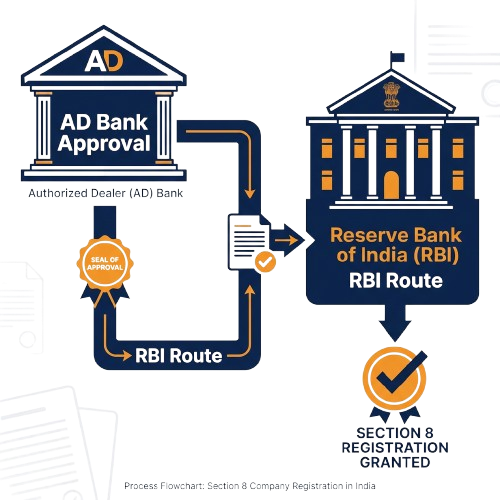
Application Through AD Category-I Bank
Foreign companies cannot approach the RBI directly. Instead, the complete application is submitted to an Authorized Dealer (AD Category-I) Bank such as HDFC, ICICI, or SBI. The bank reviews the documents, performs due diligence, and only after they are satisfied does the application move forward.
Submission on the FIRMS Portal
Once the bank clears the file, the application is uploaded to the RBI’s FIRMS portal. This is where all Liaison Office requests are officially reviewed by the Reserve Bank.
RBI Review & UIN Issuance
The RBI examines the entire application, verifies eligibility, and once everything is approved, issues a Unique Identification Number (UIN). This UIN is the official approval for establishing a Liaison Office in India.
PAN & TAN Registration
After receiving UIN approval, the Liaison Office must apply for PAN and TAN. These are compulsory for tax compliance, even though the office cannot earn any income in India.
Opening the Bank Account
A dedicated bank account is then opened for the Liaison Office. This account can only receive inward remittances from the foreign parent company. No local income, payments, or business receipts are allowed to enter this account.
Registration with the ROC (MCA)
The next step is registering the Liaison Office with the Registrar of Companies. This involves filing the required forms under the Companies Act, submitting address proofs, and officially recording the LO’s presence with the Ministry of Corporate Affairs. Once approved, the Liaison Office becomes legally recognized in India.
Setting Up Compliance Systems
After registration, the office needs to put in place systems for accounting, FLA filing, AAC filing, and other regulatory tasks. This ensures the Liaison Office stays compliant throughout the year and meets all RBI and MCA reporting requirements.
GST Registration
Most Liaison Offices don’t require GST because they cannot carry out any commercial activity. However, in rare situations involving special representational work, GST registration may be required. This is assessed case-by-case.
Yearly Reporting & Compliance
The final step is establishing the yearly compliance routine. This includes filing the Annual Activity Certificate (AAC) with the RBI, submitting the FLA return, updating ROC filings, handling bank reporting, maintaining proper books of accounts, and conducting audits if applicable. These filings ensure the Liaison Office remains fully compliant every financial year.
Common Mistakes Foreign Companies Make
When setting up a Liaison Office in India, many foreign businesses unknowingly make small mistakes that slow down the entire approval process. Here are the most common issues, explained simply:
Applying without checking basic eligibility: Companies often jump into the process without confirming net-worth or profitability requirements. This leads to quick rejection from the AD Bank.
Submitting incomplete or incorrect documents: Missing apostilles, outdated financials, or incorrectly drafted board resolutions are major reasons for delays during the opening a liaison office in India.
Assuming the Liaison Office can do business: Many companies believe they can invoice clients, sign contracts, or generate revenue. This is strictly prohibited and violates FEMA guidelines.
Opening the wrong type of bank account: A Liaison Office can operate only an inward-remittance account. Trying to open a standard current account creates unnecessary compliance hurdles.
Missing yearly RBI and ROC filings: Skipping filings like AAC, FLA, or MCA annual returns is very common, and can result in penalties or even cancellation of approval.
Choosing the wrong local representative: Appointing someone unfamiliar with Indian compliance requirements leads to preventable errors and communication delays.
Using a non-compliant office address: RBI requires a valid commercial office address. Many applications get stuck because the submitted address proof is not acceptable
Forgetting about renewal timelines: Some Liaison Offices need renewal every three years, and companies often overlook this, putting their India presence at risk.
Timeline for Opening a Liaison Office in India
Steps
Time
Documentation
3–5 days
FIRMS/RBI Application
5–7 days
RBI Approval
20–30 days
PAN/TAN
7 days
ROC Registration
10 days
Bank Setup
5–7 days
Total Time
45–60 days
Post-Setup Compliance Requirements
Operating a Liaison Office in India requires strict adherence to RBI and MCA compliance rules every year. To remain fully compliant, the office must follow the checklist below:
Annual Activity Certificate (AAC): Prepared by a Chartered Accountant and submitted to the AD Bank as well as the RBI to confirm all office activities.
Filing with DGFT / AD Bank: Any changes in office details, directors, or activities must be promptly reported to the AD Bank and DGFT.
ROC Annual Returns (MCA): Includes filing of AOC-5 and Annual Return (Form FC-3) to comply with Companies Act requirements.
FLA Return: Mandatory submission of Foreign Liabilities and Assets details, reflecting all inward remittances and obligations.
Renewals: Some Liaison Offices may require formal renewal after 3 years, depending on RBI approval terms.
Books of Accounts: Maintain proper Indian books of accounts recording inward remittances, operational expenses, and other financial records.
Yearly Compliance Checklist
Compliance
Frequency
AAC to RBI
Yearly
FC-3, FC-4 Returns
Yearly
ROC Filings
Yearly
Audit of Books
Yearly
Bank Reporting
Ongoing
Address Verification
As needed
Benefits of Setting Up a Liaison Office in India
For foreign companies looking to explore the Indian market safely and efficiently, setting up a Liaison Office in India offers several strategic advantages:
Low Compliance
Requires minimal regulatory formalities compared to a full-fledged subsidiary or branch office.
Zero Taxation Burden
Since the office cannot generate income or perform commercial activities, there is no tax liability in India.
Low-Risk India Market Entry
Allows foreign companies to explore the Indian market without committing significant capital or resources.
Official Representation
Serves as a recognized point of contact in India, helping establish credibility with partners, clients, and authorities.
No Capital-Intensive Requirements
Setting up a Liaison Office does not require large investments, making it an economical option for market entry.
Ideal for Testing the Market Before Full Expansion
Helps businesses study market demand, customer behaviour, and operational feasibility before scaling operations in India.
Supports Long-Term FDI Strategy
Acts as a stepping stone for companies planning future foreign direct investment or a full-scale subsidiary in India.
Excellent for Entering India
Particularly useful for international companies looking for a structured, compliant, and risk-free entry into the Indian market.

A Liaison Office in India is generally not taxable because:
It does not generate any income or revenue within India from any sources.
It does not sign any business contracts, agreements, or commercial deals with Indian clients.
It does not engage in any commercial, trading, or revenue-generating activities.
Taxation Applicability Only In Rare Cases
Tax may apply if:
The office performs any type of commercial activity or starts generating revenue directly or indirectly.
It acts as a fixed place Permanent Establishment (PE) for the foreign parent company in India.
It indirectly earns income or receives profits on behalf of the foreign entity through Indian operations.
Transfer Pricing:
Not applicable in normal cases because no financial transactions or business dealings occur in India.
Why Choose Taxlegit for Liaison Office Setup in India?
Setting up a Liaison Office in India can be complex, but with Taxlegit, you get a smooth, end-to-end service that ensures full compliance and expert guidance at every step.
End-to-End Documentation, Apostille, Notarization: Taxlegit manages the complete paperwork process, including all document drafting, apostille, and notarization, ensuring a hassle-free setup.
RBI + ROC Filings Handled Fully: We take care of all regulatory filings with RBI and ROC, so your Liaison Office is fully compliant from day one.
Project-Managed by Taxlegit’s Foreign Desk: A dedicated foreign desk ensures smooth coordination and expert handling of every step of your Liaison Office setup.
Dedicated Manager for International Clients: Our specialized managers provide personalized guidance tailored to clients from different regions and industries.
Compliance Dashboard for Yearly Filings: Stay on top of all statutory requirements with our user-friendly compliance dashboard for ongoing filings and deadlines.
Guidance for Market Entry & India Strategy: We provide strategic advice for entering the Indian market and planning long-term operations effectively.
Quick Turnaround Time: Efficient processes and expert handling ensure your Liaison Office is approved and operational as quickly as possible.
100% RBI-Compliant Process: Every step is designed to meet RBI regulations, minimizing any risk of non-compliance.
Experience with Multiple Industries & Global MNCs: Our team has successfully set up Liaison Offices for a wide range of industries and multinational companies, bringing practical expertise to every project.
Frequently Asked Questions
No, a Liaison Office in India cannot earn any income, charge clients, or issue invoices within India. Its operations are strictly non-commercial and limited to representational and coordination activities.
Generally, the RBI approval process takes around 30 to 45 days, depending on document completeness and bank review timelines.
The license is usually valid for three years and can be renewed upon expiry by submitting the required applications and compliance documents.
Yes, a Liaison Office can be converted into a Branch Office after applying for fresh RBI approval and fulfilling the necessary eligibility criteria.
No, taxation applies unless the Liaison Office undertakes commercial or revenue-generating activities, which are strictly prohibited under RBI and FEMA rules.
Yes, it can hire employees, but only for performing permitted activities such as coordination, market research, and administrative support.
GST is generally not applicable since the office cannot conduct commercial operations. It applies only in very rare cases where taxable services are involved.
Yes, strict FEMA compliance is required, including timely reporting, inward remittance tracking, and adherence to all RBI regulations.
Absolutely, Liaison Offices are widely used by global corporations from Japan, Korea, the US, the UK, and other countries as a low-risk entry into the Indian market.

Taxlegit handles the entire process, from preparing and submitting RBI applications to managing yearly compliance, filings, and reporting, ensuring a fully smooth and compliant Liaison Office setup.