Taxlegit Logo

Register with AI

Try Now →
FlowIQ

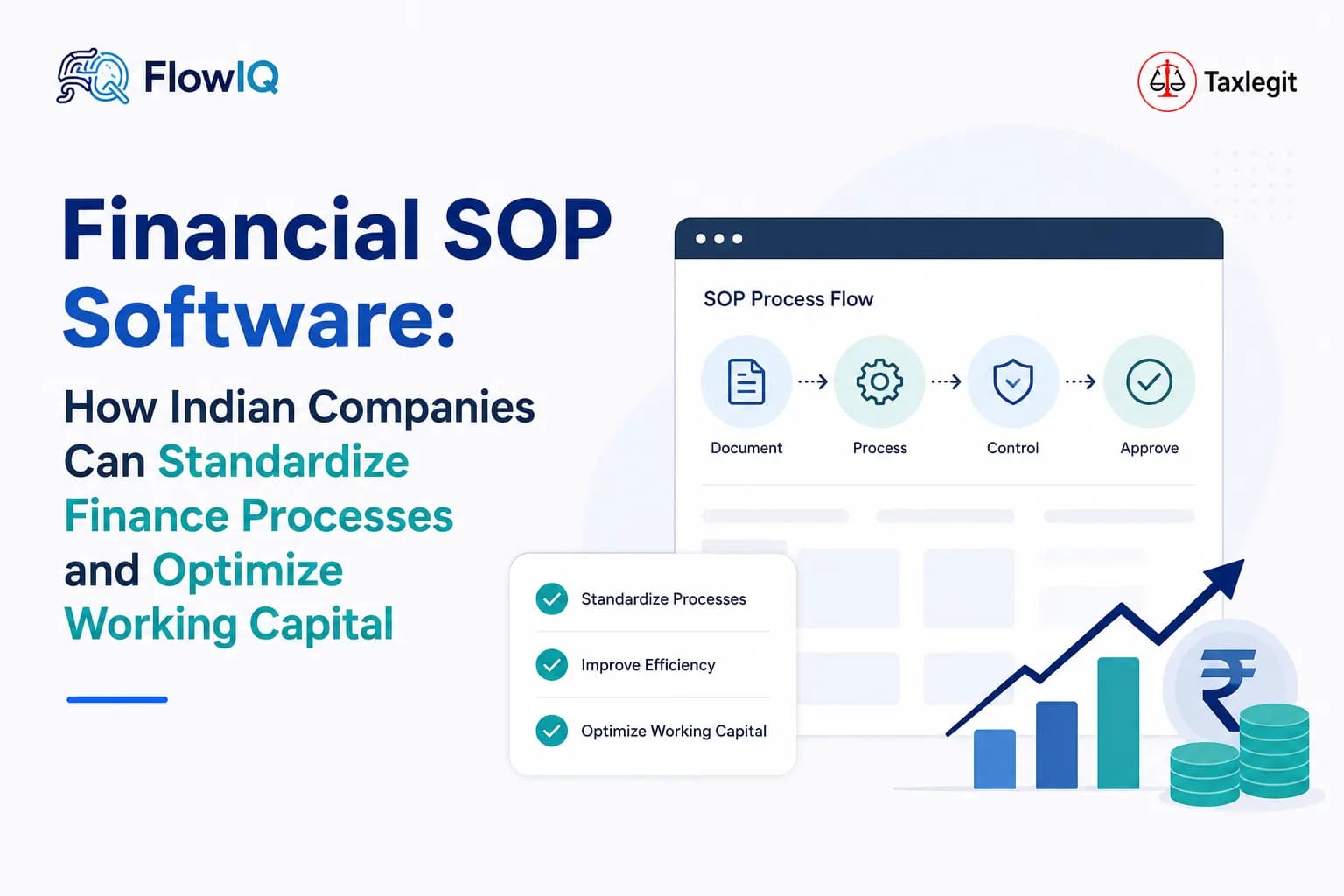
How Indian Companies Can Standardize Finance Processes and Optimize Working Capital (

Pub: Aug 1, 26Upd: Aug 1, 26507 views
How Indian Companies Can Standardize Finance Processes and Optimize Working Capital (

Your Finance Process Should Not Live in One Person’s Head

In many growing Indian manufacturing enterprises, the monthly close cycle can swing from 8 days one month to over 20 days the next. According to the PwC Working Capital Study & Deloitte CFO Survey, this massive gap between top and bottom performers is rarely about transaction volume it stems directly from undocumented processes and key-person dependency.
So, what went wrong?
The senior accountant who normally handled vendor reconciliations and GST matching was on leave. Customer follow-ups stalled, bank reconciliations were delayed, responsibilities were unclear, and nobody had a documented process outlining:
Which activity had to be completed first:
  • Who was responsible for each step
  • Which approval was required
  • What evidence had to be retained
  • What should happen when an exception appeared
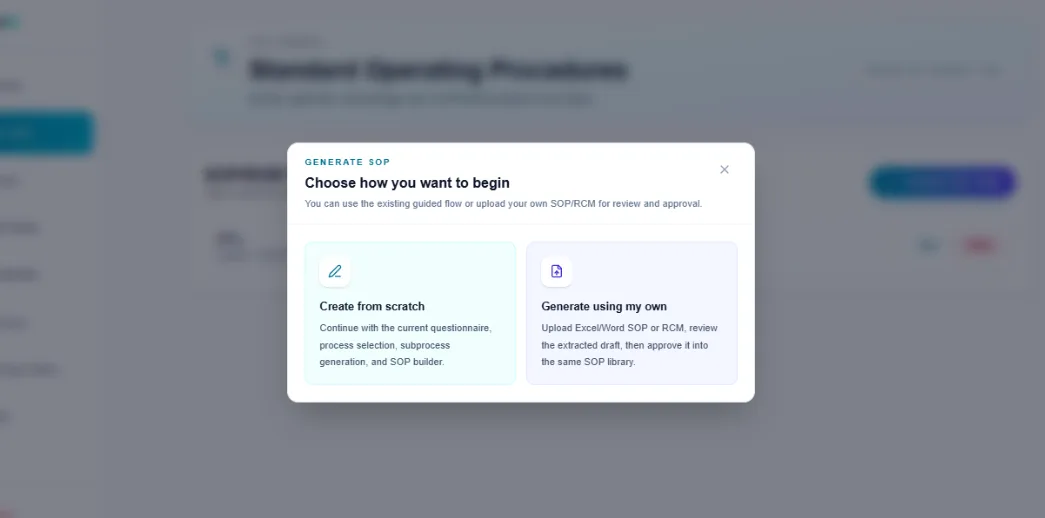
This is not simply a staffing issue, It is an undocumented process and internal-control issueFinancial SOP software helps organizations convert employee-dependent knowledge into structured, repeatable, and reviewable processes. Your process should continue working even when an employee is absent, transferred, or replaced.
When processes live in individual heads, cash gets locked up in overdue receivables, vendor disputes escalate, and working capital suffers. FLOWIQ by TaxLegit helps Indian organizations convert employee-dependent knowledge into structured, repeatable, and reviewable processes.
FLOWIQ converts practical company and operational inputs into structured SOPs, risk control matrices (RCM), and ICFR-ready documentation ensuring your cash flow and compliance operate smoothly, even when key employees are absent, transferred, or replaced.
Generate SOP Options

What Financial SOP Software Actually Is

According to the Guidance Note on Audit of Internal Financial Controls Over Financial Reporting issued by the Institute of Chartered Accountants of India (ICAI), A financial SOP is a documented, step-by-step procedure for a specific accounting task such as closing the books, approving an invoice, or posting a journal entry.
While traditional static documents satisfy basic documentation requirements, frameworks like ICAI’s Guidance on IFC and COSO require controls to be actively performed, logged, and reviewed. Financial SOP software provides that operational layer: converting static procedures into assigned, trackable workflows with hard-coded approval hierarchies and audit-ready version history.
That is why effective finance-process documentation should ideally connect three layers:

1. SOP: How the Process Works

The SOP explains the activities, responsibilities, timelines, documents, and approvals required to complete the process.

2. RCM: What Can Go Wrong and How It Is Controlled

A risk control matrix connects each process risk with its corresponding control, owner, frequency, evidence requirement, and testing approach.

3. ICFR Documentation: How Financial Reporting Risks Are Addressed
ICFR documentation connects processes and controls with financial-reporting objectives and helps management, internal auditors, and external auditors evaluate whether the control environment has been properly designed.
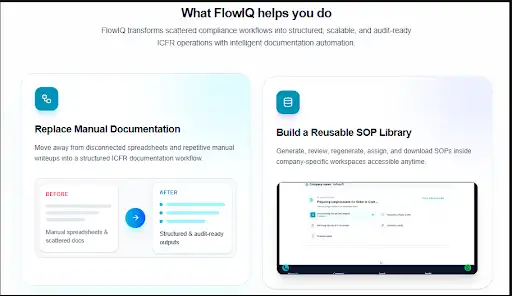
Traditional documentation methods often manage these three areas in separate Word documents and Excel files. FLOWIQ brings them into one structured documentation journey.

Unlocking Working Capital and Accelerating Collections

While standardization improves accuracy, its most direct impact for Indian businesses is on the balance sheet: faster cash conversion and optimized working capital
Here is how standardized financial SOPs built through FLOWIQ directly improve liquidity:

1. Accelerating Order-to-Cash (O2C) & Collections

Delayed invoicing and sluggish receivables collection are major causes of working capital strain in Indian SMEs and mid-market enterprises. Standardized SOPs establish:
  • Strict Invoice Generation Schedules: Eliminating billing lags immediately after goods dispatch (E-way bill generation) or service delivery.
  • Structured Credit Terms & Aging Triggers: Standardized escalation matrices for overdue invoices (e.g., automated 7-day, 15-day, and 30-day payment reminders and sales-team escalation).
  • Dispute Resolution Workflows: Shortening the time spent resolving client invoice queries, debit notes, or rate mismatches so payments aren't blocked.

2. Optimizing Procure-to-Pay (P2P) & Vendor Cash Outflows

Paying vendors too early drains cash; paying too late damages supplier relationships and forfeits early-payment discounts. Standardized SOPs ensure:
  • Systematic Payment Run Cycles: Consolidating vendor disbursements into predictable weekly or fortnightly runs aligned with actual cash inflows.
  • 3-Way Matching Mandates: Verifying Purchase Orders (PO), Goods Receipt Notes (GRN), and vendor invoices to prevent overpayments or duplicate disbursements.
  • TDS & GST Matching Compliance: Ensuring vendor invoices comply with GST 2B reconciliation before releasing payments, preventing blocked Input Tax Credit (ITC).

3. Inventory and Working Capital Cycle Tightening

Unsold inventory or delayed stock reconciliation ties up capital that could be used for business expansion. Standardizing inventory valuation and physical count SOPs prevents stock leakage, identifies slow-moving inventory, and releases tied-up cash faster.

Have Questions?

What Makes FLOWIQ Different from Generic AI Tools?

A generic AI chatbot can draft an SOP when given a detailed prompt. But the user still has to decide:
  • What information to provide
  • Which process structure to follow
  • Which risks should be considered
  • How controls should be classified
  • How the SOP should connect with the RCM
  • What format should be used
  • Whether important sections are missing
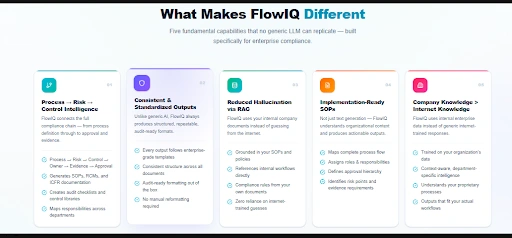
FLOWIQ is designed around finance, audit, and internal-control documentation. Instead of beginning with an empty chat box, the user follows a guided process using company context, process selection, and structured output formats.

Generic AI Generates Text

It may create a useful draft, but the structure depends heavily on the quality of the prompt.

FLOWIQ Builds Connected Documentation

It helps users move from the following:
Company Context → Process → Subprocess → Risk → Control → Evidence → Review-Ready Output
That makes it more suitable for finance teams, CFO offices, internal auditors, consultants, and CA or CPA firms that need reusable professional documentation. Chatbots can write paragraphs. FLOWIQ helps structure the complete process-and-control store.

Static Documents, Workflow Tools and FLOWIQ Are Not the Same

Understanding where FLOWIQ fits in your finance stack is straightforward:
SolutionPrimary Purpose
Word, Excel, or Google DriveStore manually prepared, static documents that quickly become outdated.
Generic Task Management SoftwareAssign and track general daily activities without built-in financial controls.
ERP / Accounting Software (Tally, SAP, Zoho)Record transactions, manage ledgers, and execute raw accounting entries.
FLOWIQConvert operational inputs into structured, audit-ready SOP, RCM, and ICFR documentation.
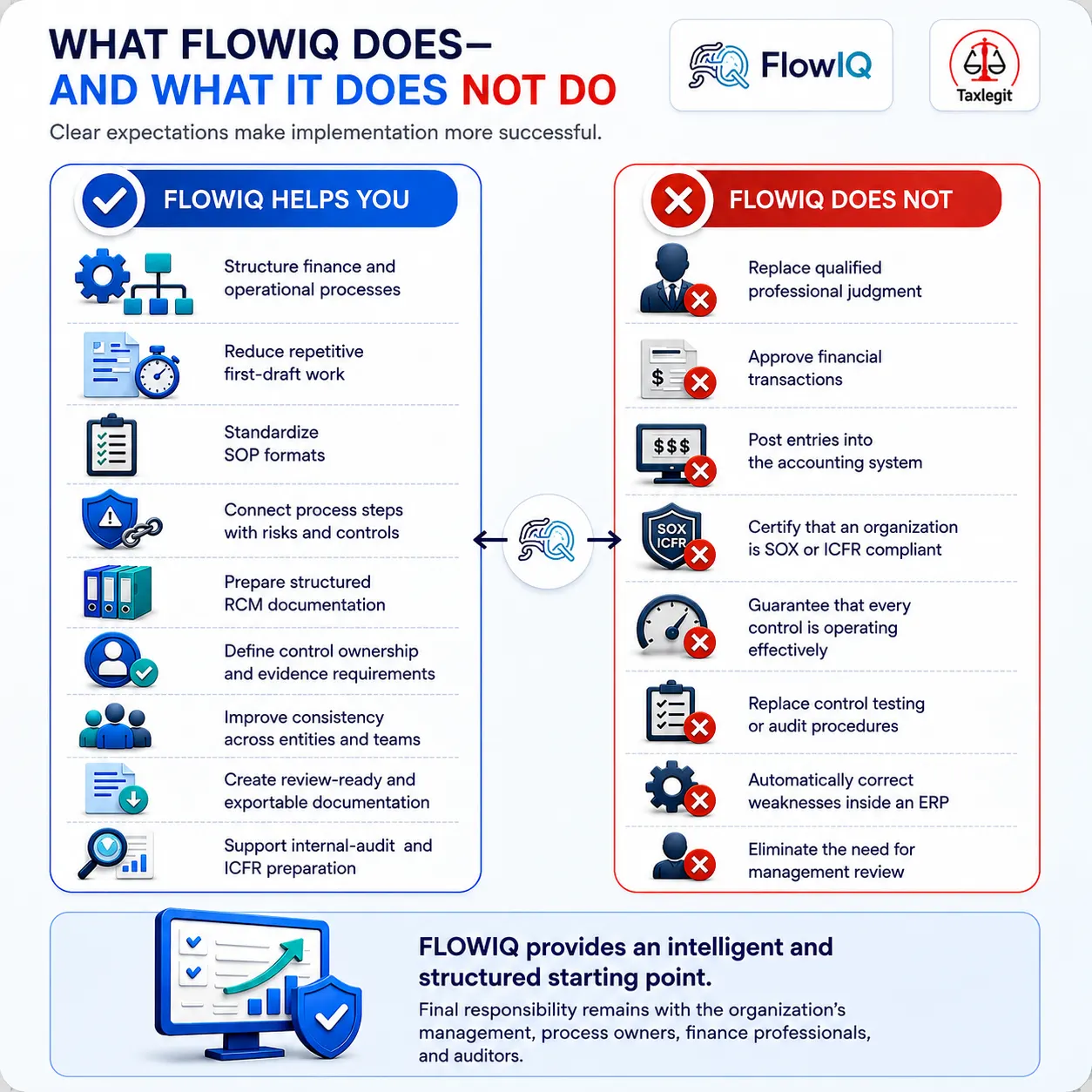
FLOWIQ does not replace your ERP, accounting team, auditor, or approval system. It works as an AI co-pilot for process and control documentation. Finance teams can enter their company context, select the relevant process, and generate a structured first draft for review, customization, and export.

Where FLOWIQ Delivers the Fastest Value for Indian Businesses

Organizations do not need to document every single workflow at once. Start with high-impact, cash-sensitive, and audit-critical processes:
  • Accounts Receivable & Collections: Standardize credit approval thresholds, collection follow-ups, and customer ledger reconciliations to directly reduce DSO (Days Sales Outstanding).
  • Accounts Payable & GST 2B Matching: Ensure payments are approved systematically, early-payment terms are utilized, and vendor ITC is verified before cash leaves the bank.
  • Month-End Close & Financial Reporting: Streamline ledger scrubbing, accruals, and intercompany reconciliations to close books faster and provide accurate financial visibility to leadership.
  • Statutory Compliance & Tax Deductions (TDS/TCS): Standardize monthly tax withholding calculations, deposit schedules, and return filings to avoid interest penalties and statutory notices.
  • Bank & Cash Reconciliations: Institute daily or weekly reconciliation protocols to catch unrecorded bank charges, unauthorized withdrawals, or timing differences early.

Have Questions?

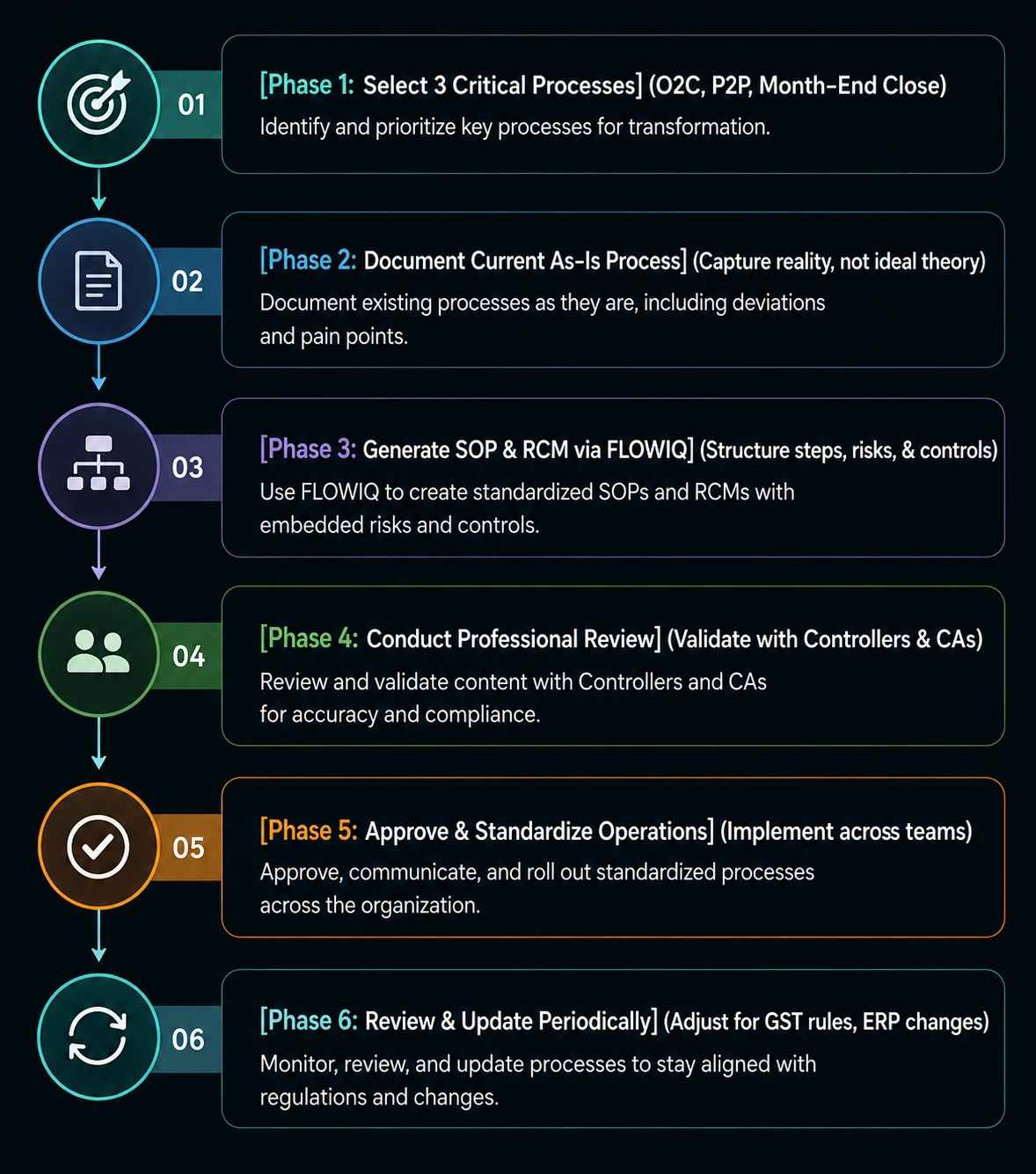
A Practical Finance SOP Rollout Plan

What FLOWIQ Does—and What It Does Not Do

Stop Starting Every SOP from a Blank Page

Your finance team already knows how your day-to-day operations run. The challenge lies in converting that informal knowledge into structured, control-backed documentation that protects cash flow and satisfies statutory requirements.
With FLOWIQ, Indian businesses can transition from fragmented, employee-dependent routines to structured, governance-ready SOPs and RCMs in a guided workflow.
Build once. Standardize across entities. Optimize your working capital. Explore FLOWIQ by TaxLegit and turn your finance operations into a scalable asset.
Disclaimer: This article is for general informational purposes only and does not constitute formal accounting, legal, or tax advice.

Frequently Asked Questions

1How does financial SOP software directly improve working capital?

Financial SOP software standardizes the Order-to-Cash (O2C) and Procure-to-Pay (P2P) cycles. By establishing clear guidelines for credit limits, invoice timing, collection follow-ups, and vendor payment schedules, businesses eliminate billing delays, reduce Days Sales Outstanding (DSO), and avoid paying invoices before they are due.

2Is financial SOP software necessary for companies using Tally or SAP?

Yes, ERP systems record transactions and store data, but they do not define human workflows, operational guidelines, or cross-departmental approval rules. FLOWIQ documents and standardizes the human execution layer that feeds into your ERP.

3How does FLOWIQ help Indian companies comply with ICFR requirements?

Under the Companies Act, 2013, Directors and Audit Committees must ensure robust Internal Financial Controls (IFC). FLOWIQ automatically maps operational process steps to Risk Control Matrices (RCM) and ICFR frameworks, ensuring your controls are clearly defined and audit-ready.

4How many SOPs should a finance team create initially?

We recommend starting with 3 core processes: Accounts Receivable (Collections), Accounts Payable (Vendor Payments), and the Month-End Close. Mastering these three provides immediate improvements in liquidity and financial visibility.

About the Author

Srijita
Srijita

Content Writer

Srijita is a legal and financial content specialist with 5+ years of experience in the Indian corporate sector. She simplifies MCA regulations and tax compliance into clear, actionable insights for entrepreneurs, working closely with Chartered Accountants and legal experts to ensure accuracy and compliance. Reviewed by Vipul Sharma, Co-Founder, Taxlegit.


Consultation

Ready to Start Your Journey?