Quick Summary
Creating Your Own Company
Understanding Indian Laws and Authorities for Company Formation
- Companies Act, 2013: Main law for registering companies like Private Limited, Public Limited, and Limited Liability Partnerships (LLPs).
- Income-tax Act, 1961 (now Income-tax Act, 2025): Governs PAN and TAN issuance, essential for tax compliance.
- Goods and Services Tax (GST) Act: Requires businesses crossing turnover thresholds to register for GST.
- Foreign Contribution Regulation Act (FCRA): Relevant if your business plans to receive foreign funds.
- Corporate Social Responsibility (CSR) Rules: Applies if your company meets certain turnover or net worth criteria.
Step-by-Step Guide to Forming Your Own Business in India
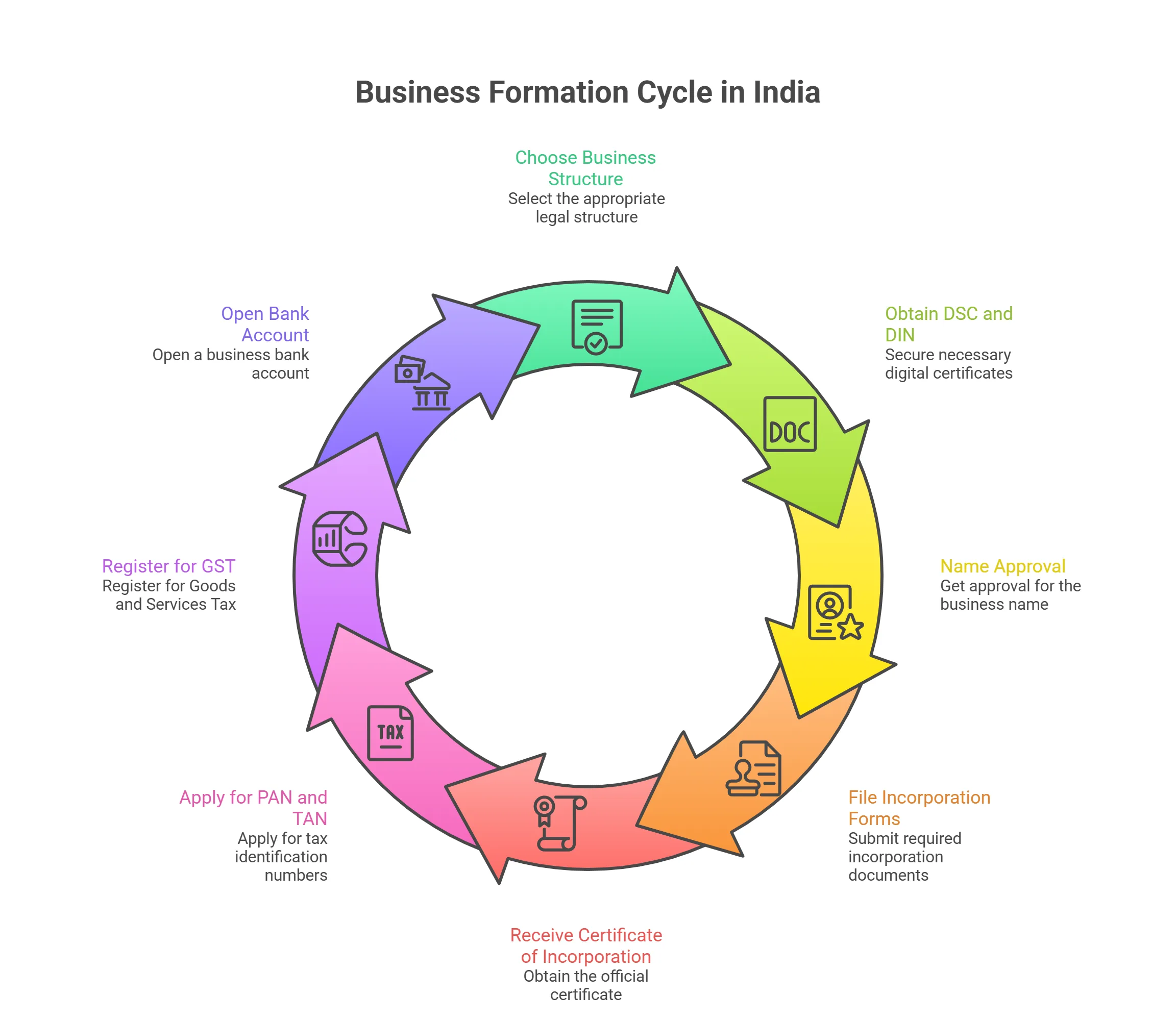
Step 1: Choose Your Business Structure
Step 2: Obtain Digital Signature Certificate (DSC) and Director Identification Number (DIN)
Step 3: Name Approval
Step 4: File Incorporation Forms
Step 5: Receive Certificate of Incorporation
Step 6: Apply for PAN and TAN
Step 7: Register for GST (if applicable)
Step 8: Open a Bank Account
Common Mistakes While Forming a Company
- Skipping the business structure assessment: Choosing the wrong structure leads to compliance headaches later. For example, Sole Proprietorships are simpler but limit funding options.
- Delaying PAN and TAN application: These are essential for tax filings under the Income-tax Act, 1961 (mapped to Chapter XIV / Section 332 in the Income-tax Act, 2025) and banking. Delay can stall operations.
- Ignoring GST registration thresholds: Many new businesses overlook GST registration until penalties arise.
- Not maintaining proper statutory records: Companies must maintain registers and minutes as per the Companies Act.
Company Formation Checklist
| Phase | Step | Action Item | Quick Tips |
| Before You Start | 1 | Decide on business type and structure | Private Ltd, Section 8, LLP, or OPC? Match your goals (profit/non-profit). |
| 2 | Gather identity and address proofs of directors and shareholders | PAN/Aadhaar, passport photos, utility bills (<2 months old). | |
| 3 | Obtain DSC and DIN for directors | Digital signatures from CA, DIN via SPICe+—takes 1-2 days. | |
| During Registration | 4 | Reserve the company name on the MCA portal | Use RUN/SPICe+ Part A; avoid reserved words—2 attempts free. |
| 5 | Prepare MOA and AOA | Customise templates for objectives; get directors to sign digitally. | |
| 6 | 2Submit incorporation forms with required fees. | File SPICe+ on mca.gov.in; ₹5K-15K fees based on capital | |
| After Registration | 7 | Apply for PAN and TAN | Auto-generated with COI under the Income-tax Act, 1961 (Income-tax Act, 2025); download within 2 days. |
| 8 | Register for GST (if turnover criteria met) | Mandatory if >₹20L turnover; apply within 30 days of registration. | |
| 9 | Open a company bank account | Use COI + board resolution; current account only. | |
| 10 | Comply with annual filing requirements under the Companies Act | AOC-4/MGT-7 due Oct 30; set reminders now! |
- Consult a company formation expert who can guide you through each step.
- Use online government portals carefully
- Remember that errors in form filling are common reasons for rejection.
- Keep a checklist of documents and deadlines to avoid missing key compliance dates.
Conclusion
Frequently Asked Questions
1How can I create my own company in India?
To create your own company in India, choose a suitable business structure, obtain Digital Signature Certificates (DSCs), reserve a company name, and submit the incorporation application through the Ministry of Corporate Affairs (MCA) portal. For a Private Limited Company, the process generally involves filing the SPICe+ form with the required documents, MoA, and AoA. After approval, you receive a Certificate of Incorporation, PAN, and TAN.
2What is the minimum investment required to start a Private Limited Company in India?
There is no statutory minimum paid-up capital requirement for incorporating a Private Limited Company in India. Entrepreneurs can start with an investment suitable for their business requirements, provided they meet applicable legal and regulatory obligations.
3Can one person create a company in India?
Yes. One individual can establish a One Person Company (OPC) in India. An OPC requires one member and at least one director. It provides a separate legal identity and limited liability protection, subject to applicable legal provisions.
4How long does it take to register a company in India?
Company incorporation generally takes around 7–15 working days after submitting complete and accurate documents. However, the timeline may vary depending on name approval, document verification, MCA processing, and any resubmission requirements.
5What documents are required to create a company in India?
The commonly required documents include: - PAN card and identity proof of directors and shareholders. - Address proof of directors and shareholders. - Recent passport-size photographs. - Digital Signature Certificates (DSCs). - Proof of the company's registered office. - No Objection Certificate (NOC) from the property owner, where applicable. - Memorandum of Association (MoA) and Articles of Association (AoA).
6Is GST registration mandatory immediately after incorporating a company in India?
No. GST registration is not automatically mandatory for every newly incorporated company. It depends on turnover thresholds, the nature of business activities, interstate supplies, and other compulsory registration conditions under GST law. Eligible businesses must obtain GST registration when the applicable legal requirements are triggered.
About the Author

Content Writer
Srijita is a legal and financial content specialist with 5+ years of experience in the Indian corporate sector. She simplifies MCA regulations and tax compliance into clear, actionable insights for entrepreneurs, working closely with Chartered Accountants and legal experts to ensure accuracy and compliance. Reviewed by Vipul Sharma, Co-Founder, Taxlegit.