
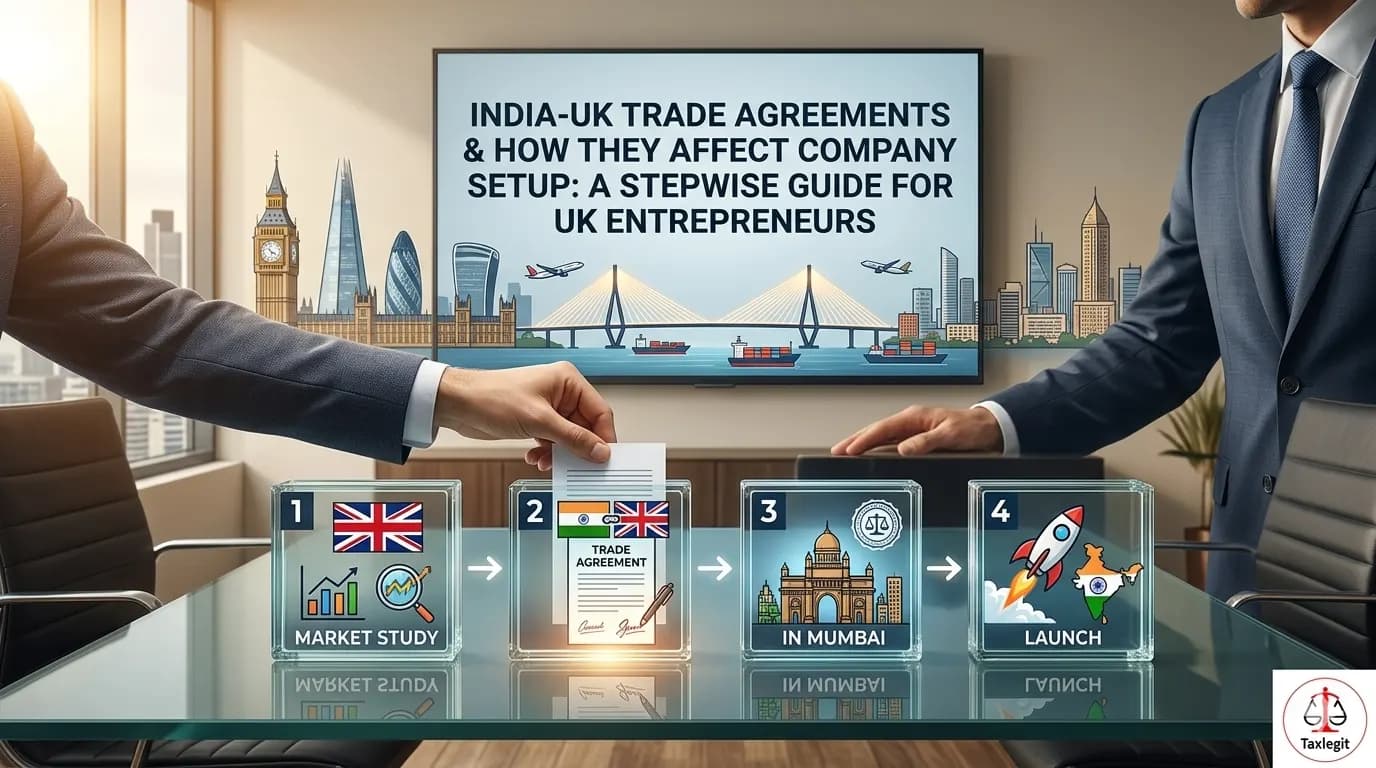
Quick Summary
Starting a business that bridges the UK and India is an exciting opportunity. However, navigating the India-UK trade agreements and understanding their impact on company setup is crucial. These agreements influence everything from market access and tariffs to intellectual property rights and MSME support. It is always advisable to avoid misleading information, as it can cause costly delays or penalties.
In this guide, UK-based entrepreneurs will learn how India-UK trade agreements shape company registration, compliance, and operational decisions when entering the Indian market or collaborating with Indian companies.
Quick Key Facts
- India and the UK are working towards a Free Trade Agreement (FTA) to ease trade barriers.
- MSMEs benefit from special provisions under India’s trade policies supporting inclusive trade.
- Intellectual Property Rights (IPR) protections directly affect product and brand security in India.
- Compliance with Indian regulations is mandatory to avoid penalties and delays in company registration.
- Key Indian authorities include the Ministry of Commerce, the Ministry of Corporate Affairs (MCA), and the Intellectual Property Office of India
What Are India-UK Trade Agreements?
India-UK trade agreements influence company setup by determining market access, tariffs, MSME benefits, and intellectual property protection. In simple words, India-UK trade agreements are formal deals that regulate trade, investment, and economic cooperation between the two countries. Currently, India and the UK are negotiating a comprehensive Free Trade Agreement (FTA) aimed at achieving the primary goals and key provisions that define this landmark deal:
1. Massive Tariff Reductions
The core of the FTA is the aggressive removal of trade barriers to boost the movement of goods:
- Indian Exports to UK: Approximately 99% of Indian goods (including textiles, leather, footwear, and marine products) will now enter the UK market with zero duty.
- UK Exports to India: India has agreed to reduce or eliminate tariffs on 90% of UK product lines.
- Scotch Whisky: Tariffs are being slashed from 150% down to 75% immediately, with a further glide path to 40% over 10 years.
- Automobiles: Import duties on British cars are dropping from 110% to as low as 10% under a new quota system.
2. Doubling Bilateral Trade
The overarching economic goal is to more than double bilateral trade, from roughly $56 billion currently to $112–$120 billion by 2030. This is expected to add billions to the GDP of both nations and support nearly a million new jobs in India alone, particularly in manufacturing and services.
3. Professional Mobility
The Double Contributions Convention (DCC): This parallel treaty ensures that Indian professionals working temporarily in the UK no longer have to pay dual social security contributions. This is estimated to save Indian companies and professionals over ₹4,000 crore annually.
4. Digital Trade and Innovation
The FTA introduces a modern framework for the digital age:
- Digital Sovereignty: It includes provisions that protect proprietary software (no forced disclosure of source code) and promote paperless trade.
- Tech Collaboration: It aligns with the UK-India Technology Security Initiative, focusing on telecommunications, semiconductors, and AI.
5. Sustainability and Inclusion
In a first for Indian trade deals, the CETA includes specific chapters on:
- Gender Equality: Supporting women-led MSMEs (especially relevant for sectors like textiles and handicrafts).
- Climate Change: Promoting trade in environmental goods and supporting India’s transition to net-zero through green energy infrastructure.
What is the Impact of these Comprehensive Agreements on Trade and Tariffs?
- Customs duties and tariffs: 90% of UK product lines will see tariffs reduced or eliminated.
- Market access for goods and services: 99% of Indian goods will enter the UK duty-free from day one
- Support for Micro, Small & Medium Enterprises (MSMEs): Lower prices for clothing and food in the UK; more luxury and tech choices in India.
- Simplified Rules and Logistics: While the benefits for Indian exporters are largely immediate, many of the tariff cuts for UK exports to India (like those on machinery and chemicals) are phased in over 5 to 10 years to allow Indian domestic industries time to adapt to the new competition
| Feature | Key Outcome |
| Status | Signed (July 2025); Implementation expected May 2026 |
| Trade Goal | $120 Billion by 2030 |
| Indian Goods | 99% Duty-Free access to the UK |
| UK Goods | Major cuts for Whisky (150% → 75%) and Cars (110% → 10%) |
| Key Benefit | Elimination of double social security taxes (DCC) |
Who Needs to Understand These Agreements?
- UK entrepreneurs planning to start a company in India.
- Indian businesses seeking UK partnerships.
- MSMEs looking for export/import opportunities between the two countries.
- Investors interested in cross-border ventures.
- Legal and compliance consultants advising UK-India businesses.
Eligibility Criteria To register a company in India, UK entrepreneurs must have:
1. A valid passport and proof of overseas residence.
2. Need a local Indian address for the registered office.
3. Should appoint at least one Indian resident director (can be an Indian or a foreign national with valid Indian residential proof).
4. Must comply with Foreign Direct Investment (FDI) norms as per Indian regulations.
5. Need to ensure business activities align with permitted sectors under India-UK trade policies.
Documents Required for Company Registration in India
| Document Type | Description | Key Notes |
| Passport | Valid passport of a UK entrepreneur. | Primary mandatory identity proof. |
| Proof of Address | Overseas residential address proof. | Must be recent (Utility bills or bank statements). |
| PAN Card | Indian Permanent Account Number. | Essential for tax registration and opening bank accounts. |
| DSC | Digital Signature Certificate. | Required for electronic filing of all official documents. |
| DIN | Director Identification Number. | Issued to appointed directors during company registration. |
| Registered Office Proof | Lease agreement or ownership proof. | The physical office address must be located in India. |
| MOA & AOA | Memorandum & Articles of Association. | Outlines the company’s objectives and internal rules. |
Step-by-Step Guide: Setting Up a UK-India Collaborative Company
1. Understand Trade Agreement Benefits & Limitations:
- Review current India-UK trade policies for tariffs, quotas, and MSME incentives.
- Check sector-specific regulations that may impact your business.
2. Choose the Right Company Structure:
- A Private Limited Company is most common for foreign entrepreneurs.
- Consider LLP or a branch office, depending on business needs.
3. Appoint Directors and Registered Office:
- Ensure at least one director is resident in India.
- Secure a registered office with valid proof.
4. Apply for Digital Signature and DIN:
- Required for the electronic submission of company documents.
5. Draft MOA and AOA:
- Align company objectives with permitted sectors under trade agreements.
6. File Incorporation Application with MCA:
- Submit all documents online via the Ministry of Corporate Affairs portal.
- Pay registration fees; fees vary based on authorized capital.
7. Obtain PAN and TAN from the Income Tax Department:
- Necessary for tax compliance and opening bank accounts.
8. Register for GST if applicable:
- Mandatory if turnover crosses threshold limits or dealing in interstate trade.
9. Comply with MSME Registration and Benefits:
- Register as an MSME to avail benefits under India's MSME support schemes.
10. Protect Intellectual Property Rights (IPR):
- File for trademarks, patents, or copyrights in India to safeguard your brand and products. Remember to protect your intellectual property early by registering trademarks and patents in India
Common Mistakes to Avoid
To benefit from the new trade provisions, UK businesses looking to establish a legal presence in India will need to avoid these common mistakes :
- Delaying the appointment of an Indian resident director.
- Ignoring sector-specific restrictions under India-UK trade agreements.
- Failing to register for MSME benefits when eligible.
- Overlooking intellectual property registration in India.
- Submitting incomplete or incorrect documents to MCA.
- Not understanding tariff and customs implications on imports/exports.
Need help with company registration or MSME benefits? Consult a compliance expert familiar with Indian regulations.
Comparison Table: Stepwise guide for UK businesses setting up in India
| Feature | Private Limited Company | Limited Liability Partnership (LLP) | Branch Office |
| Ownership | Owned by Shareholders. | Owned by Partners. | Owned by the Foreign Company. |
| Resident Requirement | At least one Resident Director required. | At least two partners (one must be a resident). | Requires a Resident Indian Authorised Signatory. |
| Compliance Level | Moderate (Requires annual audits and filings). | Lower (Less frequent regulatory filings). | Higher (Strict reporting to RBI and ROC). |
| Best For | Full-fledged Indian operations and scaling. | Professional services, consultancies, and startups. | Direct extension for market research or liaison. |
| MSME Benefits | Eligible for MSME registration and perks. | Eligible for MSME registration and perks. | Not Eligible for MSME status. |
If you’re planning to set up a company in India, start by reviewing the latest India-UK trade policies to align your business strategy. Get a free consultation on company registration and compliance tailored for UK entrepreneurs entering India. Understand trade agreements, MSME benefits, and IPR protection. Contact us today to avoid delays and penalties.
Conclusion
India-UK trade agreements are reshaping how UK entrepreneurs can establish and operate businesses in India. Understanding the impact of tariffs, MSME support, and intellectual property rights is key to making informed decisions.
By following the stepwise company setup process and complying with Indian regulations, you can avoid penalties and delays. Geography and local authorities also play a role in your compliance journey.
Frequently Asked Questions ( FAQs )
Q1. What is the current status of the India-UK Free Trade Agreement?
Negotiations are ongoing, with some interim trade facilitation measures in place. Full FTA benefits are expected once finalized.
Q2. Can a UK citizen be a director of an Indian company?
Yes, but at least one director must be an Indian resident.
Q3. What MSME benefits can UK entrepreneurs access in India?
Reduced compliance burden, priority sector lending, and subsidies under Indian MSME schemes.
Q4. How long does company registration in India usually take?
Typically, 2-4 weeks if all documents are in order.
Q5. Are there penalties for non-compliance with India-UK trade rules?
Yes, penalties can include fines, delays in customs clearance, and legal action.
Q6. Is intellectual property registration mandatory in India?
Not mandatory, but highly recommended to protect your brand and innovations.
Q7. What taxes apply to foreign companies operating in India?
Corporate tax, GST, and withholding taxes apply depending on business activities.
Q8. Can Indian companies export to the UK under these trade agreements?
Yes, with reduced tariffs and simplified customs once agreements are fully implemented.
About the Author

Srijita
Content Writer
Srijita is a legal and financial content specialist with 5+ years of experience in the Indian corporate sector. She simplifies MCA regulations and tax compliance into clear, actionable insights for entrepreneurs, working closely with Chartered Accountants and legal experts to ensure accuracy and compliance. Reviewed by Vipul Sharma, Co-Founder, Taxlegit.