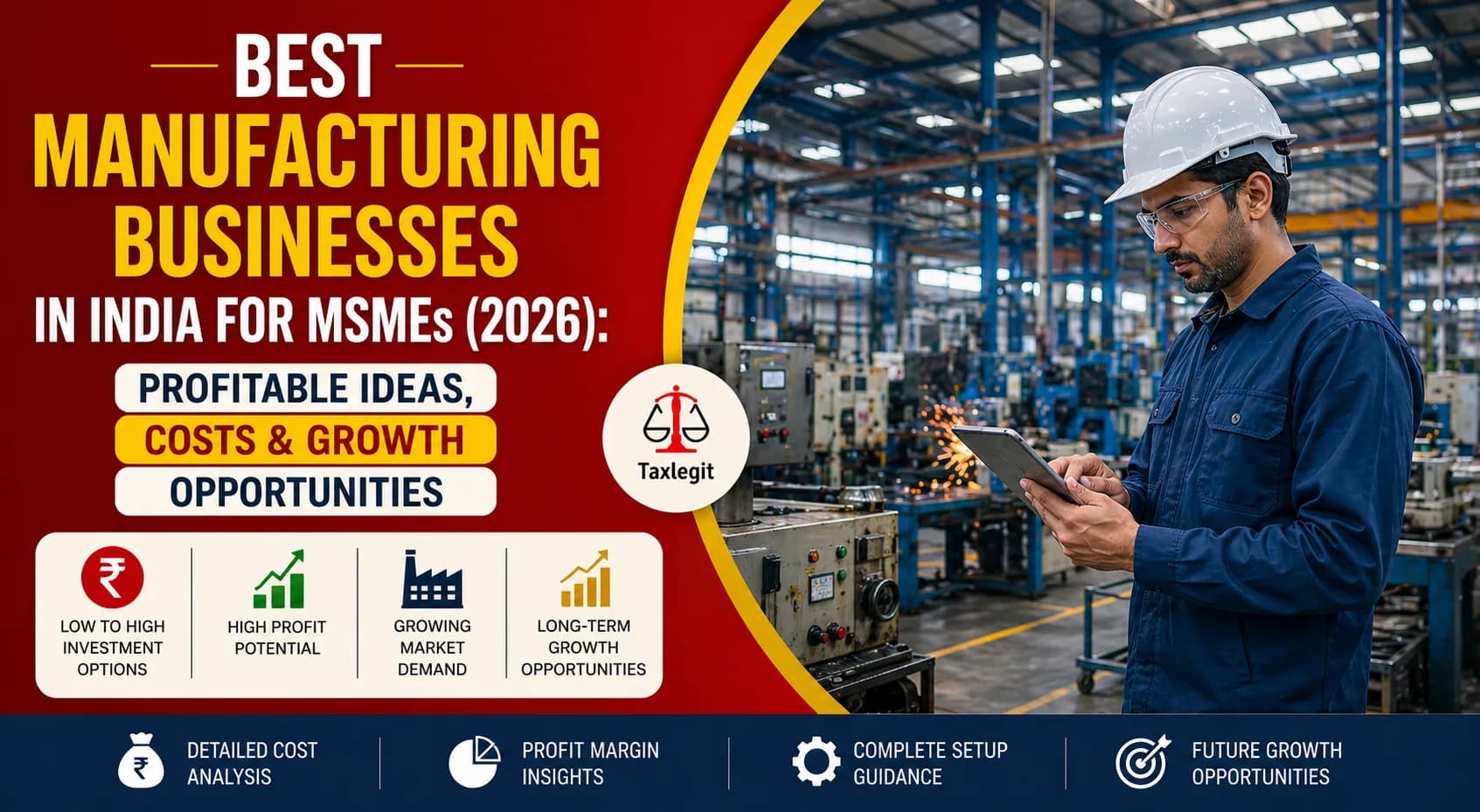
With India’s manufacturing sector recording a Gross Value Added (GVA) growth of 9.13% in the recent quarters of FY 2025-26, the MSME (Micro, Small, and Medium Enterprises) sector is the undisputed engine of this growth. Manufacturing businesses in India are booming for MSMEs in 2026, driven by strong demand, government support (Make in India, PMFME, MSME schemes), and export opportunities.
With the right planning, factory license registration, GST and pollution compliance, and smart financing, even small‑scale manufacturing units can grow into profitable, export‑ready enterprises. This guide is your roadmap to the best manufacturing business ideas in India for MSME 2026.
Why Manufacturing Businesses Booming for MSMEs in India (2026)?
Manufacturing businesses in India generated an estimated ₹12.5 lakh crore in production and ₹4 lakh crore in exports by December 2024, while creating 9.5 lakh jobs. The Union Budget 2025‑26 raised the investment limits for micro (up to ₹2.5 cr), small (₹25 cr), and medium (₹50 cr) enterprises[Official Source: Union Budget 2025-26 MSME Investment Limits], making it easier for them to access credit and scale. Let's categorise these factors:
- The China+1 Strategy: Global brands are shifting supply chains to India. This has created a massive gap for local MSMEs to become Tier-2 and Tier-3 suppliers.
- Supply Chain Formalisation: With over 4.7 crore units registered on the Udyam portal as of April 2026, the unorganised sector is becoming professional, making it easier to get bank loans and government contracts.
- The Digital Push: E-commerce isn't just for traders anymore. Small manufacturers are now selling directly to global customers via B2B platforms, bypassing expensive intermediaries.
- At the same time, consumer trends, eco‑friendly packaging, health‑centric foods, and EV components are opening high‑margin niches that require modest capital but deliver strong returns
Key MSME Advantages:
- Easy Access to Credit: MSMEs can secure collateral-free loans from banks, with priority-sector lending guidelines ensuring greater access to credit.
- Lower Interest Rates: Registered MSMEs benefit from lower loan interest rates than non-registered enterprises.
- Protection Against Delayed Payments: Under the MSMED Act, 2006, if a buyer fails to pay within 45 days, the MSME is entitled to compounded interest (three times the bank rate).
- Subsidies on Intellectual Property: A 50% subsidy is available for trademark registration and up to 75% for patent registration, along with support for product certifications.
- Government Tender Preference: Registered MSMEs get preference in government procurement and tenders.
- Electricity Bill Concessions: Subsidies on electricity bills are available, along with exemptions from certain industrial licensing requirements.
- ISO Certification Reimbursement: MSMEs can get reimbursement for expenses incurred in obtaining ISO certifications.
- Easy Business Closure: Special provisions under the Insolvency and Bankruptcy Code facilitate faster business closure.
Top Government MSME Schemes (2026)
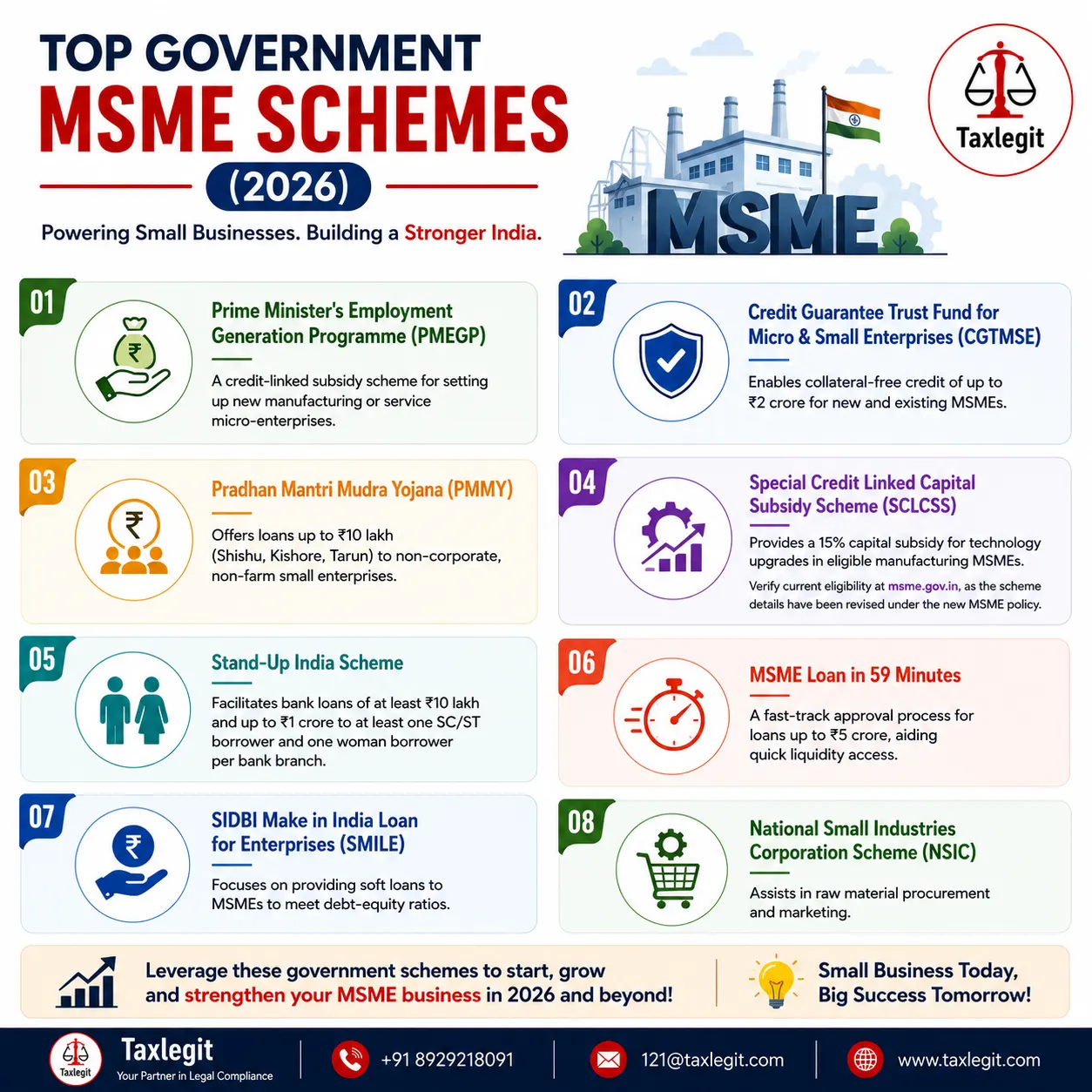
- Prime Minister's Employment Generation Programme (PMEGP): A credit-linked subsidy scheme for setting up new manufacturing or service micro-enterprises.
- Credit Guarantee Trust Fund for Micro & Small Enterprises (CGTMSE): Enables collateral-free credit of up to ₹2 crore for new and existing MSMEs.
- Pradhan Mantri Mudra Yojana (PMMY): Offers loans up to ₹10 lakh (Shishu, Kishore, Tarun) to non-corporate, non-farm small enterprises.
- Special Credit Linked Capital Subsidy Scheme (SCLCSS): Provides a 15% capital subsidy for technology upgrades in eligible manufacturing MSMEs. Verify current eligibility at msme.gov.in, as the scheme details have been revised under the new MSME policy.
- Stand-Up India Scheme: Facilitates bank loans of at least ₹10 lakh and up to ₹1 crore to at least one SC/ST borrower and one woman borrower per bank branch.
- MSME Loan in 59 Minutes: A fast-track approval process for loans up to ₹5 crore, aiding quick liquidity access.
- SIDBI Make in India Loan for Enterprises (SMILE): Focuses on providing soft loans to MSMEs to meet debt-equity ratios.
- National Small Industries Corporation Scheme (NSIC): Assists in raw material procurement and marketing.
Best Manufacturing Business Ideas in India for MSMEs: Low to High Investment
Choosing the right product is 50% of the battle. Here is a curated list of small-scale manufacturing businesses in India, categorised by investment levels.
Low Investment Manufacturing Businesses Under ₹10 Lakhs
You don’t need a massive plant to start. Some of the best home-based manufacturing businesses in India require minimal space and equipment.
1. Paper Bag Manufacturing: With the 2026 plastic-free mandates getting stricter, demand for paper bags is high, so seize the opportunity
- Investment: ₹2–5 Lakhs
2. Agarbatti (Incense Sticks) Making: A staple in Indian households and a massive export product. It is an all-time demand product.
- Investment: ₹1–3 Lakhs
3. Handmade Organic Soaps: People want chemical-free products. This is a growth-oriented business with low investment and low risk.
- Investment: ₹50,000 – ₹2 Lakhs
4. Spice Grinding & Packaging: India is the spice capital. Small units focusing on Pure & Unadulterated spices are in high demand. With appropriate packing tailored to the customer's needs, it can be a highly profitable, low-cost venture.
- Investment: ₹3–7 Lakhs
5. Biodegradable Cutlery: Think plates made from areca leaves or sugarcane bagasse, and you are all set for a high-profit business with a very low investment.
- Investment: ₹5–9 Lakhs.
Medium Investment Manufacturing Business Ideas (₹10–50 Lakhs)
If you have a slightly higher budget, you can enter technical or high-demand consumer goods.
6. EV Charging Station Components: As EVs become the norm in 2026, someone needs to make the cables, casings, and plugs.
7. Solar Panel Assembly: With the Indian government’s push for renewable energy, this is a highly profitable, high-demand industry in India.
8. Nutraceuticals (Health Supplements): Post-pandemic health awareness has made protein powders and vitamins a daily essential. It is a highly growing business opportunity in India.
9. Pet Food Production: The Indian pet care market is growing at 20% CAGR. High-quality local pet food is in short supply; there is significant growth in pet food products in India.
10. Corrugated Box Manufacturing: Every e-commerce order needs a corrugated box. This is the backbone of the logistics industry. In India, this business is in high demand.
High-Growth Manufacturing Sectors in India ( ₹50 Lakhs+ )
If you are looking for the future of small-scale manufacturing business in India, keep your eyes on these specific Sectors:
11. Electronics & Semiconductor Components: Thanks to PLI schemes, manufacturing small PCBs (Printed Circuit Boards) or sensors is incredibly lucrative.
12. Medical Devices: Manufacturing basic disposables like syringes, IV sets, or digital thermometers.
13. Bamboo & Sustainable Textiles: Eco-friendly fashion is no longer a niche; it’s the mainstream export-oriented manufacturing business in India.
Most Profitable Manufacturing Businesses in India (High ROI List)
| Business Idea | Approx. Margin | Why it's Profitable in 2026 |
| Customized Jewellery | 30% - 40% | High value, low shipping cost for global exports |
| Technical Textiles | 20% - 25% | Used in agriculture, healthcare, and construction. |
| Ayurvedic Products | 35% - 50% | There is a huge trust in Indian traditional medicine globally. |
| Food Processing (Frozen) | 15% - 25% | Urban India's demand for "Ready-to-Cook" is peaking. |
Step-by-Step Guide to Start a Manufacturing Business in India
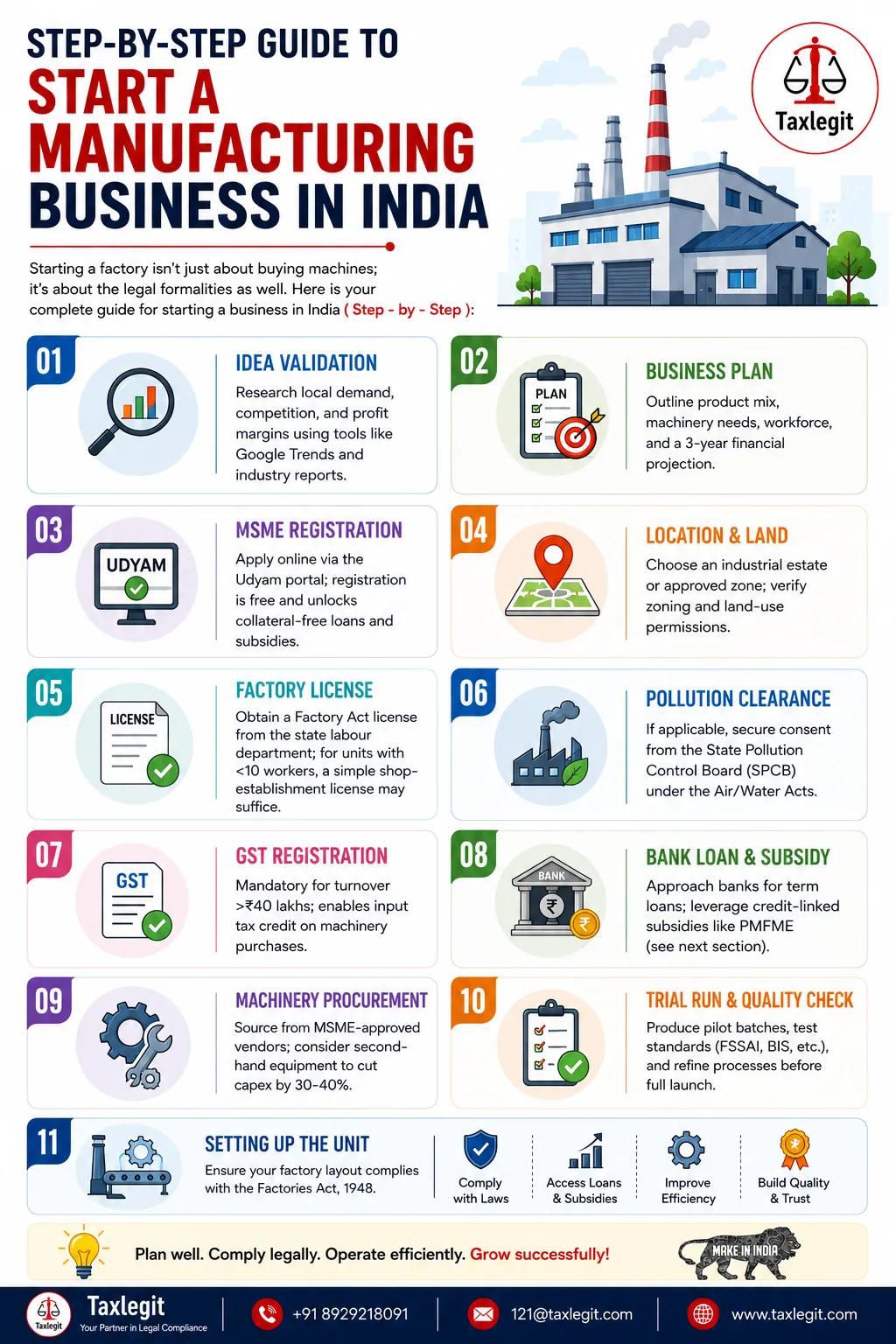
Starting a factory isn't just about buying machines; it’s about the legal formalities as well. Here is your complete guide for starting a business in India ( Step - by - Step ):
Step 1: Idea Validation
Research local demand, competition, and profit margins using tools like Google Trends and industry reports.
Step 2: Business Plan
Outline product mix, machinery needs, workforce, and a 3‑year financial projection.
Step 3: MSME Registration
Apply online via the Udyam portal; registration is free and unlocks collateral‑free loans and subsidies.
Step 4: Location & Land
Choose an industrial estate or approved zone; verify zoning and land‑use permissions.
Step 5: Factory License
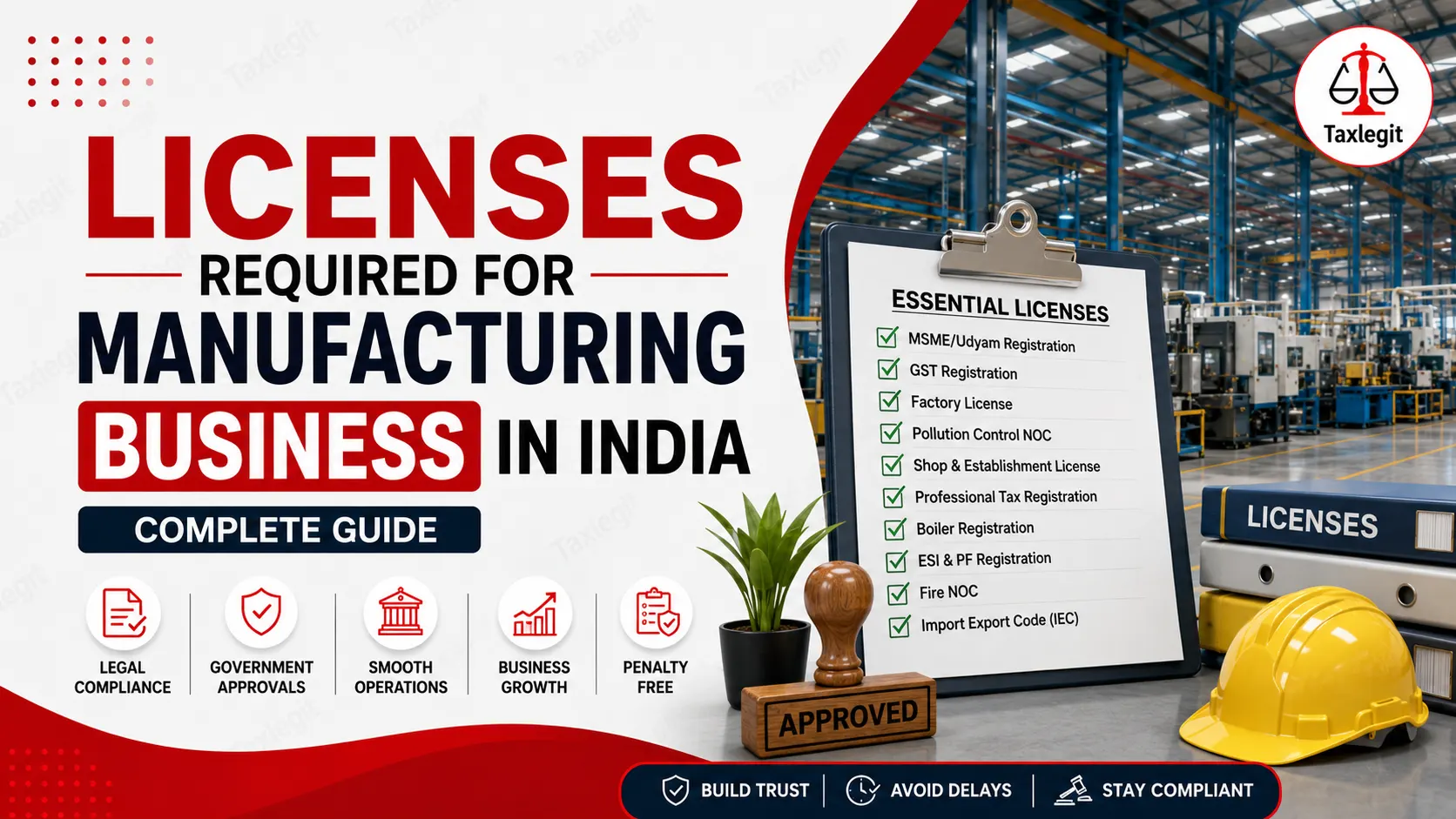
Obtain a Factory Act license from the state labour department; for units with <10 workers, a simple shop‑establishment license may suffice.
Step 6: Pollution Clearance
If applicable, secure consent from the State Pollution Control Board (SPCB) under the Air/Water Acts.
Step 7: GST Registration
Mandatory for turnover >₹40 lakhs; enables input tax credit on machinery purchases
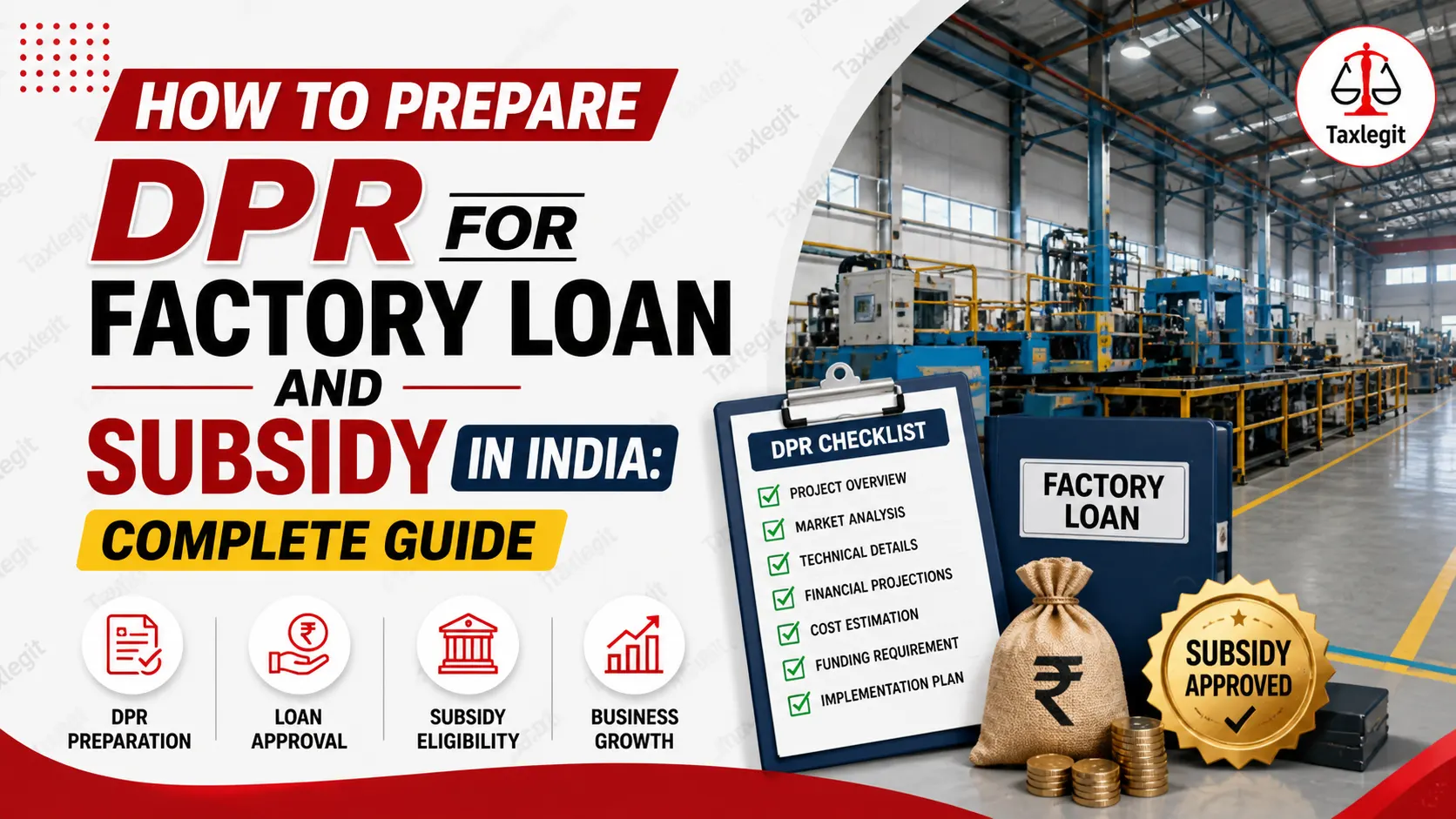
Step 8: Bank Loan & Subsidy
Approach banks for term loans; leverage credit‑linked subsidies like PMFME (see next section).
Step 9: Machinery Procurement
Source from MSME‑approved vendors; consider second‑hand equipment to cut capex by 30‑40 %.
Step 10: Trial Run & Quality Check
Produce pilot batches, test standards (FSSAI, BIS, etc.), and refine processes before full launch.
Step 11: Setting up the Unit
Ensure your factory layout complies with the Factories Act, 1948.
Why choose Taxlegit for MSME loan schemes and MSME registration?
Our experts at Taxlegit will guide you through:
- Expert end‑to‑end MSME setup: Udyam, factory licenses, GST, FSSAI/BIS, pollution clearances
- Deep knowledge of subsidies & schemes: PMFME, CGTMSE, Make‑in‑India PLI, state incentives
- Custom business plans & financial models for banks & government applications
Frequently Asked Questions ( FAQs )
Q1: What is the most profitable small manufacturing business?
A: Agarbatti, candle making, and millet‑based snack units have shown net margins of 20‑30 % with low startup costs.
Q2: How much investment is required to start a manufacturing business?
A: You can begin with under ₹10 lakhs for items like paper bags or soaps; medium‑scale food processing may need ₹10‑50 lakhs; automated lines often exceed ₹50 lakhs.
Q3: Which manufacturing business has the highest demand in India?
A: Eco‑friendly packaging, health‑centric foods (nutri‑cereals, protein snacks), and EV‑related parts are experiencing double‑digit YoY growth.
Q4: What subsidies are available for MSME manufacturers?
A: PMFME offers a 35 % subsidy (up to ₹10 lakh); CGTMSE provides loan guarantees; state schemes offer tax rebates and power concessions.
Q5: Can I run a manufacturing unit from home?
A: Yes, low‑risk activities like candle making, soap making, and snack packing are permissible under home‑based MSME rules, provided you meet local zoning and safety norms.
Conclusion
The manufacturing landscape in 2026 is full of opportunities. With the SME Growth Fund, rising PMI indices, and a robust digital infrastructure, starting an MSME manufacturing unit is a high-ROI move. Focus on quality, stay compliant, and leverage government subsidies to build a resilient business.
Contact Taxlegit today for end‑to‑end support, from MSME registration and license acquisition to subsidy applications and growth strategy. Let’s build your factory together.
About the Author

Aabha Garg
Content Writer
Aabha Garg is a TESOL-certified trainer and Lead Content Strategist at Taxlegit with 5+ years of experience. She simplifies complex topics like company registration, GST, and compliance into clear, practical insights for businesses. Reviewed by Vipul Sharma, Co-Founder, Taxlegit.