
As more US businesses look to scale their operations, learning how to maintain strict data security while outsourcing accounting work has become a non-negotiable priority. Moving financial operations to a third party doesn't have to mean compromising your clients' sensitive information. Here is how to keep your data locked down this year
Who This Guide Is For
Meet David, a composite example of a modern business owner. He wanted to capture the substantial cost efficiencies of offshore accounting, but handing over his company’s bank credentials and payroll data kept him up at night. Every vendor pitched "SOC 2 certified" like a magical shield, but David wanted proof, not sales talk. He needed to know exactly how to verify a partner’s security protocols and what happens if things go wrong.
If you're a business owner or controller like David who wants the cost savings of outsourced accounting but loses sleep over handing bank credentials, payroll data, and tax records to a third party, this guide is for you.
We will show you exactly how to protect your sensitive financial infrastructure without ever sharing raw passwords or primary bank credentials.
Why This Matters
The Problem: Businesses either avoid outsourcing entirely out of security fear, missing real cost savings, or outsource based on a badge on a website without verifying what's actually behind it.
The Bottom Line: Data security in outsourced accounting is not the provider's job alone. It is a shared responsibility that only works if you verify their controls, define them in a contract, and maintain oversight after you sign.
The Blueprint: This guide breaks down the certifications that actually matter, the technical controls to verify, the legal protections you need in writing, and what to do if a breach happens anyway.
To maintain data security while outsourcing accounting in 2026, verify your provider holds a current SOC 2 Type II report (not Type I, and not just ISO 27001 alone), confirm they enforce multi-factor authentication, role-based access control, and end-to-end encryption using AES-256 and TLS, and get data ownership, breach notification timelines, and data return protocols written into your contract, not just promised verbally.
The stakes are real: According to the IBM Cost of a Data Breach Report, the average cost of a data breach for organizations in the US reached an all-time high of $10.22 million. Furthermore, third-party and supply-chain vulnerabilities have become a massive point of exposure, now accounting for 30% of all data breaches globally (a figure that doubled year-over-year, according to the Verizon Data Breach Investigations Report).
The Golden Rules of This Decision: Never accept a certification claim without seeing the actual audit report and its date. And never sign an outsourcing contract that doesn't explicitly state who owns the data, how a breach is reported, and how your data is returned or destroyed at the end of the engagement.
Why Is Data Security So Hard to Get Right When Outsourcing Accounting?
This is difficult because most businesses evaluate security the same way they evaluate price: by taking the provider's word for it. Many firms treat security as a checklist rather than a system they confirm a certification exists, then assume responsibility has transferred entirely to the vendor. It hasn't.
The mistake most businesses make is assuming the responsibility transfers the moment a contract is signed, when in reality data security in outsourcing is a shared, ongoing obligation.
This guide gives you the certifications that actually matter, the technical controls to verify directly, the legal protections your contract needs, and a plan for what to do if something goes wrong regardless.
What Certifications Should You Actually Verify?
SOC 2 is an independent attestation framework developed by the AICPA for managing and securing customer data, evaluated against up to five Trust Services Criteria: security, availability, processing integrity, confidentiality, and privacy. For US businesses outsourcing accounting, a current SOC 2 Type II report should be treated as a baseline standard for evaluating a vendor's security, not as an optional "add-on."
The distinction between Type I and Type II matters enormously, and providers will sometimes blur it:
- Type I report: Evaluates whether security controls are designed appropriately at a single, specific point in time.
- Type II report: Confirms those controls were actually followed consistently over a testing period of several months (typically six to twelve).
Because SOC 2 is an attestation of a vendor’s custom internal controls rather than a rigid, one-size-fits-all technical "certification," simply having a report is not enough. To truly verify a provider’s security, you must request and review the actual document.
Pay close attention to:
- The Report Period: Ensure the testing period is current, and there are no significant "coverage gaps" between the report end date and your contract start date.
- The Scope: Verify that the specific systems, physical locations, and software platforms handling your accounting data are actually included in the audit Auditor's Reputation: Ensure the report was issued by an independent, accredited CPA firm.
- Exceptions and Deviations: Flip to the detailed testing section to see what controls failed during the audit period and assess whether those exceptions expose your sensitive PII (Personally Identifiable Information) or tax data.
Don't accept a badge or a certificate as proof. Request the actual audit documentation, review the scope of what was tested, and check for any noted exceptions or remediation plans. If a provider can't produce this or seems unfamiliar with what it covers, treat that as a direct red flag about their operational maturity.
ISO 27001 ( A Strong Complement, Not a Substitute )
ISO 27001 is a global information security management standard, and it is often mentioned alongside SOC 2 as if the two were interchangeable. In reality, they answer different assurance questions:
- ISO 27001: Focuses on whether a company has a robust, systematically managed Information Security Management System (ISMS) in place. It certifies that management processes, risk-assessment frameworks, and security policies are properly structured and continuously improved.
- SOC 2 Type II: Focuses on the actual, operational effectiveness of specific security controls over a defined period of time.
Because they validate security from different angles, many US buyers prefer to see both
IRS Section 7216 ( The Rule Most Businesses Miss )
If your outsourcing arrangement touches tax return preparation in any way, this federal requirement applies regardless of how strong the provider's technical security is. IRS Section 7216 requires the taxpayer's prior written consent before a preparer discloses or uses tax return information through a third party, and this is not a minor technicality a knowing or reckless violation is a misdemeanour carrying a fine of up to $1,000, up to one year in prison, or both, per violation.
Because compliance is nuanced, it is important to understand the distinct legal exposures and exceptions:
- Criminal Penalties (Section 7216): A knowing or reckless violation is a federal misdemeanor that carries a criminal fine of up to $1,000, up to one year in prison, or both, per violation.
- Civil Penalties (Section 6713): Separate from criminal charges, Section 6713 imposes a civil penalty of $250 per unauthorized disclosure or use (up to a $10,000 calendar-year cap).
- Regulatory Exceptions: Under Treasury Regulation $301.7216-2, certain limited disclosures are permitted without prior consent
Because the applicability of Section 7216 depends heavily on the specific services, location of the partners, and exact workflows involved, you should confirm this consent process is built into your provider's workflow before any tax data moves through a third party.
What Technical Controls Should Be in Place?
Certifications tell you a provider was audited. These technical controls tell you what that audit actually verified. Confirm all of the following directly, not through a sales conversation.
Multi-factor authentication (MFA) on every account: MFA gates all system access, preventing unauthorized login even if credentials are stolen
Encryption in Transit and at Rest: Verify your provider secures financial data both in transit and at rest using industry standards like TLS 1.2+ and AES-256. Do not confuse this with true end-to-end encryption (E2EE), which is rare in collaborative accounting.
Role-based access control (RBAC): Access should be granted only to people who need it for their specific role, with strict limits on who can download, modify, or share files. Ask specifically how access is provisioned and, just as importantly, how quickly it's revoked when someone leaves the provider's team.
Zero Trust architecture: This is increasingly replacing older VPN-based models. Zero Trust verifies identity, device security, and session details every time before granting access to accounting systems or client data, rather than trusting anyone already inside the network.
Secure Virtual Environments and Data Loss Prevention (DLP)
Using a Virtual Desktop Infrastructure (VDI) and disabling local downloads are excellent security measures, but they are risk-based options rather than universal requirements or a perfect fit for every workflow. If you choose this route, ensure that your data access happens within a monitored, secure cloud environment where local saving is restricted.
Daily backups and tested disaster recovery: Reliable providers back up all data in encrypted formats and test recovery protocols regularly, not just in theory ask when their disaster recovery plan was last actually tested, not just written.
Employee background checks and NDAs: Outsourced staff should be screened before hiring and operate under strict non-disclosure agreements and a documented code of conduct, including staff based offshore.
What Should Your Contract Explicitly Require?
Verbal assurances are not enforceable. Every one of the following needs to be written into the service agreement before you share any data.
| Contract Element | What It Must Specify | Red Flag if Missing |
| Data ownership | Explicit statement that you retain full ownership of all data at all times | Ambiguous language about shared or provider-retained rights |
| Breach notification | Maximum hours to notify you of a suspected or confirmed breach | No defined notification timeline |
| Incident response plan | Documented containment, root-cause analysis, and communication steps | The provider has no written plan, only informal assurances |
| Data return and destruction | Process and timeline for returning or securely destroying your data at contract end | No mention of what happens to your data after the relationship ends |
| Audit rights | Your right to request updated SOC 2 reports and conduct periodic security reviews | The provider resists ongoing verification after the initial sale |
| Sub-processor disclosure | Full disclosure of any third parties or offshore locations that will touch your data | Vague references to "our team" without specifying location or vendors |
| IRS 7216 consent workflow | Documented process for obtaining taxpayer consent before any tax data moves to a third party | No mention of 7216 if tax preparation is part of the scope |
Contracts should require adherence to SOC 2, ISO 27001, and other relevant standards, and specify evidence of compliance as part of ongoing service delivery not just at the point of signing.
What Is the Step-by-Step Process for Vetting a Provider on Security?
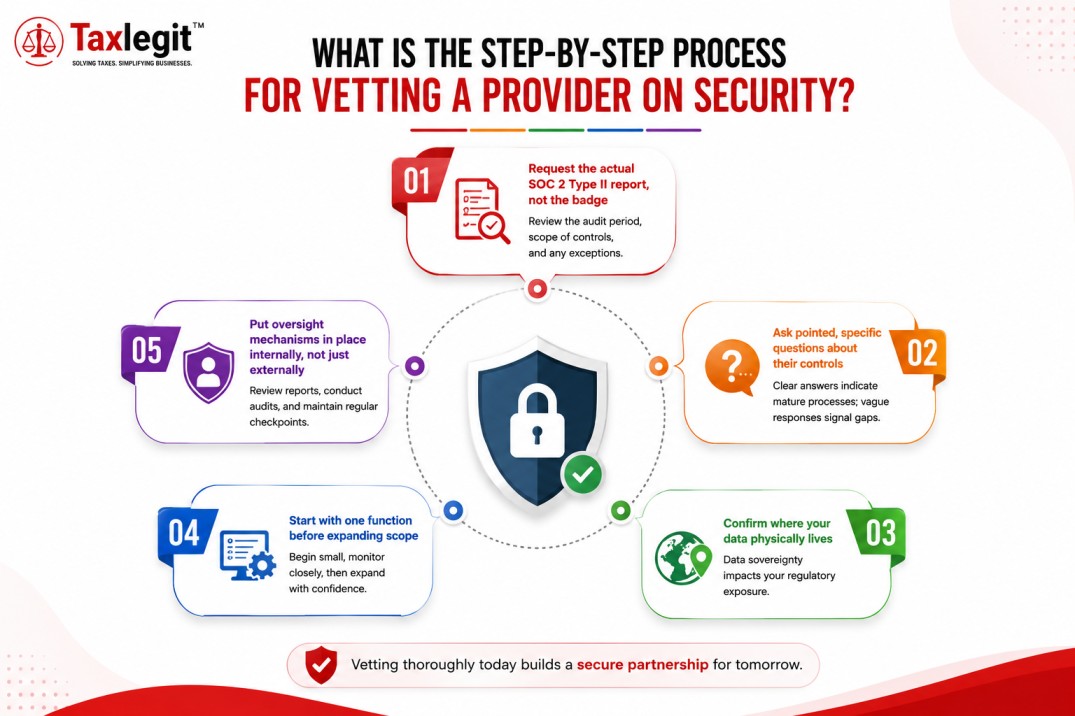
Run these five steps in order before any data changes hands:
1. Request the actual SOC 2 Type II report, not the badge: Review the audit period, the scope of controls tested, and any noted exceptions. Verification should always be evidence-based, not assumption-based.
2. Ask pointed, specific questions about their controls: Vague or generic answers about "strong security" are a signal, not a reassurance. Clear, structured answers indicate mature processes; vague responses often signal real gaps.
3. Confirm where your data physically lives: Different countries carry different data privacy laws, and data sovereignty directly affects your regulatory exposure if a provider stores or processes data outside the US.
4. Start with one function before expanding scope: Begin with a single process, such as AP processing, monitor the outcome closely, and expand only after verifying the controls hold up in practice.
5. Put oversight mechanisms in place internally, not just externally: Assign an internal team member to review reports regularly, conduct periodic audits, and maintain scheduled checkpoints with the provider security oversight doesn't end once the contract is signed.
What Ongoing Practices Keep Data Secure After You've Signed?
Security verification isn't a one-time event at onboarding. It needs to continue for the life of the relationship.
- Reassess on a fixed schedule: Most firms should audit their provider's cybersecurity policies at least annually; higher-risk data profiles warrant quarterly reviews, with additional reviews triggered by major system changes, incidents, or new regulations.
- Train your own internal staff, not just the provider's: Your team needs to understand how to interact securely with the outsourced team, particularly around email and file exchange a secure provider doesn't protect you if your own staff emails unencrypted files or falls for a phishing attempt targeting the relationship.
- Anonymize data where the use case allows it: For certain tasks, remove personally identifiable information or use aggregated data instead of full records before sharing with the provider, reducing exposure even if a breach occurs somewhere in the chain.
- Test the incident response plan before you need it: A breach plan that has never been rehearsed tends to fail exactly when it matters. Confirm containment steps, notification protocols, and root-cause analysis procedures are tested, not just documented.
What Are the Most Common Mistakes Businesses Make?
- Treating certifications as sufficient on their own: Certifications are strong indicators, but they are not sufficient by themselves a provider can hold a badge while its actual workflows and data-handling practices still carry gaps.
- Assuming responsibility transfers entirely to the vendor: This is the single most common and most costly mistake.
- Overlooking IRS Section 7216 when tax data is involved: Businesses often verify SOC 2 and ISO 27001 diligently while completely missing the federal consent requirement specific to tax return information, exposing them to criminal penalties that security certifications don't cover.
- Skipping the sub-processor question: A provider may itself outsource part of the work to another vendor or offshore team without disclosing it clearly.
- Treating oversight as a one-time onboarding task: Security posture changes over time, staff turns over, and threats evolve. The risk associated with data increases over time, which is exactly why annual or quarterly reassessment matters more than the initial vetting.
Case Study: Trust, But Request the Audit Report
The Reality Check: Sarah, the owner of a Denver-based CPA firm in this composite example, was eager for back-office relief but deeply concerned about data security. When she shortlisted three offshore bookkeeping providers, she demanded their actual, current independent SOC 2 Type II attestation reports not just their marketing brochures.
She verified that the specific cloud platforms handling her clients' bookkeeping were included in the audit, checked for any systemic testing exceptions, and confirmed that the provider's controls successfully met her firm's internal risk management requirements.
The Turnaround: The result was eye-opening: two of the three firms failed to produce the documentation. Sarah didn't dive in headfirst; she initiated a strict 90-day trial restricted solely to accounts payable processing, backed by internal weekly reviews. Only after their security controls proved flawless in practice did she expand their scope to full bookkeeping and payroll.
The Takeaway: Never settle for verbal promises of compliance. Ask for hard evidence, test the workflows in isolation, and protect your clients from becoming a breach statistic.
How Does TaxLegit Help US Businesses Outsource Accounting Securely?
TaxLegit works with US businesses in the $1M–$15M revenue range that want the efficiency of outsourced accounting without compromising on data security. We help with:
- Verified SOC 2 Type II controls with documentation available on request
- Role-based access, MFA, and VDI-based data handling with no local downloads
- IRS Section 7216-compliant workflows for any engagement involving tax return data
- Contract terms that clearly define data ownership, breach notification, and data return protocols
For a broader look at what to check before choosing any accounting outsourcing partner, see our guide on how to choose the right accounting outsourcing partner.
| Ready to vet your next accounting partner properly?[Click here to schedule your free security and compliance review] and get a custom assessment within 48 hours.🌐 Prefer to reach out directly? Email us: [email protected] OR Call or WhatsApp: +91 89292 18091 (Available across all US time zones) |
Disclaimer: This article is for informational purposes only and does not constitute legal, tax, or cybersecurity advice. Data security regulations, certification standards, and breach cost figures change frequently. Consult a qualified CA, data privacy attorney, or cybersecurity professional for guidance specific to your business before entering any outsourcing agreement.
Frequently Asked Questions
Not for high-risk financial data. A Type I report only evaluates whether controls were designed appropriately at a single point in time, while a Type II report confirms those controls were actually followed consistently over 6 to 12 months. Treat Type I as a starting point only, and ask when the Type II examination will be complete.
Not inherently. Research shows outsourcing risk is driven primarily by control and oversight, not geography — a domestic provider with weak controls is riskier than an offshore provider with strong, independently verified ones. What matters is whether the same security standards travel with the data everywhere it goes.
This depends entirely on what your contract specifies. A properly structured agreement should define a maximum breach notification window, a documented incident response and containment process, and a clear communication plan. If none of this is in writing, you have no enforceable recourse beyond the provider's goodwill.
No, but it does mean the data is accessed and processed by a third party. With proper SLAs, version control, and regular oversight, you retain decision-making authority while outsourcing the operational execution. Control is restructured, not eliminated.
No, Section 7216 specifically applies to tax return preparers disclosing or using tax return information through a third party. If your outsourcing arrangement is limited to bookkeeping or AP with no tax return preparation involved, this specific requirement doesn't apply, though general data protection obligations still do.
Most firms should conduct a security audit of their provider at least annually, with quarterly reviews recommended for higher-risk data profiles, plus additional reviews triggered by major system changes, security incidents, or new regulatory requirements.
About the Author

Srijita
Content Writer
Srijita is a legal and financial content specialist with 5+ years of experience in the Indian corporate sector. She simplifies MCA regulations and tax compliance into clear, actionable insights for entrepreneurs, working closely with Chartered Accountants and legal experts to ensure accuracy and compliance. Reviewed by Vipul Sharma, Co-Founder, Taxlegit.