
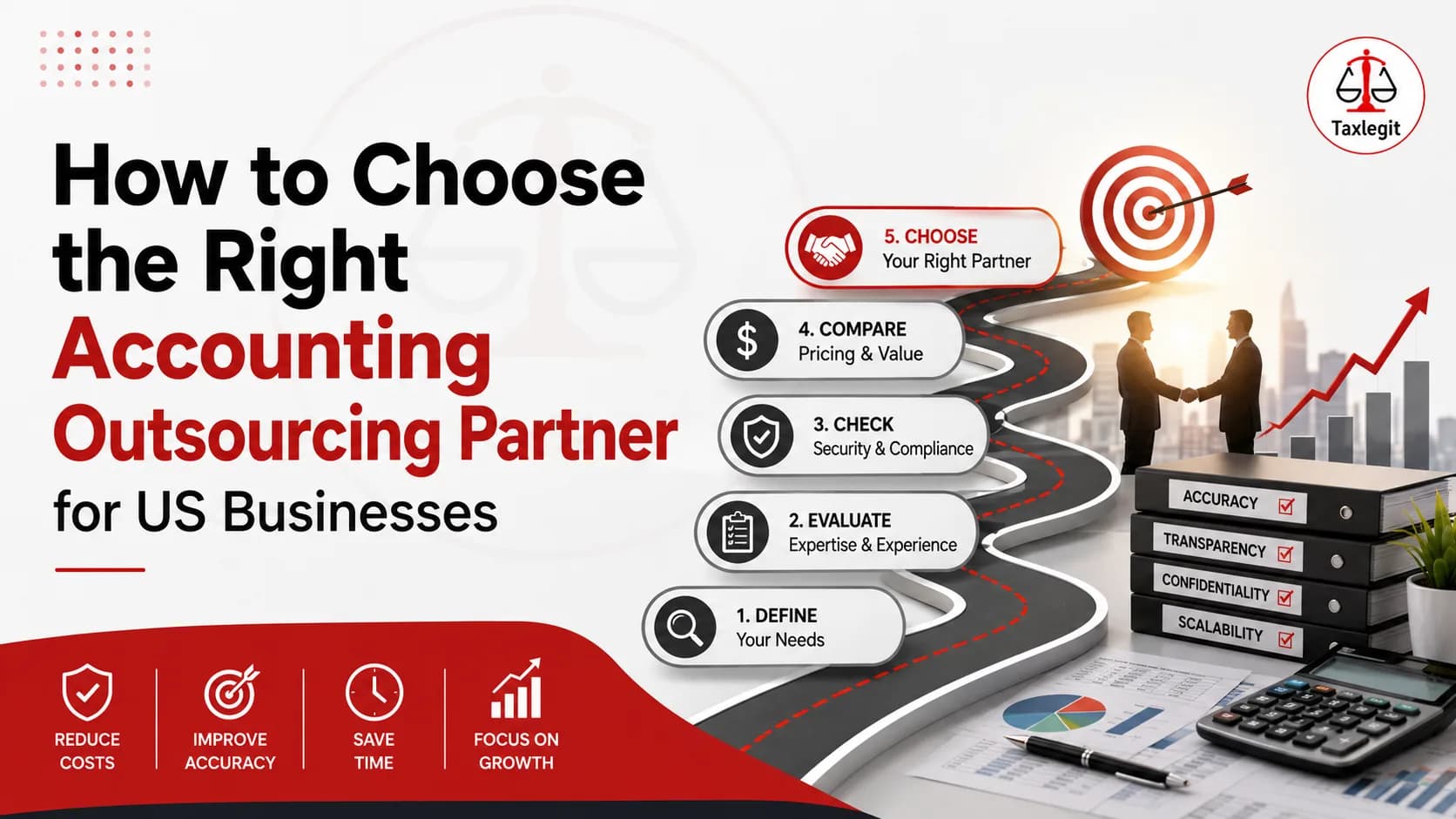
Who This Guide Is For
If you are a business owner feeling anxious about disorganized financials, missing tax deadlines, or wondering if your current low-cost bookkeeping setup is putting your business at risk, you are in the right place. This guide is written for growing companies that want to establish institutional-grade financial oversight and avoid the common compliance pitfalls that stall scaling businesses.
The True Cost of Cheap Bookkeeping: An Anonymized Case Study
To understand how a low-cost financial setup can backfire, it helps to look at a real-world scenario. We recently stepped in to manage the emergency financial cleanup for an e-commerce brand. Their experience highlights why cut-rate financial services often cost more in the long run.
The Background:
The company had outsourced its accounting to a basic, high-volume bookkeeping provider for $400 per month. For this fee, the provider promised standard monthly ledger updates and basic state sales tax filings.
The company had outsourced its accounting to a basic, high-volume bookkeeping provider for $400 per month. For this fee, the provider promised standard monthly ledger updates and basic state sales tax filings.
The Failure Points:
As the brand scaled across multiple states, the low-cost provider failed to keep pace with the increasing operational complexity:
- Missed Deadlines: The service failed to monitor shifting economic nexus thresholds, missing critical state sales tax deadlines across three high-volume states over nine months.
- Ledger Errors: Inventory management was poorly tracked, resulting in a systemic misclassification of Cost of Goods Sold (COGS) and severely distorted profitability metrics.
By investing in professional, proactive financial oversight from the start, businesses can prevent these structural errors entirely, protecting both their daily operations and their future valuation.
To choose the right accounting outsourcing partner, look beyond data entry. Opt for specialized firms offering fractional infrastructure, GAAP-compliant accrual accounting, and verified security measures like a current SOC 2 Type II report where relevant. Avoid rigid staffing agencies; instead, prioritize providers with clear communication SLAs. Transitioning to an outsourced model can reduce back-office overhead by up to 40% based on average client case studies.
The Golden Rules of Transition: Always run a 30-day parallel period before fully cutting ties with your old system. Never filter by price alone—the cost of cleaning up a cheap provider's mistakes will always dwarf their initial discount.
How to Choose an Accounting Outsourcing Partner
Choosing the right accounting partner requires balancing domain expertise with operational security. The ideal partner must understand US GAAP compliance, seamlessly integrate with your existing tech stack, and protect your data with strict security protocols. Ultimately, the right choice isn't just a scalable extension of your financial operations that mitigates risk and guarantees predictable delivery.
Choosing the right accounting partner comes down to six non-negotiable criteria:
- US GAAP Expertise: Fully verified knowledge of US accounting standards.
- Ironclad Security: Certified SOC 2 Type II data protection.
- Tech Compatibility: Seamless integration with your existing software stack.
- Strict SLAs: Clearly defined monthly close dates and deliverables.
- Transparent Pricing: Predictable flat-fee models with no hidden costs.
- Social Proof: Referenceable US clients operating within your specific industry.
The Golden Rules of Transition: Always run a 30-day parallel period before fully cutting ties with your old system. Never filter by price alone the cost of cleaning up a cheap provider's mistakes will always dwarf their initial discount.
Why Is Choosing an Accounting Outsourcing Partner So Difficult to Get Right?
Finding a good accounting partner is difficult because the market is crowded. For every trustworthy company with verified US accounting training and strong data security, there are a dozen others with great-looking websites and low prices that make promises they cannot keep.
You have good reason to be cautious. Industry data consistently shows that while cost savings drive companies to outsource, poor quality work and service gaps are the leading reasons businesses fire their providers within the first year.
Unfortunately, these mistakes usually don’t show up until tax season or when an investor requests to see the books. Ask any certified CPA, and they will tell you the same thing: the forensic accounting fees required to clean up a cheap provider's mistakes will almost always dwarf whatever initial discount they gave you.
This guide gives you a simple, six-step process to check providers, a checklist to verify their claims, a clear cost and timeline breakdown, and the four specific questions you need to ask to avoid an expensive mistake.
What Is the Step-by-Step Process for Choosing the Right Accounting Outsourcing Partner?
Run these six steps in order. Skipping any of them, especially the security check and the parallel run, is where most onboarding problems originate.
Step 1: Audit Your Own Financial Bottlenecks Before Talking to Anyone
Most businesses approach this conversation with a vague brief: 'We need help with our books.' That ambiguity leads to scoped-wrong proposals and surprise fees when the actual complexity becomes clear. Before your first discovery call, answer three questions in writing:
- What is breaking right now? Overdue reconciliations, late closes, tax deadline stress, payroll errors list them specifically, not generally.
- What level of service do you need? Basic transactional bookkeeping (receipts, bank feeds, reconciliation), full-service accounting (payroll, tax prep, monthly close), or strategic advisory (fractional CFO, cash flow forecasting, board reporting).
- What is your transaction volume? Approximate monthly transactions, number of bank accounts, number of entities, and number of states you operate in. This determines pricing tier and staffing depth providers need it to quote accurately.
Our outsourced accounting service covers all three levels; knowing which one applies to you before the call means you get a meaningful proposal, not a placeholder quote.
Step 2: Run a Structured Discovery Call ( Not a Sales Conversation )
Do not evaluate providers based on their website or their pitch deck. Evaluate them on how they handle a 30-minute discovery call. A provider worth partnering with will do three things in that call that a data-entry shop will not:
- Ask to see your current chart of accounts or a recent balance sheet before offering a price. They need to understand your complexity, not just your headcount
- Ask about your software stack; not to pitch a switch, but to confirm compatibility and integration depth.
- Ask about your reporting requirements: investor-grade GAAP reporting, board packages, or basic monthly P&L because the staffing and review structure required is different for each.
If the call is primarily about their credentials and packages without meaningful questions about your situation, that is not a partnership conversation. That is a sales script.
| Marcus's test: In his first discovery call, he asked: 'If we find a misclassified expense six months in, what is your correction process and turnaround time?' A serious provider answered in 90 seconds with a specific SLA. The other two gave a three-sentence marketing answer. The choice narrowed immediately. |
Step 3: Run the Security and Compliance Verification ( Non-Negotiable )
You are handing over banking credentials, payroll records, tax IDs, and vendor payment histories. Data security is not a nice-to-have. It is a threshold requirement.
Security Vetting Checklist:
Before signing, verify these four operational security safeguards with your prospective provider:
- SOC 2 Type II certification: Confirm they hold a current SOC 2 Type II report which is an independent attestation of sustained security over an examination period, not a one-time certification. Inspect the report's audit period, scope, auditor credentials, and any noted exceptions.
- Multi-factor authentication (MFA): Ensure MFA is strictly required across all employee workstations accessing client systems, rather than left as an optional user setting.
- Virtual desktop infrastructure (VDI): Evaluate their data isolation controls. Reputable providers often utilize Virtual Desktop Infrastructure (VDI) or strict no-local-download policies so that financial files are not stored on local employee hard drives.
- Written data security protocol document: Request their formalized data security policy. Established firms maintain a prepared document; a delay or a promise to "put something together" indicates a lack of existing protocol.
Step 4: Review and Negotiate the Service Level Agreement (SLA)
The SLA is the most important document in the relationship. It is not a formality it is the only thing that creates accountability when something goes wrong. Do not sign a contract that does not have all four of these explicitly defined:
| SLA Element | What It Must Specify | Red Flag if Missing |
| Monthly close timeline | Exact calendar day books are delivered (e.g., by the 8th business day of the following month) | Vague language like 'within a reasonable timeframe' |
| Response time | Maximum turnaround for email or portal queries (e.g., within 24 US business hours) | No defined response commitment |
| Error correction policy | Turnaround time and process for fixing misclassified entries or reconciliation errors | The provider 'handles issues as they arise' with no timeline |
| Staff continuity | What happens if your dedicated accountant leaves handover process, transition period, no service gap | No mention of staff replacement or continuity plan. |
| Scope boundaries | Explicit list of what is not included historical cleanup, audit support, state tax filings, CFO work | Open-ended scope that invites surprise billing |
If a provider is reluctant to put specific turnaround times and error-correction commitments in writing, that reluctance tells you something important about how they handle errors in practice.
Step 5: Implement Least-Privilege Tech Integration Before Full Handover
Establish a strict permission matrix that grants read-only access where appropriate and limits ledger permissions to editor/accountant roles for data entry and reconciliation, while keeping all payment approvals and administrative access entirely separate.
Technical Onboarding & Access Control
Following contract execution, technical onboarding begins under a strict least-privilege access model. A professional firm manages this integration seamlessly to protect your daily operations, though you must actively govern permission levels from your side:
- Implement Segmented Access Controls: Provision read-only permissions for bank and credit card feeds, and restrict accounting software access to standard accountant or editor views.
- Synchronize Core Subledgers: Connect payroll and invoicing tools (e.g., Gusto, ADP) directly to your central ledger (e.g., QuickBooks Online, Xero) to establish automated data syncs.
- Establish Communication Channels: Designate a single primary channel such as email, a secure client portal, or Slack and clearly document the specific account owners responsible for your deliverables.
Onboarding Timeline Expectations: For a clean, supported cloud setup, this technical integration is designed to conclude within five business days without interrupting active close cycles or payroll runs. However, implementation timelines will scale and extend based on historical cleanup volume, custom ERP integrations, multi-entity complexity, or delayed platform access approvals.
Step 6: Run a 30-Day Parallel Period Before Full Transition
This is the step most businesses skip. During the first 30 days, have the outsourced team close out the current month while you or your internal staff monitor the output against your existing records. You are not double-checking because you do not trust them. You are doing it because this is the period when categorization preferences, communication rhythms, and reporting formats get calibrated to your business.
| What Marcus found: In his parallel month, the outsourced team flagged three expense categories that had been consistently miscategorized for 14 months including $12,400 in deductible R&D expenses that had been booked as general overhead. The parallel run paid for itself in the first 30 days. |
What Non-Negotiable Standards Must You Verify Before Signing?
These are the four threshold requirements. A provider who cannot satisfy all four is not a viable candidate, regardless of price.
1. Deep US Accounting and Tax Expertise
This is the most consequential gap to miss. A team that is competent at bookkeeping but unfamiliar with US-specific compliance will produce clean-looking books with expensive errors buried inside.
Our team's US GAAP expertise and CPA-reviewed reporting structure are detailed.
2. Enterprise-Grade Data Security
Request the written SOC 2 Type II audit report not the certificate, the report with the audit period date. Confirm MFA is the policy on all workstations, VDI is used for all client data access, and sensitive data is never transmitted via unencrypted email. The AICPA's SOC 2 framework is the authoritative reference for what these certifications actually require.
3. Tech Stack Compatibility and Automation Depth
Your provider should work inside your existing software QuickBooks Online, Xero, NetSuite, not require you to switch to a proprietary platform. Beyond the core accounting system, verify that they can connect your peripheral tools: payroll (Gusto, ADP), expense management (Ramp, Expensify), payment processors (Stripe, Shopify), and any industry-specific tools your business uses.
Automation depth matters here. A provider manually re-entering data that could sync automatically introduces both errors and delay. Ask specifically: 'What parts of our monthly workflow would still require manual data entry?'
4. Communication Structure and US Time-Zone Coverage
Outsourcing fails when communication breaks down. Before signing, get answers to these three questions in writing:
- Dedicated Support: Are you assigned a dedicated account manager, or do queries go into a shared queue?
- Time-Zone Overlap: What is the minimum overlap with US business hours for real-time questions?
- Escalation Path: What is the escalation path for urgent issues; a missed payroll run, a same-day investor data request, an IRS notice?
Three to four hours of direct US daytime overlap is the minimum for an offshore provider. Less than that, and urgent issues become next-day problems by default.
What Does Choosing the Right Partner Actually Cost and How Long Does Onboarding Take?
Here is a direct comparison of what to expect at each engagement level, including the timeline to first clean deliverable:
| Engagement Level | Monthly Cost Range | Onboarding Timeline | First Clean Deliverable |
| Basic bookkeeping (reconciliation + categorization) | $300–$800/mo | 1–2 weeks | Reconciled books by end of first close cycle |
| Full-service accounting (payroll + tax + monthly close) | $800–$2,500/mo | 2–4 weeks | GAAP-compliant monthly package within 30 days |
| Controller-level (multi-entity + board reporting) | $2,500–$5,000/mo | 3–5 weeks | Board-ready financial package within 45 days |
| Fractional CFO (strategy + forecasting + investor prep) | $3,000–$8,000/mo | 4–6 weeks | Cash flow model + investor package within 60 days |
| Historical clean-up (12+ months behind) | $1,500–$5,000 one-time | 4–8 weeks | Restated financials with reconciliation summary |
Core Pricing Scope & Assumptions
- What’s Included: Professional labor, primary ledger access (basic tiers), dedicated account oversight, and secure, encrypted document collection workflows.
- What’s Excluded: Premium enterprise software licenses (e.g., QuickBooks Online Advanced or NetSuite enterprise tiers), point-of-sale (POS) integration troubleshooting, third-party payment processing fees, and specialized multi-state tax litigation support. These are scope-dependent and billed directly or added as custom line items.
| Note: Onboarding timelines assume clean records. Businesses with significant backlogs or multi-entity complexity should expect the upper end of each range. Contact TaxLegit for a custom scoping estimate based on your transaction volume and entity structure. |
What Are the Most Common Mistakes Businesses Make When Choosing an Accounting Outsourcing Partner?
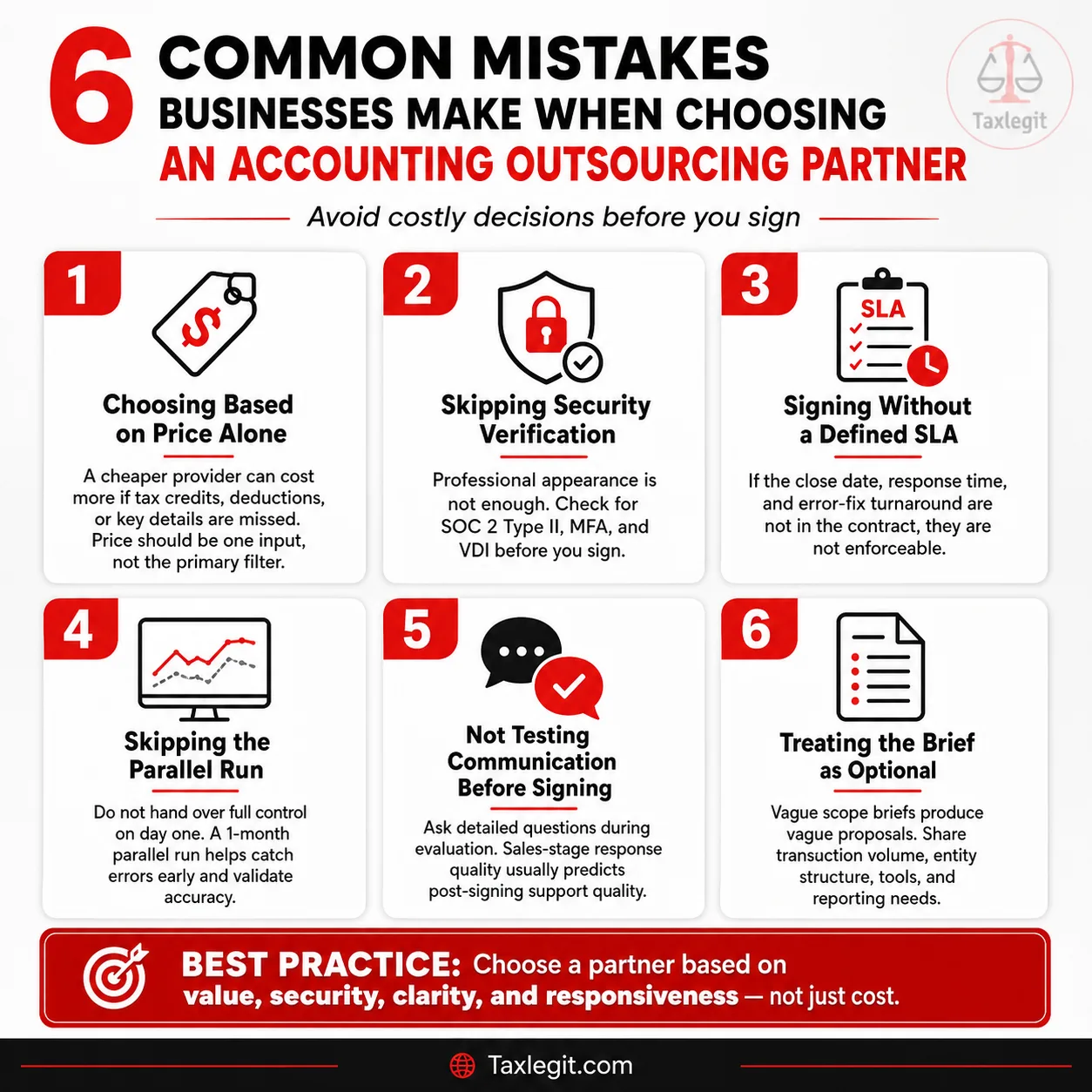
In our direct operational experience of onboarding more than 250 US entities into our system since TaxLegit’s inception in 2021, we have observed consistent operational friction points when companies transition away from poorly structured provider setups.
By combining these internal operational observations with broader, independent macroeconomic accounting market findings, we have mapped out the primary pitfalls buyers encounter:
- Choosing based on price alone: A provider who charges $200/month less and misses one deductible R&D credit costs you more than $2,400 in the first year. Price is one input, not the primary filter.
- Skipping the security verification: 'They seemed professional' is not a security protocol. SOC 2 Type II certification, MFA, and VDI are binary requirements.
- Signing a contract without a defined SLA: 'We'll close your books within a reasonable timeframe' is not an SLA. If the close date, response time, and error-correction turnaround are not in the contract, they are not enforceable.
- Skipping the parallel run: Handing over full control on day one means you have no baseline to validate accuracy against. One month of parallel operation costs almost nothing and catches categorization errors before they compound.
- Not testing communication before signing: Send a detailed question to the account manager during the evaluation process and see how long it takes to get a substantive answer. Response speed and quality during the sales process is the best predictor of response speed and quality after you sign.
- Treating the brief as optional: Vague scope briefs produce vague proposals. A provider who quotes without understanding your transaction volume, entity structure, and reporting requirements is guessing
What Should You Check Before Signing Any Outsourcing Contract?
Run every candidate through this checklist before a contract is signed. If a box is unchecked, don't sign until you get answers.
| Requirement | Verified? | Notes |
| Verified US client references in your revenue range | ☐ Yes ☐ No | Ask for two and actually call them |
| SOC 2 Type II certification with current audit report date | ☐ Yes ☐ No | Request the report, not the badge |
| MFA required on all employee workstations accessing client data | ☐ Yes ☐ No | Confirm this is enforced policy, not optional |
| VDI in place — no local downloads of client financial files | ☐ Yes ☐ No | Ask specifically how data is accessed and stored |
| Ask specifically how data is accessed and stored | ☐ Yes ☐ No | Licensed oversight at the top is non-negotiable |
| SLA with defined monthly close date, response time, error correction | ☐ Yes ☐ No | All three must be in the signed contract |
| Transparent flat-fee pricing with explicit scope exclusions | ☐ Yes ☐ No | No open-ended variable billing |
| Tech stack compatibility confirmed (QuickBooks/Xero/NetSuite) | ☐ Yes ☐ No | Integration test before full onboarding |
| Dedicated account manager assigned (not shared queue) | ☐ Yes ☐ No | Name of the person, not just the team |
| Minimum 3–4 hours US daytime overlap for offshore providers | ☐ Yes ☐ No | Confirm the working hours schedule in writing |
| 30-day parallel run included in the onboarding plan | ☐ Yes ☐ No | Non-negotiable; any pushback is a red flag |
What Does a Successful Outsourcing Partner Selection Actually Look Like?
The situation: A Dallas-based e-commerce business (seven-figure annual revenue, selling into 11 states) came to TaxLegit after a nine-month relationship with a previous provider ended when the provider missed four state sales tax nexus filings and was unable to produce a GAAP-compliant balance sheet when a growth equity investor requested one.
What went wrong: The previous provider had been selected primarily on price $400/month for full-service accounting. They had no SOC 2 certification, no CPA review layer, and no SLA. When the investor due diligence request arrived, the business had to engage a Big 4 affiliate for emergency restatement for $23,000 nearly five years of the savings from the cheaper provider.
What changed: TaxLegit ran a six-week parallel onboarding, restated 14 months of financials, identified $31,000 in unclaimed deductions across miscategorized inventory and R&D spend, and delivered the first investor-ready GAAP package within 45 days. The business closed its growth equity round three months later.
The lesson: The $400/month decision cost $23,000 to unwind. The 'expensive' provider would have cost $1,200/month to a $9,600/year difference that saved a $23,000 emergency and a fundraising delay measured in months.
How Does TaxLegit Help US Businesses Find and Transition to the Right Setup?
TaxLegit works specifically with US businesses in the $1M–$15M revenue range that have either outgrown an in-house setup or are transitioning from a provider that wasn't delivering investor-grade output. We cover the full service spectrum:
- Outsourced bookkeeping and reconciliation
- AP/AR management
- Multi-state US tax preparation
- GAAP-compliant financial reporting
- Fractional CFO services
Frequently Asked Questions
Bookkeeping is transactional: recording daily financial activity, matching receipts, reconciling bank statements, and running payroll. Accounting is analytical: taking that recorded data to produce GAAP-compliant financial statements, manage tax compliance, run cash flow forecasting, and provide strategic financial advice.
No, A professional outsourced team operates with read-only or accountant-view access to your bank accounts and accounting software. This gives them the ability to download statements and view transactions but provides no ability to move funds, authorize wires, or alter account settings.
For a standard business with reasonably clean records, onboarding takes two to four weeks system integration, communication protocols, and first-month parallel run. If books are significantly behind or require historical cleanup, expect four to eight weeks.
Yes, provided they employ US tax specialists or partner directly with US-licensed CPAs or enrolled agents. Top-tier offshore firms maintain dedicated US tax departments trained in federal corporate returns (Form 1120, 1120S), partnership filings (Form 1065), multi-state income and sales tax returns, and payroll tax compliance.
SOC 2 (Service Organization Control 2) is an independent security audit standard developed by the AICPA. Type II certification means an independent auditor has verified that the provider's data security, privacy, and system availability controls have functioned consistently over a period of six to twelve months.
This is exactly why the SLA matters. Your contract should specify the error-correction turnaround time — typically 24 to 48 business hours for categorization errors, with a defined review and sign-off process. A reputable provider will also carry professional liability (errors and omissions) insurance.
About the Author

Srijita
Content Writer
Srijita is a legal and financial content specialist with 5+ years of experience in the Indian corporate sector. She simplifies MCA regulations and tax compliance into clear, actionable insights for entrepreneurs, working closely with Chartered Accountants and legal experts to ensure accuracy and compliance. Reviewed by Vipul Sharma, Co-Founder, Taxlegit.