
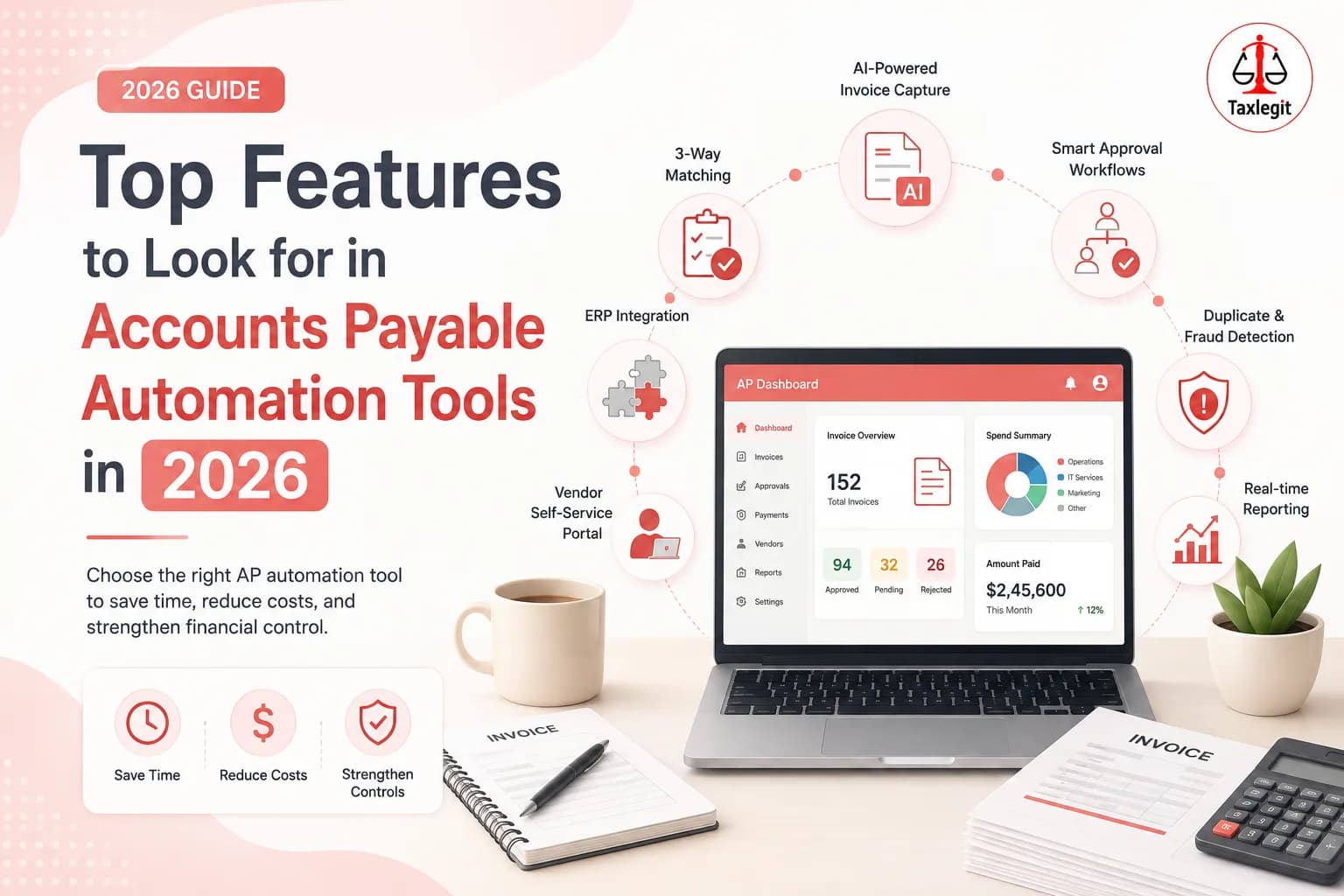
Why This Comparison Matters
The Problem: Most AP automation demos lead with the interface, not the controls. Businesses end up buying based on how clean the dashboard looks, then discover six months in that the platform can't do three-way matching properly or doesn't actually integrate with their ERP.
The Blueprint: This guide ranks the ten features that matter most in 2026, explains why each one earns its place, and gives you a vendor-evaluation checklist so you can score any platform objectively before you sign.
Why Is It Hard to Know Which AP Automation Features Actually Matter?
It's difficult because nearly every AP automation vendor now claims to offer the same core feature list. The line between AP automation and broader spend management has blurred, with vendors expanding into procurement on one side and payments and dynamic discounting on the other, which makes basic feature comparison harder than it used to be.
The businesses that end up disappointed are usually the ones who evaluated tools on demo polish rather than testing the features that actually carry financial risk if they fail matching accuracy, duplicate detection, and audit trail completeness. AI-powered invoice capture has narrowed the implementation gap that used to separate mid-market tools from enterprise platforms, so feature depth now matters more than brand name or price tag alone.
This guide walks through the ten features worth prioritizing, in the order they should influence your decision, along with a scoring checklist to use in vendor evaluations.
The 10 Features That Matter Most in AP Automation Tools
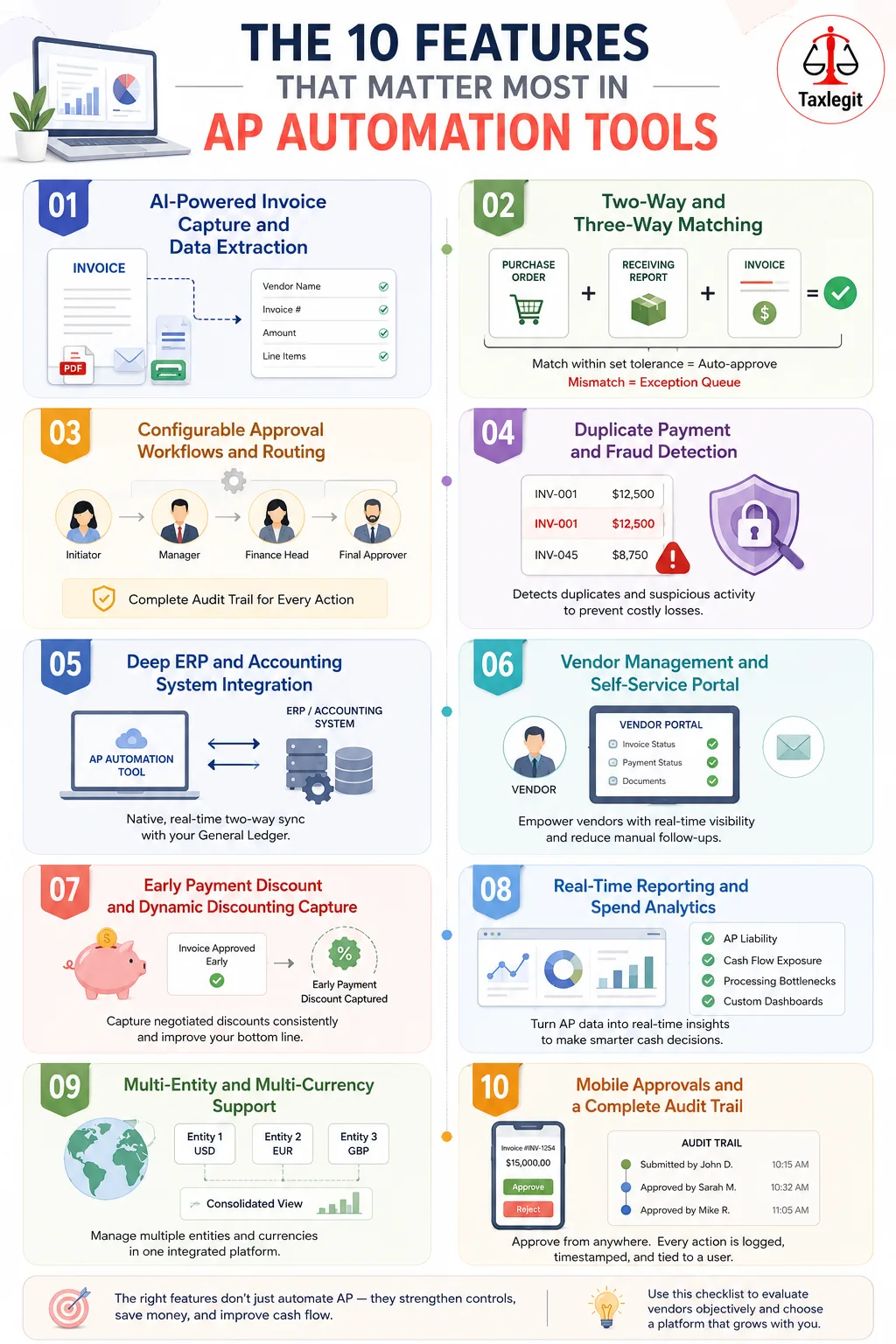
1. AI-Powered Invoice Capture and Data Extraction
This is the entry point for everything else, and it's where the biggest quality gap between vendors shows up. Look for a platform that uses OCR combined with AI-based extraction to pull the vendor name, invoice number, amount, and line-item detail from PDFs, emails, and scans not just the invoice total.
Test this feature directly during your evaluation: submit a handful of your messiest real invoices, not the vendor's clean demo file. Line-item accuracy capturing complete detail down to cost codes, jobs, and projects, not just header-level totals is what separates platforms built for complex AP from ones built for simple bill pay.
2. Two-Way and Three-Way Matching
Matching is the control that actually prevents overpayment, not just a convenience feature. Before any invoice is paid, the system should confirm that the purchase order, the receiving report, and the invoice all agree within a tolerance you configure. If all three match, the invoice should move forward automatically; if they don't, it should route into an exception queue instead of getting paid anyway.
3. Configurable Approval Workflows and Routing
Your approval hierarchy is not generic, so your software shouldn't force you into one. The platform should let you route invoices by amount, department, cost center, or project, with the flexibility to change rules as your organization grows. At a minimum, AP automation software should include approval routing with a complete audit trail every action logged, timestamped, and attributable to a named user.
Ask specifically how the platform handles approver absence. A workflow that stalls because one manager is on vacation defeats the purpose of automating it in the first place.
4. Duplicate Payment and Fraud Detection
This feature alone can justify the software cost. Duplicate payments typically drain 1 to 5% of total AP spend for a company processing $10 million a year through AP, that's $100,000 to $500,000 in preventable losses..
5. Deep ERP and Accounting System Integration
A feature-rich platform is worthless if it doesn't sync cleanly with your general ledger. Push past the marketing claim of "integrates with" and ask how. A tool that requires managing a separate sync job creates ongoing overhead that partially offsets the automation benefit, compared to a platform with native, real-time two-way sync.
6. Vendor Management and Self-Service Portal
The best platforms don't just manage your side of the transaction they reduce the back-and-forth with vendors too. Look for a vendor self-service portal where suppliers can check invoice and payment status directly, which cuts down on "Has my invoice been paid?" emails that eat into your team's time.
7. Early Payment Discount and Dynamic Discounting Capture
This is the feature most businesses underweight, and it's a direct revenue opportunity, not just an efficiency gain. When invoices are captured, matched, and approved fast enough to consistently pay within vendor terms, platforms can flag and prioritize invoices specifically to capture negotiated early-payment discounts that get missed under manual processing.
8. Real-Time Reporting and Spend Analytics
You should be able to see your full AP liability, cash flow exposure, and processing bottlenecks at any moment, not just at month-end close. Real-time spend visibility and custom dashboards turn AP from a historical record into a forward-looking cash management tool.
9. Multi-Entity and Multi-Currency Support
If you operate more than one legal entity, more than one currency, or vendors across borders, this feature moves from nice-to-have to mandatory. Confirm the platform can process bills for multiple entities and accounts within a single integrated view, rather than requiring separate logins or manual consolidation across entities.
This matters even for businesses that are only starting to expand: find a platform that accommodates additional entities, users, or features without requiring costly customization down the line, so you're not re-platforming in eighteen months.
10. Mobile Approvals and a Complete Audit Trail
Approvers are rarely at their desks when an invoice needs sign-off. Mobile approval capability and accessible audit history are especially valuable for owners and managers who aren't chained to a desk, and delayed approvals are one of the most common causes of missed early payment discounts and strained vendor relationships.
Supports Audit & Control Requirements( A Quick Reference )
| Feature | Priority | Why |
| AI-powered invoice capture | Must-have | Foundation for every downstream control |
| Two-way / three-way matching | Must-have | Prevents overpayment before it happens |
| Configurable approval workflows | Must-have | Keeps payment authority with the right people |
| Duplicate payment & fraud detection | Must-have | Directly protects cash; highest ROI feature |
| ERP / accounting integration | Must-have | Without it, you're maintaining two systems |
| Vendor self-service portal | Nice-to-have | Saves staff time, doesn't affect financial control |
| Early payment discount capture | Nice-to-have (high value) | Direct savings, but not a control risk if absent |
| Real-time reporting & analytics | Nice-to-have | Useful for forecasting, not a blocker on its own |
| Multi-entity / multi-currency support | Must-have if applicable | Mandatory only if you operate more than one entity |
| Mobile approvals & audit trail | Must-have | An audit trail is a compliance requirement, not a preference |
What Are the Most Common Mistakes Businesses Make When Evaluating AP Automation Features?
- Evaluating the interface instead of the control layer: A clean dashboard says nothing about whether the matching logic or duplicate detection actually works on your invoice formats. Test those features directly; don't take a demo's word for it.
- Assuming "integration" means real-time, two-way sync: Many platforms technically "integrate" with your ERP through batch exports or manual sync jobs. Confirm the integration architecture, not just the integration claim.
- Ignoring multi-entity needs until they're urgent: If acquisition or expansion is even a possibility in the next two years, evaluate this feature now. Re-platforming a live AP system mid-growth is far more disruptive than paying slightly more upfront for a platform that scales with you.
- Treating fraud detection as a bonus feature rather than core infrastructure: Given that close to four in five businesses face payment fraud attempts annually, this belongs on your must-have list, not your wish list.
- Not testing exception handling: Every platform performs well on invoices that match perfectly. The real differentiator is how gracefully the platform handles the invoices that don't.
How Does TaxLegit Help US Businesses Choose the Right AP Automation Platform?
TaxLegit works with US businesses in the $1M–$15M revenue range to evaluate, implement, and configure AP automation software around what their invoice complexity actually requires not around whichever platform is easiest to demo.
For a broader look at how automation compares to outsourcing your AP function entirely, see our guide to AP automation vs. AP outsourcing.
Ready to evaluate AP automation platforms the right way?
Click here to schedule your free AP automation readiness assessment and get a custom feature-fit analysis within 48 hours.
Frequently Asked Questions
Duplicate payment and fraud detection typically deliver the fastest and largest return, since duplicate payments alone can drain 1 to 5% of total AP spend and traditional ERP checks miss more than half of sophisticated duplicates.
If your business uses purchase orders at all, three-way matching applies regardless of size. It's described as the workhorse internal control in accounts payable precisely because manual teams can typically only apply it consistently to their largest invoices automation makes it possible to apply it to every invoice.
Industry research points to up to a 70% reduction in processing costs when automation is implemented well, though the exact figure depends heavily on your current manual cost baseline and how much of the feature set you actually use.
If most of your vendors genuinely don't offer early payment terms, this feature drops in priority for your business specifically. But confirm that assumption first businesses that automate often discover discount opportunities they weren't capturing under manual processing simply because invoices weren't being approved fast enough to qualify.
Traditional OCR reads text from a fixed template and struggles with format variation. AI-powered extraction interprets and structures data from invoices regardless of format, structured or unstructured, which matters significantly if your vendor base sends invoices in inconsistent layouts.
A platform with mediocre matching and fraud detection but an impressive chat interface will still expose you to overpayment risk. Modern AP platforms increasingly blur into broader spend management, which makes it easy to be impressed by breadth evaluate the must-have features in this guide first, and treat everything else as a tiebreaker.
About the Author

Srijita
Content Writer
Srijita is a legal and financial content specialist with 5+ years of experience in the Indian corporate sector. She simplifies MCA regulations and tax compliance into clear, actionable insights for entrepreneurs, working closely with Chartered Accountants and legal experts to ensure accuracy and compliance. Reviewed by Vipul Sharma, Co-Founder, Taxlegit.