
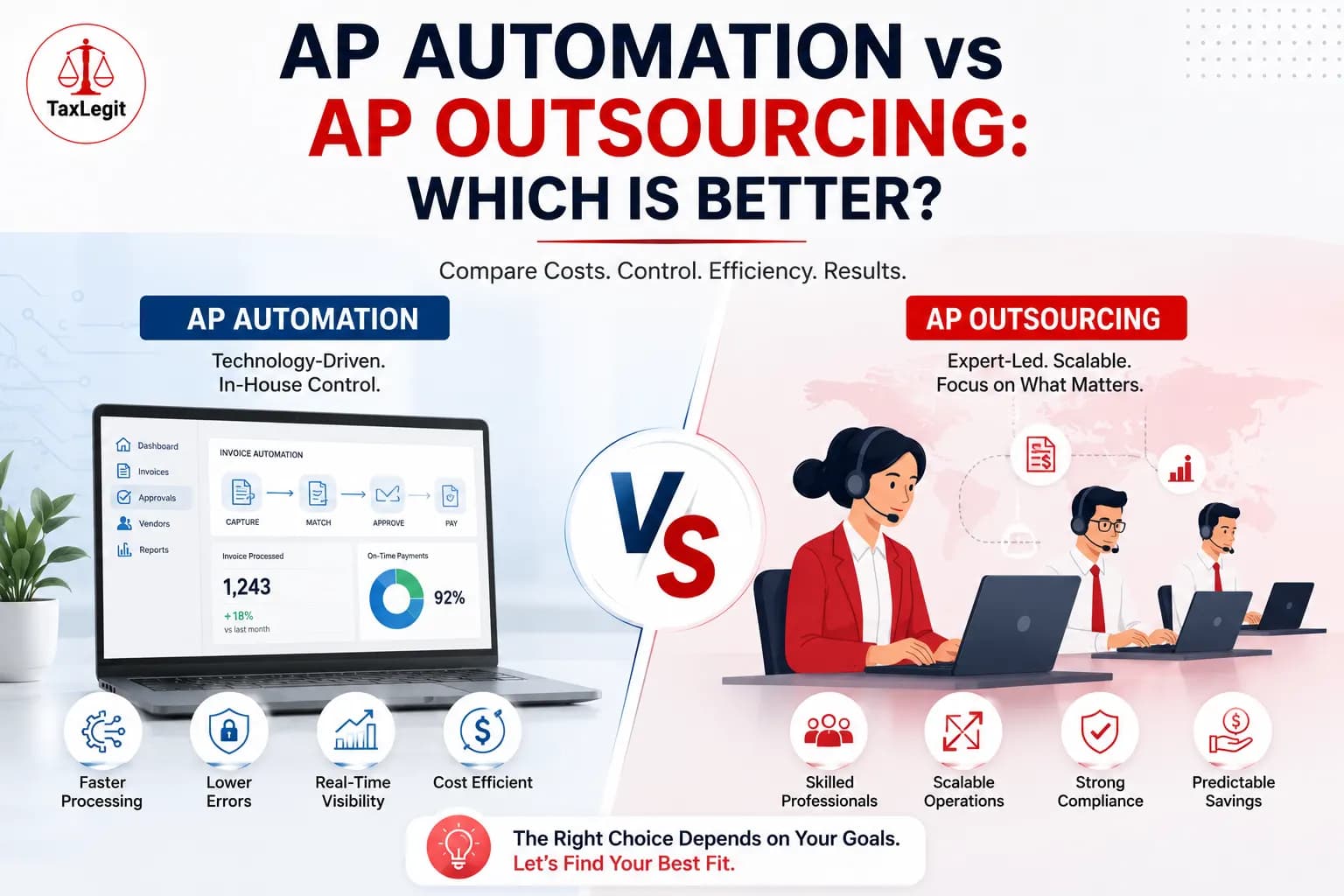
Who This Guide Is For
If you are a controller at a fast-growing Chicago distribution firm processing 1,500+ invoices a month, this guide is written for you.
You keep hearing "just automate it" from one software vendor and "just outsource it" from a service provider, with no one clearly explaining what each option actually means for your bottom line, control, and internal risk.
Why Does This Comparison Matter?
The Problem: Most businesses frame this as a binary choice automate or outsource when the real decision depends on invoice volume, vendor complexity, and how much control you're willing to hand over.
The Bottom Line: Below a few thousand invoices a month, automation software usually wins on cost and control. Above that, with multi-entity or multi-currency complexity, outsourcing can close gaps automation alone can't.
The Blueprint: This guide breaks down what each model actually does, compares real cost-per-invoice benchmarks, and gives you a framework to decide, including the hybrid approach most mid-market companies land on.
Why Is Choosing Between AP Automation and AP Outsourcing So Difficult?
This decision is challenging because both options solve overlapping problems in entirely different ways. Furthermore, vendors on both sides have a strong financial incentive to frame the comparison in their favor:
- Software companies will tell you that outsourcing is an outdated, labor-driven model.
- BPO (Business Process Outsourcing) providers will argue that software alone cannot handle your unique exceptions, vendor relationships, or compliance complexities.
The Reality: A Shifting Middle Ground
The truth sits somewhere in the middle. As Artificial Intelligence (AI) has become increasingly adept at the data-entry and matching work that offshore outsourcing was originally built to make cheaper, the labor-arbitrage argument for outsourcing has significantly weakened.
At the same time, a pure software deployment still leaves your internal team responsible for the critical tasks that machines can't fully handle:
This guide gives you a clear definition of each model, a side-by-side comparison, real cost benchmarks, a step-by-step decision framework, and the four questions to ask before you commit a budget to either one.
What Is AP Automation?
AP automation is software that digitizes and manages your invoice-to-payment workflow while keeping your team in complete control of data and decisions.
Instead of typing numbers manually, invoices land in a digital inbox via email, portals, or scans. The software uses optical character recognition (OCR) and advanced AI to extract the vendor name, invoice number, amounts, and individual line items.
From there, the system runs two-way or three-way matching against your purchase orders and receiving documents, tags the correct General Ledger (GL) account, and automatically routes the file to the right manager based on approval limits you set.
What Is AP Outsourcing?
AP outsourcing means hiring a third-party partner to take over the day-to-day work of managing your invoice-to-payment cycle.
Outsourcing fits your specific needs, ranging from full-service care (where a partner handles the entire pipeline from receipt through reconciliation) to targeted help with time-consuming tasks like data entry, matching, or answering vendor queries.
You submit invoices to the provider; they extract and validate the data, run matching, route approvals, and prepare or execute payment files depending on your contract. Many outsourcing providers layer automation and reporting tools into their service, so you get invoice tracking and analytics without building or licensing that software yourself. What you're really paying for is the labor and expertise sitting on top of that technology, not the technology itself.
The Key Takeaway
| Operational Focus | AP Automation (Software Only) | AP Outsourcing (Software + Experts) |
| Who does the work? | Your internal team manages the software. | The partner's team handles the data entry and tasks. |
| What are you buying? | A software license fee. | Labor, operational expertise, and the software combined. |
| Vendor Management? | Your team answers vendor emails and calls. | The partner fields vendor queries for you. |
Many top-tier outsourcing firms layer automation and reporting tools right into their service. This gives you advanced invoice tracking and real-time analytics without requiring you to buy, build, or learn the software yourself. You are paying for the specialized labor and peace of mind sitting on top of the technology, rather than just the tool itself.
AP Automation vs. AP Outsourcing: Operational Comparison
The table below summarizes key structural differences between operating an internal AP automation tool and hiring an AP outsourcing service.
| Factor | AP Automation | AP Outsourcing |
| Who executes the work | Internal team, supported by software | Third-party provider’s service team |
| Where data lives & permissions sit | Direct integration within your systems | Managed via provider platforms or client ERP access |
| Cost structure | Fixed software license + internal labor | Per-invoice tier or monthly retainer |
| Visibility & control | Real-time internal tracking and immediate audit logs | Dependent on provider SLAs and reporting interfaces |
| Volume suitability benchmark | Scalable across volumes; typical ROI break-even at ~300 to 500+ invoices/mo | Variable; often cost-effective for operational relief or multi-entity complexity |
How Do the Real Costs Compare?
Numbers drive business decisions far more than opinions. To evaluate AP automation against AP outsourcing, you must compare them using a unified, fully loaded cost model rather than isolated software fees or unanchored per-invoice metrics.
Baseline Benchmarks (2026 Industry Standards)
- Manual Processing: Standard manual processing ranges from $12.88 to $19.83 per invoice in direct labor and document handling. When factoring in an average 39% error rate (with a standard $53 rework cost per exception), late-payment fees, and lost early-payment discounts, total fully loaded costs often reach $15.00 to $40.00+ per invoice.
| Reconciled Volume Example: For a company handling 50,000 invoices annually, pure processing labor ($12.88–$19.83) equals $644,000 to $991,500. Including average exception rework and payment delay friction pushes the total cost structure into the $750,000 to $2,000,000+ total operational drag. |
- AP Automation (Software-Led): Processing software fees run $0.50 to $3.50 per invoice depending on AI extraction levels and volume tiers. However, your internal staff still handles system exceptions, approvals, and vendor communication.
- AP Outsourcing (Service-Led): Outsourced providers charge $3.00 to $8.00+ per invoice (or an equivalent flat monthly retainer). This fee covers both the underlying tech stack and external operational labor, drastically reducing internal FTE requirements.
Consolidated Cost Model ( Example: 1,500 Invoices/Month | 18,000/Year )
Below is a side-by-side reconciliation for a business processing 1,500 invoices per month, comparing an Internal AP Automation Model against an Outsourced AP Model.
| Cost Component | Pure Manual Processing | In-House AP Automation | Full AP Outsourcing |
| Software & Platform Licenses | $0 | $10,000 – $15,000/yr (e.g., BILL, Tipalti) | Included in provider fee (or platform fee pass-through) |
| Implementation & ERP Setup | $0 | $3,000–$5,000 (One-time amortized) | Included or low setup fee ($1,500–$3,000) |
| Internal Labor (Fully Loaded FTE) | $130,000 – $195,000 (2 to 3 Full-Time Clerks) | $45,000 – $65,000 (0.5 to 0.75 FTE for approvals/exceptions) | $10,000 – $15,000 (~0.1 FTE internal oversight only) |
| Variable Unit Processing / Outsourcing Fees | $0 | $9,000 – $18,000 ($0.50–$1.00/invoice transactional add-ons) | $72,000 – $108,000 ($4.00–$6.00/invoice fully managed rate) |
| Exception & Error Rework Drag | $25,000 – $40,000+ (39% error rate) | $3,000 – $6,000 (5-8% error rate) | Absorbed by provider SLA guarantees |
| Total Annual Cost | $155,000 – $235,000+ | $70,000 – $109,000 | $83,500 – $126,000 |
| Effective Fully Loaded Cost / Invoice | $8.61 – $13.05+ | $3.88 – $6.05 | $4.63 – $7.00 |
Key Takeaway for Decision Makers
- Automation Software ($3.88–$6.05 fully loaded/invoice): Yields the lowest net unit cost if you already have qualified internal finance staff to handle workflow exceptions, system maintenance, and vendor queries.
- AP Outsourcing ($4.63–$7.00 fully loaded/invoice): Slightly higher net unit cost than pure software, but eliminates the need to recruit, manage, and retain dedicated internal AP staff converting fixed labor overhead into a flexible, volume-based operational expense.
Total Cost Breakdown: AP Outsourcing Model
While a baseline processing rate of $4.00 per invoice yields a $72,000 annual base cost for 18,000 invoices (1,500/month), your actual total spend typically ranges from $80,000 to $110,000 per year once operational variables are included.
Illustrative Annual Cost Formula
Total Annual Cost = Base Volume Fee + Onboarding
- Onboarding & Parallel-Run Setup ($3,000 – $6,000): One-time implementation, system integration, and dual-system testing during handoff (amortized over Year 1).
- Exceptions, Complex Routing & Ad-Hoc Fees ($2,000 – $7,000): Surcharges for non-standard paper processing, multi-currency conversions, urgent check runs, or high-touch exception resolution beyond baseline SLAs.
- Internal Oversight Labor ($3,000 – $25,000): 0.05 to 0.15 FTE internal controller time retained for final payment approvals and vendor escalation governance.
Navigating Volume & Complexity Thresholds
In the model above, software-led automation tends to deliver the best balance of cost and control below roughly 5,000 invoices per month for standard, domestic vendor operations.
Cost Snapshot at 1,500 Invoices/Month
| Model | Annual Cost Range | What's Included |
| Fully manual | $185,000+ | Labor, error correction, late-payment penalties |
| AP automation (software + in-house labor) | $73,000 – $110,000 | Software subscription + 1–1.5 FTE fully loaded |
| AP outsourcing (BPO) | $80,000 – $110,000 | Per-invoice fees + parallel run + escalators + exceptions |
| Figures are illustrative industry benchmarks compiled from the sources cited throughout this article; actual costs vary by vendor, volume, and complexity. |
What Are the Real Advantages of Each Model?
Where AP Automation Wins
Automation keeps your data, your controls, and your audit trail entirely in-house. Every approval action and payment is timestamped and logged automatically, so exporting a full audit trail for a lender or auditor takes minutes instead of a back-and-forth with an external provider. It also scales down your cost per invoice as volume grows, which is the opposite of what happens with a per-invoice outsourcing fee. If your invoice mix is domestic, your approval hierarchy is stable, and your invoice volume is under a few thousand a month, this is usually the more defensible long-term investment.
Where AP Outsourcing Wins
Outsourcing earns its keep when your problem isn't process but capacity or complexity. A manufacturer managing supplier payments across three countries was spending hours navigating international payment regulations and managing multiple bank relationships, with wire fees alone costing $30,000 a year consolidating that under one outsourced provider cut wire fees by 60% and eliminated the delays. Outsourcing also absorbs volume swings well: if your invoice count fluctuates with seasonality or fast growth, a provider flexes with you instead of forcing you to hire and lay off temp staff.
What Most Mid-Market Companies Actually Do
A practical hybrid pattern real-world setup in 2026 isn't a clean either/or. The recommended approach for most mid-market finance teams is to run automation software in-house for the 70 to 80% of invoices that are standard and routine and outsource only the residual exception work international payments, complex tax handling, and credit memo reconciliation. Businesses following this model often automate their domestic vendor payments while outsourcing international payments or automate approvals while letting a provider handle the more specialized execution work.
This keeps your data and your controls with you while giving you a release valve for the parts of AP that genuinely benefit from specialist handling.
What Is the Step-by-Step Process for Making This Decision?
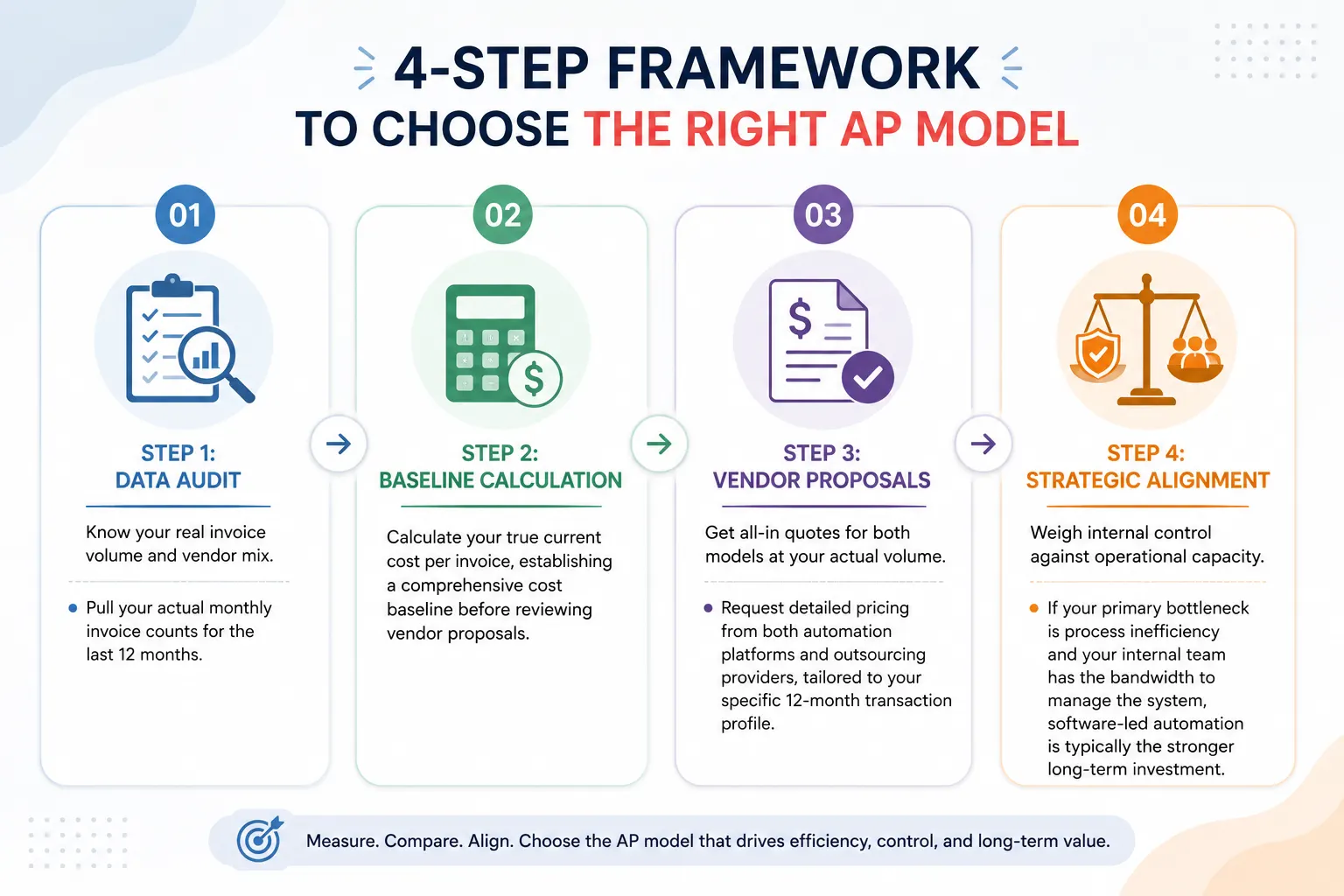
Execute these four steps in exact sequence before signing a software contract or an outsourcing agreement to ensure you are making a data-driven decision based on your actual operational baseline.
- Step 1: Data Audit: Know your real invoice volume and vendor mix. Pull your actual monthly invoice counts for the last 12 months
- Step 2: Baseline Calculation: Calculate your true current cost per invoice, establishing a comprehensive cost baseline before reviewing vendor proposals.
- Step 3: Vendor Proposals: Get all-in quotes for both models at your actual volume request detailed pricing from both automation platforms and outsourcing providers, tailored to your specific 12-month transaction profile.
- Step 4: Strategic Alignment: Weigh internal control against operational capacity. If your primary bottleneck is process inefficiency and your internal team has the bandwidth to manage the system, software-led automation is typically the stronger long-term investment.
What Are the Most Common Mistakes Businesses Make in This Decision?
- Assuming outsourcing eliminates the need for internal oversight: Control does not disappear when you outsource—it gets restructured. Strategic decisions about supplier terms, payment timing, and cash-flow optimization stay with you; what transfers is the operational execution, not the financial authority. If a provider frames it otherwise, that's a red flag.
- Comparing sticker price instead of the total cost of ownership: A low per-invoice outsourcing quote often excludes exception fees, price escalators, and the parallel-run period. A low-looking software subscription often excludes the in-house labor still needed to run it.
- Automating without redesigning the approval workflow first: Bolting software onto a broken approval process just makes the broken process faster, not better.:
- Outsourcing before automating: If you outsource before you automate, the provider ends up defining your process and owning your cost baseline—companies that sign multi-year BPO contracts without automating first often find themselves locked into a floor price even after volume drops.
What Should You Check Before Committing to Either Model?
| Requirement | AP Automation | AP Outsourcing |
| Confirmed ERP/Accounting System Integration | ☐ Yes ☐ No | ☐ Yes ☐ No |
| All-In Pricing (Includes implementation, platform fees & volume escalators) | ☐ Yes ☐ No | ☐ Yes ☐ No |
| Current SOC 2 Type II Report (Review scope, period, exceptions & sub-processors) | ☐ Yes ☐ No | ☐ Yes ☐ No |
| Core Security & Data Protection (End-to-end encryption, MFA & defined breach notice) | ☐ Yes ☐ No | ☐ Yes ☐ No |
| Data Ownership & Retention (Guaranteed data export & strict deletion protocols) | ☐ Yes ☐ No | ☐ Yes ☐ No |
| Internal Payment Authority (Final release authority remains with your named signer) | ☐ Yes ☐ No | ☐ Yes ☐ No |
| Real-Time Audit Trail & Processed Status Visibility | ☐ Yes ☐ No | ☐ Yes ☐ No |
| 30-Day Parallel / Shadow Run Built into Onboarding | ☐ Yes ☐ No | ☐ Yes ☐ No |
What Does a Well-Chosen Model Actually Look Like?
The Situation
- Note: Illustrative composite case based on mid-market healthcare benchmarks.
- The Business: A Chicago healthcare distributor processing 1,800 monthly invoices (85% domestic, 15% international).
- The Problem: A two-person AP team ($110k total labor) missed early payment discounts and wasted time on cross-border compliance.
The Strategy & Fix
- The Switch: Deployed domestic AP automation ($1,200/mo) and outsourced cross-border payments ($800/mo).
The 90-Day Result
- Cost Before: $110k labor + $12k missed discounts = $122k/yr.
- Cost After: $55k labor (1 FTE reassigned) + $24k software/vendor fees - $8k discounts captured = $71k/yr (42% net savings).
- Domestic invoice processing time dropped from an average of 9 days to under 2 days.
- The outsourced international payment queue, previously a source of constant delays, was fully current within the first billing cycle.
- Total AP processing cost, blending both models, came in roughly 45% below their prior, fully manual baseline.
How Does TaxLegit Help US Businesses Get This Decision Right?
TaxLegit works with US businesses in the $1M–$15M revenue range to design AP operations around what their invoice volume and complexity actually require, rather than defaulting to whichever model a single vendor is selling. We help with:
- Invoice volume and cost-per-invoice audits to establish your real baseline
- AP automation platform selection and implementation (QuickBooks Online, Xero, NetSuite, Bill.com)
- Outsourced AP support for exception handling, international payments, and overflow capacity
- Hybrid AP design that keeps payment authorization internal while removing manual processing load
For the full breakdown of which specific AP tasks are safe to hand to an outsourced team versus which should stay in-house, see our guide to what can be outsourced in the accounts payable process.
Ready to figure out which model fits your business?
Click here to schedule your free AP workflow assessment and get a custom cost comparison within 48 hours.
Frequently Asked Questions
For most businesses under roughly 5,000 invoices a month with mostly domestic vendors, yes. Automation software typically runs $1.50 to $3.50 per invoice fully loaded, compared to $4 to $8 per invoice for outsourcing once labor markup is included. Above that volume, or with significant multi-currency complexity, the gap narrows, and outsourcing can become competitive.
Yes, and it's increasingly the default approach for mid-market companies. Running automation software in-house for the majority of standard, routine invoices while outsourcing only the residual exception work is the recommended structure for most mid-market finance teams.
Not necessarily, but it does mean your data lives on the provider's platform rather than yours. In a well-governed outsourcing relationship, finance leaders retain visibility through dashboards, SLA reporting, and exception escalation, while the operational execution transfers to the provider. Confirm this visibility in writing before signing.
A typical AI-driven invoice processing deployment runs on a five-week timeline: process audit and mapping in week one, build and configuration in weeks two and three, a parallel run in week four, and go-live with human review limited to exceptions by week five. Full ROI realization, including staff adjustment, typically plays out over 12 to 24 months.
Risk depends on the provider's controls, not the model itself. A properly structured setup, whether automated or outsourced, should log every approval action and flag duplicate invoices, mismatched bank details, and unusual payment timing automatically. Ask any outsourcing provider to show you their fraud-detection controls before you share vendor banking data with them.
Outsourcing tends to make sense above roughly 5,000 invoices a month with real multi-entity or multi-currency complexity but ideally only after you've automated the standard work and are outsourcing the residual exceptions, not the whole function from day one.
About the Author

Srijita
Content Writer
Srijita is a legal and financial content specialist with 5+ years of experience in the Indian corporate sector. She simplifies MCA regulations and tax compliance into clear, actionable insights for entrepreneurs, working closely with Chartered Accountants and legal experts to ensure accuracy and compliance. Reviewed by Vipul Sharma, Co-Founder, Taxlegit.