

Who Is This Article For?
If you are staring at an unclosed month, missing critical deadlines, or worrying about who might walk out the door next, you are not alone. Meet Carla the CFO of a $9M company currently drowning in a three-week close process after her senior accountant abruptly quit. With a high-stakes board meeting just nine days away, her month-end close has dragged on for three painful weeks instead of the usual eight days.
Now, if you too are stuck handling reactive paperwork instead of driving strategy due to the ongoing accounting talent crunch, this article provides a clear blueprint to quantify these hidden operational costs and permanently stabilize your financial infrastructure.
Why Carla's Story Matters
- The Problem: Chronic understaffing is actively crippling her department's efficiency.
- The Bottom Line: She needs to quantify the hidden financial toll of operational delays.
- The Blueprint: This guide offers the immediate, actionable strategies Carla needs to stabilize her team.
The True Cost of the Accountant Shortage
The US accountant shortage costs mid-market businesses far more than an open job posting suggests. Over 340,000 accountants have left the profession since 2019; university accounting enrollment has dropped roughly 30% in a decade, and hiring cycles now average 47–73 days. The real cost includes delayed closes, compliance penalties, and burned-out staff. Outsourced accounting bypasses the shortage entirely and cuts back-office costs by 40–70% compared to a fully loaded in-house hire.
| Need Immediate Financial Clarity?Get a guaranteed 48-hour turnaround on your diagnostic review. Learn exactly where your cash flow is bleeding without committing to a full-time salary hire. |
Why Has the US Accountant Shortage Gotten This Bad?
Carla's situation is not bad luck. It is the predictable result of two converging trends that most business owners do not connect until they are living through both at once.
- 340,000 the number of accountants who left the US workforce between 2019 and 2026, driven largely by Baby Boomer retirements and burnout exits during and after the pandemic. ( Source: Wall Street Journal accounting workforce coverage; AICPA Trends Report on Accounting Enrollments and Supply )
- 30% the drop in university accounting program enrollment over the past decade, as students gravitate toward finance, data analytics, and tech roles with faster pay growth and less CPA-exam friction. ( Source: AICPA Pipeline Acceleration Report )
The pipeline that used to replace retiring accountants has narrowed at exactly the moment retirements accelerated. This is a structural supply problem, and it is the reason a standard 47-day hiring cycle has become, for many businesses, a permanent operational headache instead of a one-time inconvenience.
How Much Does an Open Accounting Role Actually Cost You ( Beyond the Salary? )
Most business leaders calculate staffing costs through the lens of a base salary alone. That is the wrong number, and it is the single biggest reason this shortage costs more than it looks like on paper.
| Cost Component | In-House US Senior Accountant (Annual) | Outsourced Accounting Model (Annual) |
| Median Base Salary / Service Fee | $81,680 (BLS, 2024) | $9,600–$36,000 (tier-dependent) |
| Taxes & Healthcare Benefits | $12,500–$19,500 | Included in service fee |
| Software Subscriptions & Hardware | $4,500–$9,500 | Included in service fee |
| Recruitment & Onboarding | $4,683 (SHRM Benchmark) | $0 |
| Total Loaded Annual Cost | $103,363–$115,363 | $9,600–$36,000 |
| Net Savings | Baseline | 40–70% reduction |
( Sources: BLS Occupational Outlook Handbook Accountants and Auditors, SHRM Human Capital Benchmarking Report )
This is not a one-time hiring cost. It is the cost Carla repeats every time someone leaves and in a market where the average accountant stays in a role for 2–3 years before moving on, that repetition is the real expense most businesses fail to budget for.
What Does the Shortage Cost You?
The dollar figure above is only part of the picture. The operational cost compounds in ways that do not show up on a single line item:
Delayed closes
When one overworked accountant covers a role built for two, month-end close stretches from days to weeks. Carla's clothes went from 8 days to over 21 days.
Compliance exposure
Rushed, understaffed closes increase the risk of missed reconciliations, late filings, and multi-state tax errors that surface during audits or due diligence.
Burnout-driven turnover
Remaining staff absorb the workload of departed colleagues, accelerating their own exit a cycle that compounds the original shortage rather than solving it.
Decision Lag
Leadership makes hiring, spending, and forecasting decisions on financial data that is weeks old because current numbers simply are not ready.
This is the part most cost calculators miss. The accountant shortage is not a one-time expense. It is an ongoing operational drag that gets worse every time a position stays open.
| Ready to see what the shortage is actually costing your business? Schedule your free financial workflow assessment and get a clear picture within 48 hours. |
How Does Outsourcing Solve the Problem the Shortage Creates?
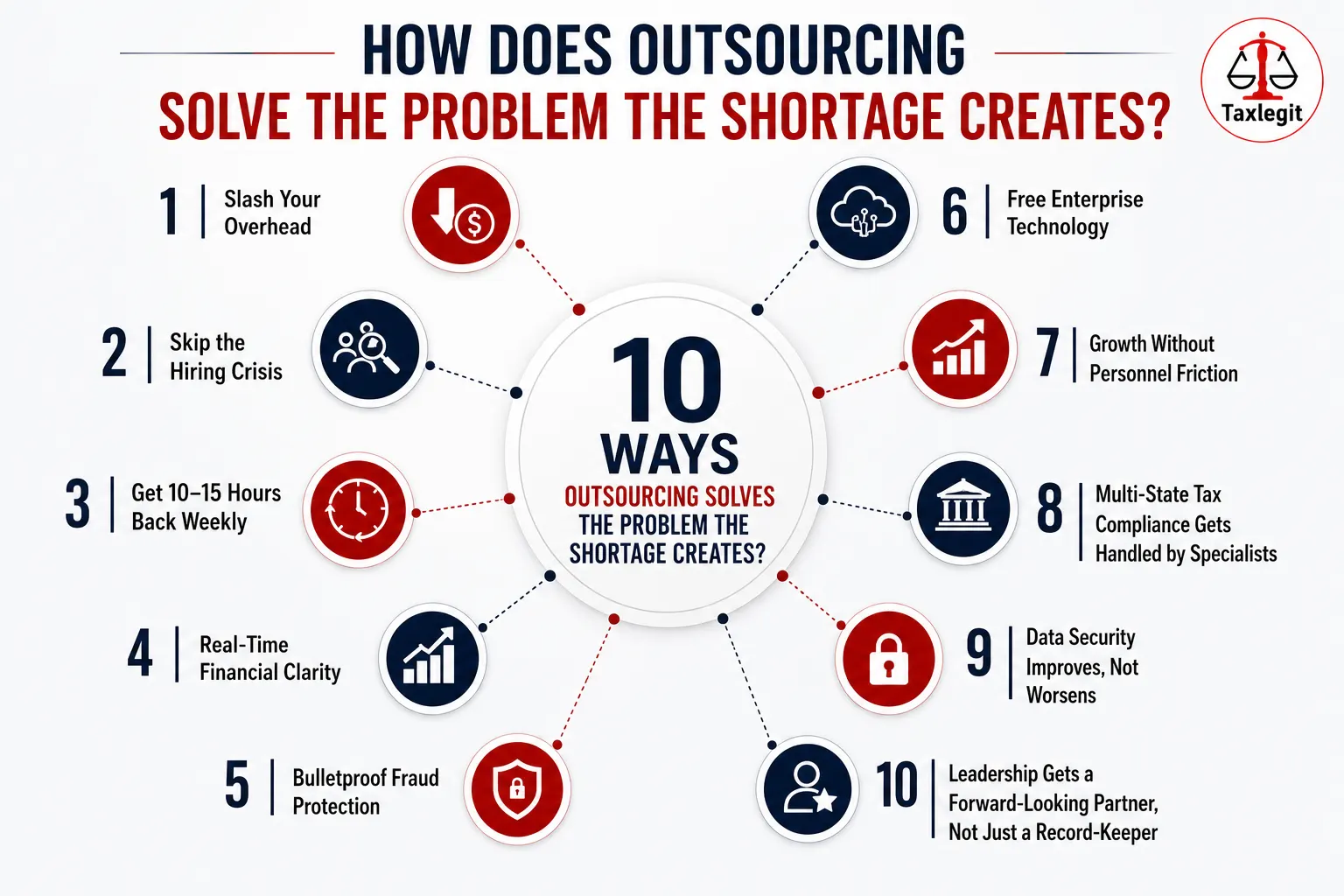
Outsourced accounting does not compete for the same shrinking domestic talent pool. It sidesteps the shortage entirely by accessing global, US GAAP-trained professionals who are already trained and available. Here is what changes structurally when a business makes that switch
1. Slash Your Overhead
Shifting from a heavy full-time payroll to a flexible, pay-as-you-go subscription cuts back-office costs by 40% to 70%. You can instantly pump those savings back into your marketing and sales engines.
2. Skip the Hiring Crisis
Over 90% of US finance leaders report severe difficulties finding qualified local talent. Outsourcing bypasses the domestic shortage entirely, giving you instant access to global experts fluent in US GAAP and IRS tax codes.
3. Get 10–15 Hours Back Weekly
C-suite executives waste hours chasing receipts and matching transactions. Handing off these tasks frees up your week to focus on closing high-value deals and driving growth. Why should you spend your Sunday evening balancing a spreadsheet?
4. Real-Time Financial Clarity
Forget waiting weeks after the month ends to see your numbers. Our outsourced accounting service runs exactly this overnight processing model for US clients.
5. Bulletproof Fraud Protection
Letting a single internal employee handle invoices, payments, and ledger entries poses a huge security risk. External teams enforce a strict division of duties across your general ledger accounts to keep your cash safe.
6. Free Enterprise Technology
Building a modern accounting tech stack is incredibly expensive. Outsourcing firms bundle premium tools, like automated expense trackers and machine-learning invoice scanners, directly into your service fee.
7. Growth Without Personnel Friction
Business growth fluctuates throughout the year. Instead of dealing with a costly hiring spree or painful layoffs, an outsourced model scales its support up or down instantly based on your transaction volume.
8. Multi-State Tax Compliance Gets Handled by Specialists
Economic nexus rules under South Dakota v. Wayfair mean businesses can owe sales tax in states where they have no physical presence. A team that tracks this as a core service closes a gap most stretched in-house teams cannot keep up with.
9. Data Security Improves, Not Worsens
Reputable providers operate under SOC 2 Type II certification, which most SMB networks cannot match internally MFA, zero-trust access, and full audit trails are standard, not optional.
10. Leadership Gets a Forward-Looking Partner, Not Just a Record-Keeper
A quality outsourced partner delivers cash flow forecasting, margin analysis, and board-ready reporting—the strategic functions a stretched in-house team rarely has the bandwidth for.
Which Financial Functions Can a Business Actually Delegate?
Most businesses scale their transition across three operational pipelines rather than outsourcing everything at once:
| Pipeline | What It Covers | Primary Outcome |
| Procure-to-Pay (Accounts Payable) | Invoice verification, expense tracking, vendor payment cycles | Clean AP records, on-time vendor payments |
| Order-to-Cash (Accounts Receivable) | Invoice generation, payment reminders, collections management | Lower Days Sales Outstanding (DSO) |
| Record-to-Report (General Ledger) | Bank reconciliations, GAAP compliance checks, financial statement prep | Investor- and lender-ready financials |
What Is the Step-by-Step Framework for Selecting an Outsourcing Partner?
Your executive team must screen potential providers using a structured evaluation matrix to prevent operational friction. Here is the exact three-step process we recommend:
- Step 1: Evaluate Tech Integration (Cloud native, API connections, no manual emails)
- Step 2: Verify Industry Specificity (Proven track record in your exact regulatory niche)
- Step 3: Confirm Communication SLAs (Documented turnarounds, dedicated managers)
At TaxLegit, we help US businesses modernize their back-office infrastructure. Our team combines advanced automation with experienced accounting professionals to handle your day-to-day bookkeeping, payroll, and compliance demands.
How Does TaxLegit Help US Businesses Navigate the Shortage?
Relying on an overloaded internal team often means delayed reporting, compliance exposure, and missed growth opportunities. TaxLegit helps US mid-market businesses modernize their back-office infrastructure with outsourced bookkeeping and accounting, AP/AR management, multi-state tax preparation, and fractional CFO advisory.
Every engagement begins with a financial workflow assessment that maps your current bottlenecks, transaction volume, and compliance exposure into a scoped proposal typically within 48 hours, with full onboarding completed in two to four weeks.
Carla's lesson applies broadly: the cost of the shortage compounds the longer a position stays open. The earlier a business moves to a structurally different model, the less expensive the transition.
Legal Disclaimer
This publication serves exclusively to provide educational information concerning corporate accounting structures, fractional financial management, and bookkeeping workflows within the United States. It does not constitute formal legal, accounting, or statutory tax advice. Because state-specific reporting thresholds, software integrations, and federal IRS rules adjust frequently, business owners must always consult a qualified CPA or licensed professional tax advisor regarding their specific business situation before implementing new infrastructure.
| Need Help Cleaning Up Your Books?TaxLegit serves US businesses seamlessly from our global delivery center ensuring your financial stack is handled accurately while you sleep.👉 Click Here to Book a Free Consultation in Your Time Zone Or reach our team directly to review your ledger architecture at: https://taxlegit.com/ |
Frequently Asked Questions
No, You maintain full ownership and absolute control over your capital. The outsourced team works within your cloud accounting platform to categorize transactions and prepare reports. Still, your internal management retains sole approval authority for all outgoing funds, bank wires, and strategic financial decisions.
A standard migration to an outsourced model takes between two and four weeks. This period includes securely mapping your historical ledger data, connecting financial tech platforms, establishing communication rules, and deploying automated workflows without interrupting your daily business operations.
Yes, small businesses often see the highest relative return on investment. Startups rarely have the budget to hire a full-time internal controller or CPA. Outsourcing lets you access institutional-grade financial talent on a fractional, budget-friendly basis that matches your exact growth phase.
Top-tier providers align their operational schedules with US business hours, offering real-time coverage or overnight processing. This structured workflow ensures your financial records are fully up to date and reconciled by the time you log in every morning.
Bookkeeping focuses on accurately recording historical data, such as categorizing expenses, tracking receipts, and reconciling accounts. Fractional CFO services look forward to providing strategic advisory, cash flow forecasting, capital structure optimization, and boardroom-ready financial planning.
Yes, Professional fees paid to an external agency for operational business assistance, bookkeeping, tax preparation, and corporate compliance are classified as ordinary and necessary business expenses, making them fully tax-deductible under Internal Revenue Code Section 162.
About the Author

Srijita
Content Writer
Srijita is a legal and financial content specialist with 5+ years of experience in the Indian corporate sector. She simplifies MCA regulations and tax compliance into clear, actionable insights for entrepreneurs, working closely with Chartered Accountants and legal experts to ensure accuracy and compliance. Reviewed by Vipul Sharma, Co-Founder, Taxlegit.