
The U.S. accountant shortage directly threatens business stability. Over 300,000 accountants left the field between 2019 and 2022 (WSJ), and the BLS projects ~124,000 annual openings through 2034. For growing mid-market businesses facing hiring delays and rising salary costs, outsourcing is one flexible option to maintain GAAP-compliant reporting, protect close schedules, and reduce back-office overhead
What Is the US Accountant Shortage and How Bad Is It?
According to data compiled between 2019 and 2022 by The Wall Street Journal, over 300,000 U.S. accountants and auditors departed the workforce. The U.S. Bureau of Labor Statistics (BLS) projects a sustained supply-and-demand mismatch, estimating approximately 124,000 annual openings through 2034 driven by retirements and career transitions. For small and mid-sized businesses, this persistent talent deficit results in extended hiring cycles, higher compensation demands, and operational friction in maintaining timely, compliant financial records.
For a deeper look into why 300,000 accountants left the industry and what lies ahead for firms, check out 300,000 Accountants Left Their Profession, What's Next?
This video provides valuable insights into the ongoing labor shortage in accounting and how technology and outsourcing strategies are helping businesses adapt.
US Accounting Labor Market Snapshot
The U.S. accounting shortage stems from a dual squeeze in overall labor and licensed professionals:
- Workforce Exits: 300,000 accountants and auditors left their roles between 2019 and 2022 (WSJ / BLS analysis).
- Projected Demand: The BLS projects 124,200 annual openings for accountants and auditors through 2034
- CPA Pipeline: Active U.S. CPAs stand at 653,408 (NASBA, Aug 2025), while first-time CPA exam candidates dropped over 40% from 2016 levels.
- Aging Demographics: 28% of active accountants are age 55 or older, accelerating retirement-driven supply shortages.
Cost 1: How Much Is a Vacant Accounting Role Actually Costing You Per Week?
Sarah has been running with an unfilled staff accountant role since February. What she hasn't calculated is what that vacancy is actually costing her every week it stays open.
Vacancy Cost Components
| Cost Component | Weekly cost | Benchmark Source | Notes & Classification |
| Lost Productivity (reporting delays, slower monthly close) | $3,000 – $5,000 / week | Industry Peer Benchmark (e.g., Talentfoot / SHRM) | Opportunity Cost: Capacity loss and delayed financial visibility. |
| Staff Overtime & Bridge Coverage | $800 – $2,000 / week | Compensation Data (e.g., Robert Half Salary Guide) | Direct Cash Cost: Premium pay for existing staff covering excess workload. |
| Compliance & Errors (misclassifications, late filings) | Non-numeric / Variable | Academic Research (e.g., U. Maryland / UGA) | Qualitative Risk: Audit exposure and potential tax interest/penalties (unquantifiable before occurrence). |
| Recruitment & Sourcing (job board fees, agency placement) | $8,000 – $25,000 (one-time fee) | Talent Acquisition Benchmarks (SHRM CPH-001) | Direct Cash Cost: Agency placement fees (typically 15%–25% of annual salary) or internal sourcing costs. |
| Total Estimated Vacancy Impact (73 Days) | $50,000 – $95,000 | Calculated aggregate | See footnote for detailed scenario breakdown. |
Calculation Footnote (73-Day Basis):
- Timeframe: 73 calendar days equals 10.43 working weeks.
- Operational Drag (Weekly Run Rate): At $3,800/week (Low) to $7,000/week (High) in combined productivity loss and overtime, the 10.43-week operational drag equals ~$39,600 – $73,000.
- Recruitment: Adding one-time placement costs ($8,000) (low-tier internal/board fees vs. $22,000+ High-tier agency fee) brings the baseline range to $47,600 – $95,000, rounded to $50,000 – $95,000.
Cost 2: What Happens to Your Financial Reporting When Accounting Talent Is Stretched Thin?
When accounting roles remain vacant, or the finance team is overloaded, reporting quality usually suffers first. Research by Rebecca N. Hann and co-authors found that longer accounting vacancy periods are linked to a higher risk of material weaknesses in internal control over financial reporting.
Labor Shortage Impact on Financial Controls
The accounting talent shortage directly impacts internal financial controls across public and private sectors:
- Public Market Exposure: Nearly 640 U.S.-listed companies cited accounting personnel shortages as a contributor to material weaknesses in internal controls during the 12 months through June 2024 (Wall Street Journal / Hudson Labs reporting).
- Private Business Impact: While unlisted small-to-midsize businesses do not issue SEC filings, the same personnel deficit manifests as operational drag specifically delayed month-end closes, backlogged reconciliations, unrecorded adjustments, and degraded financial reporting accuracy.
Cost 3: Why Is Hiring an In-House Accountant Getting More Expensive?
Hiring an in-house accountant in the US has become more costly because demand for skilled accounting talent is rising while the available talent pool is shrinking. Many experienced accountants have left the workforce, fewer new professionals are entering the pipeline, and businesses are competing harder for qualified candidates.
For a small business like Sarah’s $1.8M company, hiring even one accountant is not just about salary. An $85,000 role can become much more expensive after benefits, payroll taxes, software, recruitment, and onboarding costs. And if the role remains open for weeks, the business still faces delayed closes, reconciliation errors, and pressure on existing staff.
Sources: US Bureau of Labor Statistics, Reuters, Robert Half 2026 Salary Guide, EY US announcement, CFO Dive.
Cost 4: What Does the Shortage Do to the Person Already Doing Your Books?
Here is an operational cost that rarely appears on a balance sheet: the hidden toll on staff members forced to temporarily cover accounting duties—whether that's an office manager, an internal operational lead, or the business owner.
When accounting workflows are handled by employees without specialized technical training, operational drag compounds: reconciliations stall, categorization errors increase, and valuable tax deductions are routinely missed.
Illustrative Example: The Cost of a Missed Deduction
Consider an illustrative scenario where an office manager covering temporary bookkeeping misclassifies a $4,200 equipment lease payment as a non-deductible draw or forgets to record it before tax year-end:
Direct Impact = Missed Deductible Expense × Effective Corporate
Assuming a combined federal and state corporate income tax rate of 25%:
$4,200 × 0.25 = $1,050
Cost 5: What Opportunities Are You Losing While Your Books Are Running Behind?
This is the hardest cost to quantify and the most expensive one to ignore.
Delayed accounting does not just create reporting problems. It can also block business decisions. Research on accounting vacancies shows that longer gaps in finance roles are linked to delayed financial reporting and weaker internal controls.
For a small business like Sarah’s $1.8M company, the impact may look different, but it still hurts. Slow books can delay a loan application, block equipment financing, or make it harder to justify a new hire because margins and cash flow are unclear. The real cost is not just late reports — it is the growth opportunity lost while waiting for accurate numbers.
What Does Outsourced Accounting Actually Fix and Is It Right for Your Business?
The U.S. accountant shortage presents a genuine challenge for growing companies, but chasing scarce local talent is not the only path forward. Businesses navigate this labor market through various strategies including internal process automation, elevated training programs, technology integration, and fractional leadership.
For many small-to-midsize businesses, one practical response is to build a modern finance function around a dedicated outsourced team rather than relying solely on a single local hire.
In-House Hiring vs. Outsourced Accounting Team
| Evaluation Factor | In-House Hiring Path | Outsourced Accounting Model |
| Time to Operational | 73 days on average to recruit plus 30–60 days for internal onboarding and process training. | 1–2 weeks for standard cloud setup (for clean general ledgers). Historical cleanup, multi-entity integrations, or legacy payroll migrations require 30–60 days. |
| Estimated Monthly Cost | $7,000 – $9,500 / month (Base salary, health benefits, 401k match, payroll taxes, recruiting fees, and software seats for a mid-level staff accountant). | $1,500 – $3,500 / month (Scalable retainer model based on monthly transaction volume, entity count, and scope of reporting—e.g., AP/AR, reconciliations, monthly close). |
| Bench Depth & Continuity | Single Point of Failure: Operational capacity is dependent on one individual's skill set, bandwidth, and presence (vacations, sick leave, departures). | Multi-Tiered Coverage: Primary account manager backed by specialized bookkeepers, payroll experts, and review controllers on demand. |
| Shortage & Turnover Risk | Directly Exposed: Fully vulnerable to local talent shortages, salary inflation, and sudden resignations requiring a full repeat hiring cycle. | Mitigated Exposure: Shifts individual vacancy risk to the provider, though buyers must verify provider staffing continuity, SLAs, and backup coverage. |
| Scalability & Tech Stack | Relies on the individual's existing software knowledge; scaling requires hiring additional headcount at each growth milestone. | Standardized cloud software stack (e.g., QuickBooks Online, Xero, Bill.com) configured to scale with transaction volume without adding headcount. |
Accounting Strategy Decision Guide
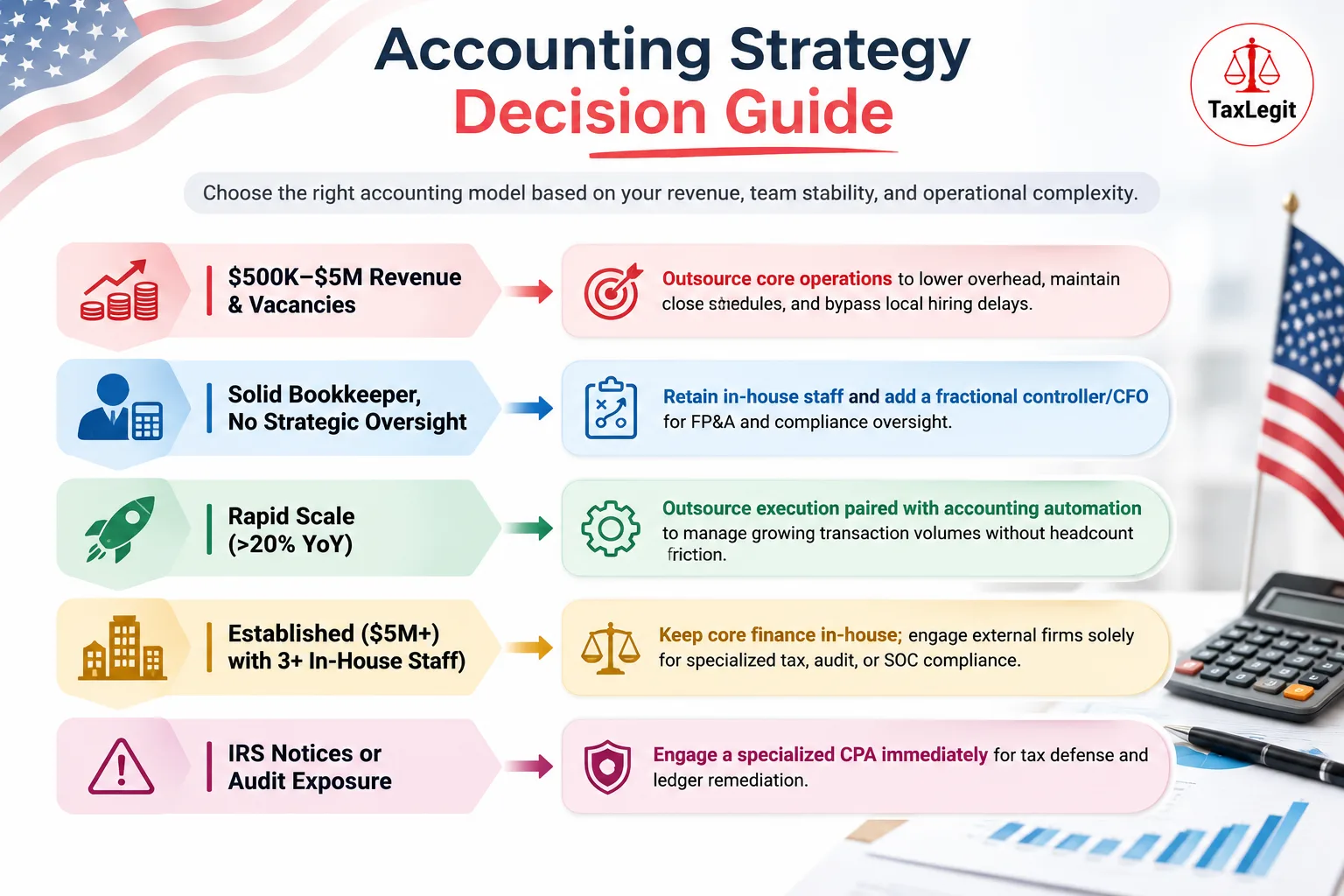
Choosing the right accounting model depends on your revenue, team stability, and operational complexity:
- $500K–$5M Revenue & Vacancies: Outsource core operations to lower overhead, maintain close schedules, and bypass local hiring delays.
- Solid Bookkeeper, No Strategic Oversight: Retain in-house staff and add a fractional controller/CFO for FP&A and compliance oversight.
- Rapid Scale (>20% YoY): Outsource execution paired with accounting automation to manage growing transaction volumes without headcount friction.
- Established ($5M+ with 3+ In-House Staff): Kept core finance in-house; engaged external firms solely for specialized tax, audit, or SOC compliance.
- IRS Notices or Audit Exposure: Engage a specialized CPA immediately for tax defense and ledger remediation.
How TaxLegit Helps US Businesses Handle the Shortage
At TaxLegit, we work specifically with US small- and mid-sized business owners like Sarah who are caught in the talent shortage and need their finance function to work right now, not after a 73-day hiring cycle.
- Outsourced Bookkeeping Services: Clean books, bank reconciliations, and transaction categorization done accurately and on time, every month, regardless of what the US talent market looks like.
- Tax Preparation & IRS Compliance: Quarterly estimates, year-end filings, deduction optimization, and multi-state compliance. No rushed filings because the accountant left.
- Virtual CFO & Controller Services: Cash flow forecasting, financial modelling, and board-level reporting without the $150,000+ full-time hire that the shortage has made even harder to justify.
- Cloud Accounting System Setup: QuickBooks, Xero, and leading platforms set up and integrated so your data is clean, automated, and accessible from day one.
- IRS Representation & Audit Support: If you get a notice or face an audit, TaxLegit stands with you. We handle the IRS so you don't have to.
Whether you're a growing startup or an established business, we build a solution tailored to your specific situation, timeline, and budget that doesn't depend on a talent market that is structurally broken.
Frequently Asked Questions
Most industry projections expect the shortage to persist through at least 2029. Some put the recovery timeline at 2034–2035, based on current enrollment trends and retirement demographics. Undergraduate accounting enrollment rose 12% in spring 2025 versus 2024, which is encouraging, but those students won't enter the workforce as licensed CPAs for another 5–7 years.
Software tools like QuickBooks, Xero, and Gusto handle transaction capture and payroll mechanics well. But they don't catch misclassified expenses, file multi-state sales tax returns, prepare your Schedule C correctly, or flag the deductions you missed. Software requires a skilled human to interpret and act on the data it produces. The shortage affects the human layer, not the tool layer.
The opposite tends to happen. Reputable outsourced accounting firms operate on encrypted, cloud-based platforms with role-based access controls and dual-review processes. Most clients report gaining more visibility into their finances after outsourcing because they're getting real-time dashboards and scheduled reports rather than waiting for a single employee to pull numbers together.
Most clients are fully onboarded within 1–2 weeks. For businesses that also need system upgrades or backlog cleanup which is common when books have been managed by a non-specialist during a vacancy expect 30–60 days for a full transition. The onboarding process is structured so that you have clean numbers before the next monthly close.
Outsourced accounting services are typically delivered via predictable monthly retainers ($1,500–$3,500/month for mid-market SMBs), tied directly to transaction volume and scope. This eliminates full-time employee overhead such as health benefits, 401(k) matching, payroll taxes, recruiting fees, and software seat licenses saving most businesses 30% to 50% relative to a comparable full-time in-house team.
Unlike relying on a single in-house employee where a resignation leaves your finance function completely stalled a professional outsourced firm utilizes a multi-tiered team structure. Your account is assigned a primary manager backed by cross-trained secondary staff and review controllers. If a team member leaves the provider, cross-training ensures seamless continuity without disrupting your daily reconciliations or monthly close schedules.
About the Author

Srijita
Content Writer
Srijita is a legal and financial content specialist with 5+ years of experience in the Indian corporate sector. She simplifies MCA regulations and tax compliance into clear, actionable insights for entrepreneurs, working closely with Chartered Accountants and legal experts to ensure accuracy and compliance. Reviewed by Vipul Sharma, Co-Founder, Taxlegit.
