
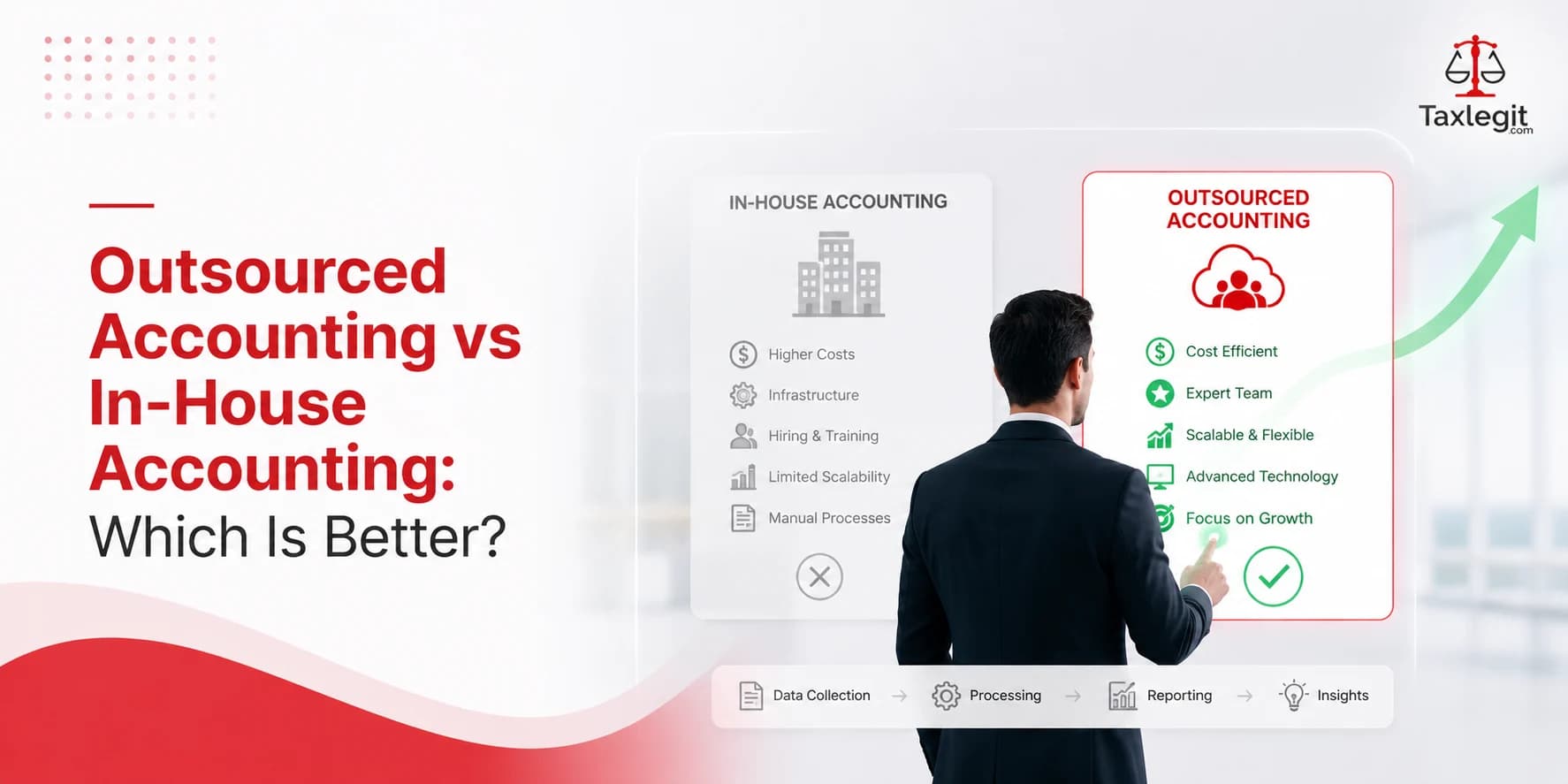
The real cost gap between in-house and outsourced accounting runs 40–70% once you count everything beyond base salary payroll tax, benefits, software, and turnover. The US median accountant salary is $81,680 (BLS, May 2024), but the fully loaded cost usually clears $100,000. The right choice depends on whether your business needs someone physically present for cash handling or whether your accounting is digital and document-based.
Is This Article Written for You?
Meet Daniel, 44, who runs a $4M industrial parts distribution business in Kansas. He has an in-house controller earning $78,000 a year and a part-time bookkeeper. His controller just gave notice she's retiring in three months. Now Daniel has two choices: start another multi-month hiring cycle or look seriously at outsourcing for the first time. He's done the math on salary, but not on everything salary doesn't include.
If you're facing the same decision, this article walks through the real, fully loaded cost comparison between in-house and outsourced accounting.
What's the Real Cost Difference Between In-House and Outsourced Accounting?
The real cost difference usually comes out to 40–70% in favor of outsourcing once you count everything beyond base salary. That gap is the single biggest reason US founders make the switch.
Here's the part most comparisons skip: a $78,000 salary on paper rarely stays at $78,000. By the time you add payroll taxes, health insurance, a 401(k) match, software licensing, and the cost of a multi-month hiring gap every time someone leaves, the real number creeps well past six figures.
According to the US Bureau of Labor Statistics, the median annual wage for accountants and auditors in the US was $81,680 as of May 2024, with the top 10% earning over $141,420 a year. CPAs specifically average closer to $119,000 once certification premiums are factored in.
Real Example: A Texas-based e-commerce brand doing roughly $2.1M in annual revenue cut its accounting spend from $7,200 a month (one in-house controller plus a part-time bookkeeper) to $2,400 a month for a three-person offshore team covering bookkeeping, AP/AR, and monthly close. That's a 67% drop, and their month-end close went from 12 days to 5.
Quick Comparison Table ( In-House vs Outsource )
Daniel, before you post that job listing, look at this side-by-side:
| Factor | In-House US Accountant | Outsourced Team in India |
| Annual cost | $81,680 median salary (BLS, May 2024) plus payroll tax, benefits, and software often $100k+ total | Typically 60-70% lower all-in, billed as a monthly service fee |
| Bench strength | One person, one skill set | A team bookkeeper, reviewer, CA, and a CFO-level advisor on call |
| Turnover risk | High, a resignation during filing season can stall your books | Low, the firm reassigns work internally if someone leaves |
| Working hours | Standard 9-to-5, your time zone | Overnight cycle IST overlaps, so books are ready by your morning |
| Compliance depth | Limited to what one person has learned on the job | Teams trained specifically on US GAAP, IRS filings, and state nexus rules |
Why Does the India Time Difference Actually Matter?
The time difference matters because it turns your accounting cycle from a 9-to-5 process into a 24-hour one. India sits 9.5 to 13.5 hours ahead of US time zones, which means your offshore team is working while you're asleep.
Here's how that plays out in practice. Suppose you close your laptop in Kansas at 6 PM. By the time you're having your morning coffee the next day, your bank feeds are reconciled, vendor invoices are entered, and your dashboard reflects yesterday's numbers.
Now, if you are wondering whether it is always a dramatic difference, then the answer is no, at least not for every business. If you process five invoices a month, the overnight cycle won't change much. But for a distribution business like Daniel's, that overnight turnaround is the difference between making same-week decisions and discovering a cash crunch two weeks too late.
Is It Safe to Send Financial Data to an Offshore Accounting Team?
Technically, the answer is yes but only if the firm plays by the same strict rules US regulators demand and if you keep the keys to your bank accounts.
Here’s the deal: US businesses have to follow a strict FTC law called the Gramm-Leach-Bliley Act (GLBA) Safeguards Rule. It basically means financial data must be heavily encrypted, monitored, and protected by multi-factor authentication. Reputable offshore firms know this, so they build their entire security system to match these rules, usually proving it with a "SOC 2 Type II" certification. (Sources: FTC—Gramm-Leach-Bliley Act, Safeguards Rule; AICPA & CIMA—GLBA and FTC Safeguards Rule Resources.)
But here's the part that matters most: you can outsource the work, but you can't outsource the blame. If a provider mishandles your data, the IRS and FTC still hold you accountable. That's why your contract matters just as much as their technology stack.
Before you sign anything, make sure they check these boxes:
- Bank-level encryption: Your data needs to be locked down, whether it's at rest or in transit.
- No shared passwords: Every single person needs their own login with multi-factor authentication (MFA).
- Look for a VDI setup: This means their team works on a "virtual desktop" they can see the data, but they can't download it to a physical computer.
- Paperwork protection: Get a solid NDA and a written security plan that explicitly mentions US compliance.
How Do I Know If Outsourcing Will Actually Work for My Business?
Outsourcing tends to work best for businesses with repeatable, document-heavy accounting tasks and worst for businesses where someone needs to be physically present to count cash or sign checks.
If your business runs primarily through bank transfers, online payments, and digital invoices, an offshore team can plug into your existing software (QuickBooks, Xero, and NetSuite) within a few weeks.
On the other hand, a retail store with daily cash drawer counts, or a Fortune 500 division needing a finance team physically embedded in operations, will keep at least part of its accounting function in-house. That's not a knock on outsourcing it's just a mismatch of work type.
A Simple Way to Decide: The 4-Step Fit Check
- List your top 5 recurring accounting tasks (bookkeeping, AP, AR, reconciliation, payroll, tax prep).
- Mark which ones require someone physically present.
- Add up the monthly hours each task currently takes your in-house staff.
- If more than 60% of those hours are remote-friendly, you're a strong candidate for outsourcing.
What Does an Outsourced US Accounting Engagement Actually Look Like, Week to Week?
In practice, it looks like a remote team member sitting in a different time zone daily updates, scheduled calls, and the same software you already use, just with more hands on it.
A typical engagement runs on a weekly rhythm: daily bank reconciliation and invoice processing happen overnight; a weekly summary lands in your inbox every Monday; and a 30-minute video call covers anything that needs a judgment call. Month-end close, AP/AR aging reports, and payroll journal entries follow a fixed calendar, so nothing slips.
Who Should Choose In-House vs. Offshore Outsourced Accounting?
While offshoring has many advantages, it is critical to match your unique business model to the appropriate accounting framework.
Who Should Keep Accounting In-House
- Large US Enterprises: Corporations requiring large, physical on-site financial departments and complex, localized cash-handling operations.
- Strictly Localized Cash Operations: Small businesses with high volumes of physical, daily cash-register drops that require on-site cash auditing.
Who Should Choose Offshore Outsourced Accounting
- US Startups & E-Commerce Brands: Fast-moving companies using Shopify or Amazon FBA that need agile, cloud-based financial tracking across multiple sales channels.
- US Small-to-Medium Businesses: Real estate firms, marketing agencies, SaaS companies, and consulting practices that need elite financial oversight without the full US executive price tag.
- US CPAs and Accounting Firms: Domestic practices looking to scale by outsourcing smaller-account bookkeeping and tax prep to reliable international partners freeing them to focus on local client relationships.
Whichever way you're leaning, don't just look at the sticker price of a single salary. This week, map out how many hours your team actually spends on finance. Figure out what it would cost to hand 60% of that over to a service provider. Once you see those numbers side by side, the decision tends to become clear quickly.
What Does This Actually Cost, Daniel?
Here's an honest, sourced breakdown so you can map this against your own controller's salary:
| Service Level | US In-House Equivalent | Outsourced (India) |
| Bookkeeping & Reconciliation | $500–$1,200/mo or $25–$50/hr | $200–$500/mo or $8–$12/hr |
| Full-Service Accounting & Tax | $1,500–$5,000/mo | $500–$1,500/mo |
| Controller / Virtual CFO | $5,000–$15,000/mo (vs. $78K–$150K+ full-time hire) | $2,000–$6,000/mo |
Therefore, Daniel is not just replacing a controller's salary; he is trading one resignation-risk hire for a full team that doesn't disappear when one person leaves.
Whichever way you're leaning, don't just look at the sticker price of a single salary. Instead, figure out what it would cost to hand 60% of that over to a service provider. Once you see those numbers side by side, the decision tends to become clear quickly.
How TaxLegit Helps US Businesses Get Their Finances Right
At TaxLegit, we work specifically with US business owners like Daniel who are ready to build a finance function that doesn't depend on one person.
- Outsourced Bookkeeping Services: Clean books, bank reconciliations, and transaction categorization done accurately and on time, every month.
- Tax Preparation & IRS Compliance: Quarterly estimates, year-end filings, deduction optimization, and full IRS compliance. No surprises at tax time.
- Virtual CFO & Controller Services: Cash flow forecasting, financial modeling, and board-level reporting for businesses that need strategic financial leadership without the full-time hire.
- Cloud Accounting System Setup: We set up and manage QuickBooks, Xero, and other leading platforms so your data is accurate, integrated, and always accessible.
- GLBA-Aligned Security: Bank-level encryption, individual MFA logins, and virtual desktop infrastructure built around US compliance requirements from day one.
Whether you're replacing a single controller or building a finance function for the first time, we build a solution around your specific situation, timeline, and budget.
What to Do Next
Unlike Daniel, if your controller's resignation has you considering a replacement hire versus outsourcing for the first time, start with the math above not a job posting. The right partner handles the transition, gets your books running on day one, and removes the resignation risk entirely
Frequently Asked Questions
Top-tier outsourcing firms in India employ professionals who specialize exclusively in US tax codes, GAAP principles, and IRS compliance. They undergo continuous professional training on updated US regulations, state-by-state sales tax laws, and corporate filing requirements.
Not at all. Professional offshore firms structure their schedules to provide substantial overlap with US business hours (EST, CST, and PST). They utilize modern communication stacks like Slack, Microsoft Teams, and secure email to ensure smooth, transparent communication.
No, An outsourced accounting team functions strictly as an analytical and recording entity. You maintain full, exclusive administrative control over your bank accounts, wire transfers, and final financial sign-offs. They prepare the data; you make the decisions.
The main difference is structural overhead. An in-house accountant requires direct management, payroll taxes, physical space, and benefits from your US company. An outsourced model treats financial management as an on-demand utility, delivering high-level expertise and high accuracy through a streamlined monthly service.
About the Author

Srijita
Content Writer
Srijita is a legal and financial content specialist with 5+ years of experience in the Indian corporate sector. She simplifies MCA regulations and tax compliance into clear, actionable insights for entrepreneurs, working closely with Chartered Accountants and legal experts to ensure accuracy and compliance. Reviewed by Vipul Sharma, Co-Founder, Taxlegit.