
To outsource bookkeeping, define your scope; choose between flat-fee and hourly pricing (flat-fee wins for ongoing work); vet 2–3 providers on software expertise and data security; and run a structured 30–60-day handover. Most small businesses pay $300–$1,500/month for outsourced bookkeeping versus $52,000–$73,000/year for an in-house hire; that amounts to savings of roughly 80–90%. The biggest risk isn’t losing control of your numbers; it’s choosing a provider without a clear data migration plan.
Is This Guide Written for You?
Meet Maria, a dynamic 35-year-old entrepreneur who runs a $1.8M digital marketing agency in Chicago. She has nine employees and a rotating bench of five to eight contractors, depending on client load. Her in-house bookkeeper just gave notice, and replacing her means another $55,000 salary plus benefits, plus a 6-week hiring gap where nothing gets reconciled. Maria knows outsourcing is the logical next step, but she’s never done it before, as her biggest fear isn’t the cost it’s losing visibility into her own numbers during the switch.
If that sounds like you, this guide walks through exactly how to outsource bookkeeping the right way without losing control.
What Does “Outsourcing Bookkeeping” Actually Involve?
Outsourcing bookkeeping means handing transaction recording, bank and credit card reconciliation, accounts payable/receivable tracking, and monthly financial reporting to a third-party firm or remote bookkeeper while you retain full ownership and visibility of your data through cloud accounting software like QuickBooks or Xero.
It is not the same as hiring a freelancer for one-off cleanup work, and it’s not the same as a fully outsourced CFO function. It sits in between: ongoing, systematic, and built around a defined monthly scope of work.
Step 1: Define Exactly What You Need Done
Before you contact a single provider, write down your actual scope. A generic goal like “outsource my bookkeeping” is too vague to get an accurate quote and it is the exact reason many small businesses end up disappointed with their provider just three months in. At a minimum, your scope document should answer:
- How many bank and credit card accounts need monthly reconciliation?
- What is your average monthly transaction volume?
- Do you need accounts payable and receivable tracking, or just reconciliation?
- Do you need payroll coordination, or is that handled separately?
- How quickly do you need monthly reports delivered after the period close?
- Are your books currently clean, or do they need a catch-up/cleanup first?
Step 2: Understand the Pricing Models Before You Talk to Anyone
There are three common pricing structures in the market, and the one your provider uses matters as much as the dollar figure.
| Pricing Model | How It Works | Best For |
| Flat Monthly Fee | Fixed price for a defined scope of work, regardless of hours worked | Ongoing bookkeeping predictable cost, providers incentivized to be efficient |
| Hourly Billing | You pay per hour worked, typically $40–$80/hr for staff bookkeeping | One-time cleanups, catch-up work, or projects with undefined scope |
| Per-Transaction Pricing | Charged per transaction processed, typically $0.50–$2.00 each | Rarely ideal costs become unpredictable as volume fluctuates |
Step 3: Vet Providers on These Five Criteria
Once you know your scope and budget range, evaluate every provider against the same checklist. Don’t let pricing alone make your decision.
- Experience & Industry Fit: Do they have a proven track record working with businesses of your size and in your specific niche?
- Tech Stack Compatibility: Are they certified in the software you use (e.g., QuickBooks, Xero), and can they integrate with your existing tools?
- Communication & Responsiveness: Who is your daily point of contact, and what are their guaranteed response times?
- Security & Compliance: How do they protect your sensitive financial data, and do they have robust backup and liability protocols in place?
- Pricing Structure & Transparency: Is their pricing flat-rate, hourly, or value-based, and what specific triggers will result in out-of-scope fees?
Step 4: Run a Structured 30–60-Day Transition
This is the step most business owners skip, and it’s the one that creates the “losing visibility” fear Maria has. A rushed handover, dumping QuickBooks access, and walking away is how books get messier, not cleaner. A structured transition fixes that.
- Week 1–2: Read-only audit. Your new provider reviews your existing books without making changes, identifying gaps, miscategorizations, and unreconciled items.
- Week 2–3: Chart of accounts cleanup. A clean, consistent chart of accounts is built or repaired before any new transactions are processed under the new system.
- Week 3–4: Opening balances and historical reconciliation. Opening balances are verified against bank statements, and any backlog is reconciled.
- Week 4–6: Parallel run (optional but recommended). For 2–4 weeks, your new provider and old system run in parallel so you can confirm accuracy before fully cutting over.
- Week 6–8: Full cutover and first monthly close. Your new provider delivers their first complete monthly report on the agreed schedule.
Red Flags to Watch for When Choosing a Provider
Not every outsourced bookkeeping firm is built the same. Watch for these warning signs during your evaluation:
- No clear data migration plan: If a provider can’t describe their onboarding process in specific steps, that’s a preview of how disorganized your ongoing engagement will be.
- Reluctance to discuss security: Vague answers about encryption or access controls are disqualifying, not just a yellow flag.
- Locked-in annual contracts with no exit clause: Reputable providers earn renewal through performance, not contractual lock-in.
- No named point of contact: If you can’t identify who is actually doing your books each month, accountability disappears.
Not Sure Where to Start?
Tell us your current setup in one line. Our team will review your scope and recommend a clear transition plan for free, in under 15 minutes.
What Will Outsourced Bookkeeping Actually Cost You?
Here’s a grounded look at 2026 outsourced bookkeeping pricing by service tier:
| Service Tier | What's Included | Typical Monthly Cost |
| Basic (Foundation) | Transaction entry, bank reconciliation, and single-entity reporting | $150–$800/mo |
| Mid-Range (Growth) | Bookkeeping plus AP/AR management, month-end close, and payroll coordination | $800–$2,500/mo |
| Premium (Controller-Level) | Full bookkeeping plus controller review, FP&A support, cash flow forecasting, and board-ready reporting | $2,500–$6,000+/mo |
How TaxLegit Makes the Switch Easy
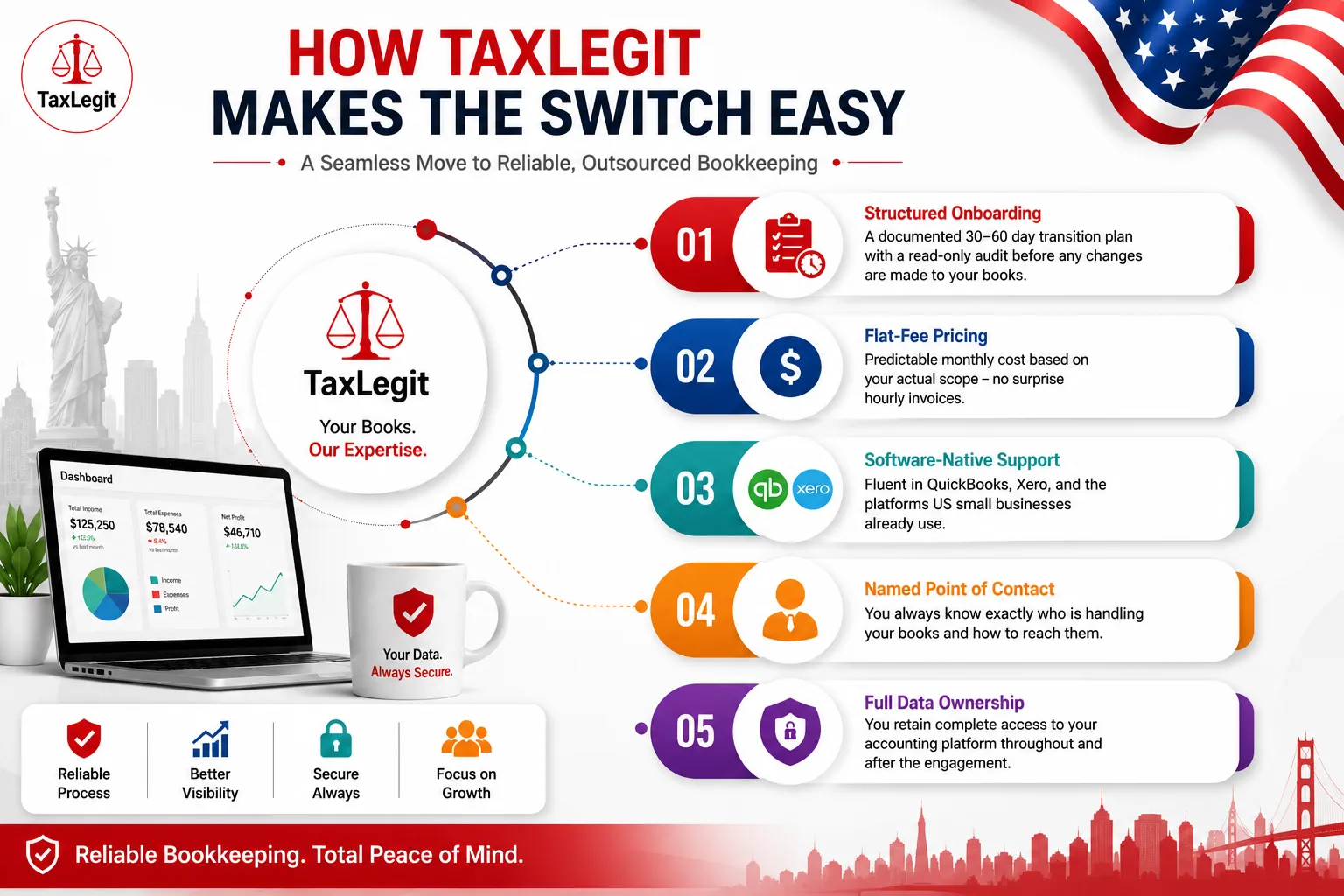
At TaxLegit, we specialize in exactly the transition you are facing: moving from a DIY setup or a disjointed in-house process to a reliable, outsourced bookkeeping system all without losing visibility into your day-to-day financial data along the way.
- Structured Onboarding: A documented 30–60 day transition plan with a read-only audit before any changes are made to your books.
- Flat-Fee Pricing: Predictable monthly cost based on your actual scope no surprise hourly invoices.
- Software-Native Support: Fluent in QuickBooks, Xero, and the platforms US small businesses already use.
- Named Point of Contact: You always know exactly who is handling your books and how to reach them.
- Full Data Ownership: You retain complete access to your accounting platform throughout and after the engagement.
Your Next Step
Now, switching to outsourced bookkeeping doesn’t have to mean losing control of your numbers. With a clear scope, the right pricing model, and a structured transition, most businesses come out the other side with cleaner books than they’ve had in years not messier ones.
Frequently Asked Questions
Most businesses are fully transitioned within 30–60 days, including a read-only audit, a chart of accounts cleanup, and a parallel run before full cutover. Businesses with clean existing books can move faster; those needing catch-up work should expect the longer end of that range.
No, A properly structured transition keeps you on your existing cloud accounting platform (QuickBooks or Xero) throughout, so you retain read access at every stage. You should never have to hand over your login and wait.
Flat-fee pricing is almost always better for ongoing work because it gives you predictable costs and aligns the provider’s incentives with efficiency. Hourly billing makes more sense for one-time cleanup or catch-up projects where the scope genuinely can’t be defined upfront.
A quality provider identifies these during the read-only audit phase and addresses them as part of onboarding either as part of the standard engagement or as a separately scoped cleanup project, depending on severity.
Yes, Outsourced bookkeeping scopes are flexible. Many businesses start with core reconciliation and reporting, then add payroll coordination, AP/AR management, or controller-level review as they grow.
TaxLegit runs a structured 30–60 day onboarding that starts with a read-only audit of your existing books, followed by a chart of accounts cleanup, opening balance verification, and a parallel run before the final cutover. To see our step-by-step onboarding roadmap, visit taxlegit.com.
About the Author

Srijita
Content Writer
Srijita is a legal and financial content specialist with 5+ years of experience in the Indian corporate sector. She simplifies MCA regulations and tax compliance into clear, actionable insights for entrepreneurs, working closely with Chartered Accountants and legal experts to ensure accuracy and compliance. Reviewed by Vipul Sharma, Co-Founder, Taxlegit.