
Introduction
The framing is almost always wrong.
Every time I talk to a US business owner about bookkeeping outsourcing, the conversation starts in the same place. They think of it as a cost-cutting shortcut a way to pay less for something they have to do but do not want to think about.
That framing makes them do two things wrong.
First, they evaluate outsourcing providers like they evaluate a staffing agency. Second, when the cheap option underdelivers, they conclude that outsourcing itself doesn't work. Then they go and hire another in-house bookkeeper who might leave them in fourteen months.
I have been working with US small businesses on their accounting and financial infrastructure for years. I've watched this cycle repeat with dozens of founders.
What Is Bookkeeping Outsourcing
Bookkeeping outsourcing is the delegation of a business’s day-to-day financial tracking to a specialized external firm. In 2026, US businesses need it not just to cut costs by 40–60% over an in-house hire but also to solve severe domestic accounting talent shortages and maintain real-time compliance amidst tightening IRS reporting regulations.
What I want to do in this post is tell you what bookkeeping outsourcing actually is not what the marketing materials say. I want to trace why it exists in the first place, what problem it actually solves at this specific moment in 2026, and how to think about it correctly if you are a business owner deciding whether to make the switch.
Key Takeaways
- What It Actually Is: Bookkeeping outsourcing is a strategic shift to a modern financial infrastructure that scales with your business.
- The 2026 Reality: Evolving tax regulations and real-time compliance demands mean that old-school, reactive bookkeeping is no longer enough to protect a US business.
- The Mindset Shift: Success requires moving from doing the books to reviewing the data, just as shifting your role from data entry clerk to strategic decision-maker.
The Foundation: Every Business Owner Was the Bookkeeper?
To understand what bookkeeping outsourcing is and why it matters, you first need to understand what bookkeeping looked like before it was an outsourceable function.
In the 1970s and 1980s, if you ran a small or mid-sized business in the United States, your financial records lived in a physical ledger book
This was expensive, slow, and required a physically present professional to manage
Then, in 1978, Peachtree Software launched the first accounting software package for personal computers. Intuit followed in 1983 with Quicken and released QuickBooks in 1992. By the mid-1990s, QuickBooks had captured 85% of the small business accounting software market in the United States.
This changed everything. And almost nothing.
Here is what I mean by that.
QuickBooks made bookkeeping faster, more organized, and accessible to non-accountants. But it did not make bookkeeping any less of a time-consuming obligation. It just transferred that obligation directly to the business owner.
The average small business owner still spends 10 to 15 hours per month on bookkeeping tasks when managing books in-house, according to CSI Accounting benchmarking data. For those who also handle billing and payroll, that figure rises to 25 hours per month.
| Example: A $1.8M professional services firm in Charlotte runs QuickBooks. The owner reconciles accounts herself, twice a week, on evenings she would rather spend on client work or business development. She is not running a bookkeeping operation. She is running a professional services firm that has accidentally also become its own bookkeeping department. |
Cloud Accounting Changed the Delivery. It Did Not Solve the Problem
Around 2006, something important happened.
Xero launched as a cloud-first accounting platform. By 2010, there were roughly 6 million users of cloud-based accounting applications globally. QuickBooks Online followed. NetSuite expanded. Suddenly, your books were no longer locked on a single desktop. They lived in the cloud, accessible from anywhere, updatable by anyone with credentials.
The fear at the time was similar to what you hear about outsourcing today. If software is this accessible and easy to use, do you even need a bookkeeper?
The answer turned out to be "yes, more than ever."
Cloud accounting did not eliminate the complexity of bookkeeping. It democratized access to the tools while increasing the volume and sophistication of what businesses needed to track.
By 2015, a mid-sized US business was not just recording sales and expenses. It was managing:
- Multiple revenue streams across different platforms
- Multi-state payroll for remote employees
- Sales tax obligations in states where it had economic presence post-Wayfair
- Inventory across multiple fulfilment channels
- Contractor payments with 1099 reporting obligations
- Accrual-basis accounting for investor or lender reporting
Cloud software handled the access. It did not handle the expertise gap.
And the expertise gap kept widening. By 2024, the US had 300,000 fewer accountants in its workforce than in 2019, according to data from the AICPA and Auxis. CPA exam participation had dropped by 27% over the preceding decade. CPA-credentialed finance roles were taking an average of 73 days to fill, 41% longer than roles without the designation.
The supply of qualified bookkeeping talent contracted just as demand was accelerating. That is the structural problem bookkeeping outsourcing solves.
What Bookkeeping Outsourcing Actually Is
Let me be precise about this, because the term gets used loosely.
Bookkeeping outsourcing entails contracting an external firm to manage financial record-keeping rather than handling these tasks in-house. The external team accesses your accounting platform such as QuickBooks Online or Xero—and performs tasks like recording transactions, reconciling accounts, managing accounts payable and receivable, facilitating payroll, and producing monthly financial statements on a set date.
And henceforth,
You keep full access to your books at all times.
You retain 100% approval authority over all outgoing payments.
You get a monthly report that reflects your actual financial position, produced by a team that specializes in this work, without you spending Tuesday evenings doing it yourself.
When you hire a financial team instead of a part-time bookkeeper, you benefit from consistent support. If one team member is unavailable, the work continues seamlessly, ensuring your financial records stay up to date.
| Example: A $2.5M e-commerce brand in Denver outsources its bookkeeping to a three-person team: a dedicated bookkeeper who manages daily transactions, an accountant who handles monthly close and reviews, and a controller who signs off on every deliverable before it reaches the owner. The owner pays $1,400 per month. The same capability in-house even a single mid-level accountant would cost $85,000 to $110,000 per year in loaded cost. The team covers everything from Amazon settlement reconciliation to multi-state sales tax compliance. |
Why US Businesses Actually Need It in 2026 And Why the Timing Matters
I do not think most guides explain this clearly enough.
Outsourcing bookkeeping is not a recent idea. It has been around in some capacity since cloud accounting enabled remote financial management in the late 2000s. However, the reasons businesses require it today specifically in 2026 differ from those in 2012. Three things converged in the last three years that changed the calculus.
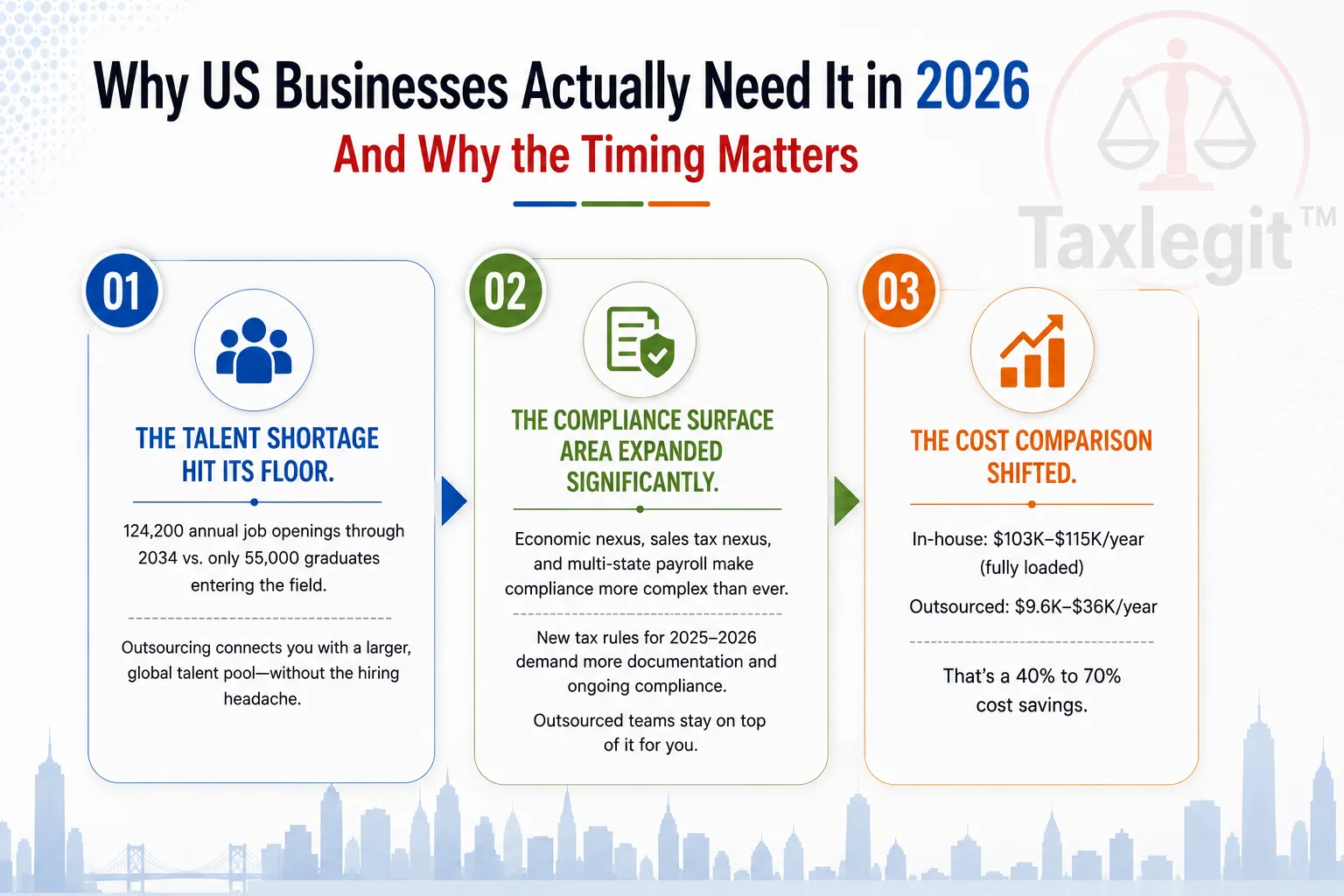
First: The talent shortage hit its floor.
The accounting workforce has been contracting since 2019. The Bureau of Labor Statistics projects 124,200 annual accounting and auditor openings through 2034, against roughly 55,000 graduates entering the profession each year. That gap does not close through normal hiring cycles. A business posting for a qualified bookkeeper is competing for a vanishingly small pool of candidates against every other business doing the same thing.
Outsourcing bypasses that competition entirely. The pool of qualified offshore professionals fluent in US GAAP, QuickBooks, and Xero is larger, more accessible, and not subject to the same domestic supply constraints.
Second: The compliance surface area expanded significantly.
The Supreme Court’s South Dakota v. Wayfair decision in 2018 introduced economic nexus for sales tax. The rise of remote work has led to multi-state payroll obligations. New tax provisions in 2025 and 2026 altered the deductibility of R&D expenses, necessitating transaction-level documentation throughout the year. A stretched or under-resourced bookkeeper may miss these details, while an outsourced team can manage compliance effectively.
Third: The cost comparison shifted.
In 2026, a fully loaded in-house senior accountant costs $103,000 to $115,000 per year when you factor in the BLS median salary of $81,680, employer FICA taxes, healthcare benefits, software subscriptions, and the SHRM-benchmarked recruiting cost of $4,683 per hire.
A full-service outsourced bookkeeping engagement for the same scope costs $9,600 to $36,000 per year, depending on transaction volume and service depth. That is a 40% to 70% reduction.
That spread has always existed. But it has widened as domestic accounting salaries have risen under supply pressure while offshore team quality has improved as cloud tools made remote collaboration genuinely seamless.
The economics are simply better than they were five years ago.
What Actually Changes When You Outsource Your Bookkeeping
I want to be direct about this, because the marketing materials are often too optimistic.
Outsourcing bookkeeping does not eliminate your need to understand your own finances. A business owner who never looks at a P&L statement will not become financially fluent because they outsourced the underlying work. You still need to spend 60 to 90 minutes per month reviewing your reports, understanding your margins, and asking questions when something does not look right.
What outsourcing changes is the nature of your involvement.
You shift from doing the work to reviewing the output. That is a fundamentally different relationship with your financial function.
Here is what that shift looks like in practice:
| Before Outsourcing | After Outsourcing |
| 12–15 hours per month on reconciliation, data entry, payroll review | 60–90 minutes per month reviewing accurate, current reports |
| Month-end close finishes 18–22 days into the following month | Month-end close delivered by the 5th–8th business day on a fixed schedule |
| Missed deductions discovered at year-end when it is too late | Deductions flagged monthly; year-end package delivered clean |
| Single bookkeeper dependency one resignation breaks continuity | Team-based model with guaranteed continuity regardless of individual availability |
| Compliance tracked manually or reactively | Compliance calendar managed systematically with built-in checks |
| CPA time spent on cleanup at year-end | CPA receives clean, categorized books and focuses on strategy and tax planning |
| Books 2–3 weeks behind; decisions made on outdated data | Current financial position visible at any time; decisions grounded in real numbers |
That last point is the one most business owners underestimate.
When your books are three weeks behind, you are making hiring decisions, pricing decisions, and investment decisions based on financial data that may no longer reflect your actual position. Outsourcing does not just save time. It changes the quality of information you operate on.
What Could Actually Go Wrong
Let's be honest about this too, because I think most outsourcing advocates are not.
Bookkeeping outsourcing fails in predictable ways, and most of those failures are preventable.
Choosing based on price without vetting scope
A $200/month bookkeeping service that excludes reconciliation is not bookkeeping. It is data entry. The difference only becomes clear at year-end when your CPA asks questions the books cannot answer. By then, the cleanup cost exceeds the savings multiple times over.
No defined SLA
If your contract doesn't specify the monthly closing date, response times for queries, and error correction procedures, you don't have a fixed-fee service. Instead, you have a retainer with no accountability, leaving you without grounds to request corrections when problems occur.
Outsourcing to a provider without industry-specific expertise
A bookkeeper unfamiliar with multi-state payroll nexus, Shopify settlement reconciliation, or accrual-basis revenue recognition for SaaS contracts may make mistakes that lead to higher cleanup costs. Be sure to ask if the provider has experience with businesses of your revenue size and compliance requirements.
No parallel run at onboarding
Giving complete bookkeeping responsibility to an outsourced team on the first day can lead to problems. Instead, use the first month as a time to review their work against your own records. This calibration period helps you spot errors in categorization and communication early, instead of letting them grow for six months.
Successful businesses treat the first 60 days as a structured onboarding process, not just a handoff. They review reports, ask questions, and establish clear communication before stepping back fully.
The Real Opportunity That Most Business Owners Miss
Here is what I think about every time I talk to a business owner who is on the fence.
The question they are asking is, "Does outsourcing bookkeeping save me money?"
That is the wrong question.
The right question is, "What is the most valuable use of my time and attention as the person running this business?"
The Clutch survey of small businesses found that 27% of owners who outsource administrative and financial tasks cite time recovery and improved efficiency as the primary benefit, ahead of cost reduction. That is not because cost savings are small. It is because the founders who have actually made the switch know that the time is what changes the business.
That is the real opportunity.
Not cheaper bookkeeping. Better use of the time bookkeeping was consuming.
How TaxLegit Approaches This
Are you a business owner in the $500K–$10M revenue range, tired of spending evenings on bookkeeping? At TaxLegit, we specialize in helping you regain your time and focus on what matters. We cover the full back-office spectrum: outsourced bookkeeping, AP/AR management, multi-state payroll coordination, US tax preparation, and fractional CFO services all under one flat monthly fee.
| Want to discover how outsourcing bookkeeping can benefit your business? Book your free financial workflow assessment here.Call: +91 89292 18091 | Email: [email protected] |
Conclusion
Bookkeeping outsourcing has been around for about fifteen years in its modern form.
For most of that time, it was seen as a cost play. You hired an offshore bookkeeper because they were cheaper than a domestic one.
The text emphasizes that outsourcing in 2026 offers more than just cost savings; it represents a significant structural shift for businesses. By outsourcing bookkeeping, companies not only spend less but also achieve better financial output, including faster closes and improved compliance. The question is not whether bookkeeping outsourcing is worth considering. At this point, for most businesses past $500K in revenue, it clearly is.
The question is whether you pick the right provider.
That is worth thinking carefully about.
Frequently Asked Questions
Outsourced bookkeeping typically covers transaction categorization, monthly bank and credit card reconciliation, accounts payable and receivable management, payroll recording, and monthly financial statements (P&L, balance sheet, and cash flow).
A part-time bookkeeper is one person with one set of skills, a single point of failure when they are unavailable, and limited scalability as your volume grows. An outsourced bookkeeping firm provides a team typically a bookkeeper, accountant, and reviewer under one fixed monthly cost.
Reputable outsourced bookkeeping firms operate under SOC 2 Type II certified infrastructure with bank-level encryption, multi-factor authentication on all employee accounts, and virtual desktop environments that prevent financial data from being downloaded locally.
Pricing ranges from $200 to $2,500 per month for most US small businesses, depending on transaction volume, entity structure, and service scope. A typical $1M–2M revenue business with standard complexity falls in the $500 to $1,200 range for core bookkeeping and monthly financial statements.
For a business with current books and a single accounting platform, onboarding takes two to four weeks. For businesses with backlogs, a cleanup project is completed first before the standard monthly engagement begins.
Yes, Professional fees paid to an external accounting firm for bookkeeping, financial administration, and tax preparation are classified as ordinary and necessary business expenses under Internal Revenue Code Section 162 and are fully tax-deductible in the year paid.
About the Author

Srijita
Content Writer
Srijita is a legal and financial content specialist with 5+ years of experience in the Indian corporate sector. She simplifies MCA regulations and tax compliance into clear, actionable insights for entrepreneurs, working closely with Chartered Accountants and legal experts to ensure accuracy and compliance. Reviewed by Vipul Sharma, Co-Founder, Taxlegit.