
You post a vendor bill, and your accounting software asks you to choose a debit or credit side for accounts payable. Guess wrong, and your trial balance won't tie out, your cash position looks better than it actually is, and you're the one hunting for a rounding error at 11 p.m. That's really a misclassified liability. This is one of the most common points where new bookkeepers and founders doing their own books get tripped up, and it's worth thirty seconds to get permanently right.
What Are Accounts Payable?
Accounts payable (AP) is a current liability account that tracks money a business owes to its suppliers and vendors for goods or services it has already received but not yet paid for. It sits on the balance sheet under current liabilities and typically clears within the payment terms a vendor sets commonly net 30, net 60, or net 90 days.
Is Accounts Payable a Debit or a Credit?
Accounts payable is a credit account, because it is a liability, and liability accounts carry a normal credit balance. This follows directly from the accounting equation Assets = Liabilities + Equity which double-entry bookkeeping is built to keep in balance. In that system:
- Debits increase asset and expense accounts and decrease liability, equity, and revenue accounts.
- Credits increase liability, equity, and revenue accounts and decrease asset and expense accounts.
So when your business receives a bill, you credit accounts payable (the liability grows) and debit the matching expense or asset account (you now have the inventory, service, or supplies). When you pay that bill, the entry reverses: you debit accounts payable (the liability shrinks) and credit cash or your bank account.
Why Getting This Right Matters
Misclassifying accounts payable isn't just a bookkeeping technicality it distorts the numbers a founder or lender actually relies on. Overstate a debit where a credit belongs and your liabilities look smaller than they are, which can mean signing off on spending you don't actually have room for. This is exactly the kind of error that manual, unautomated AP processes are prone to: Ardent Partners' 2025 State of ePayables research puts the average fully loaded cost to process a single invoice at $10.89 against $2.78 at best-in-class organizations a gap driven largely by manual entry, miscoding, and the rework that follows. At scale, that difference compounds fast.
How to Record Accounts Payable: Step-by-Step
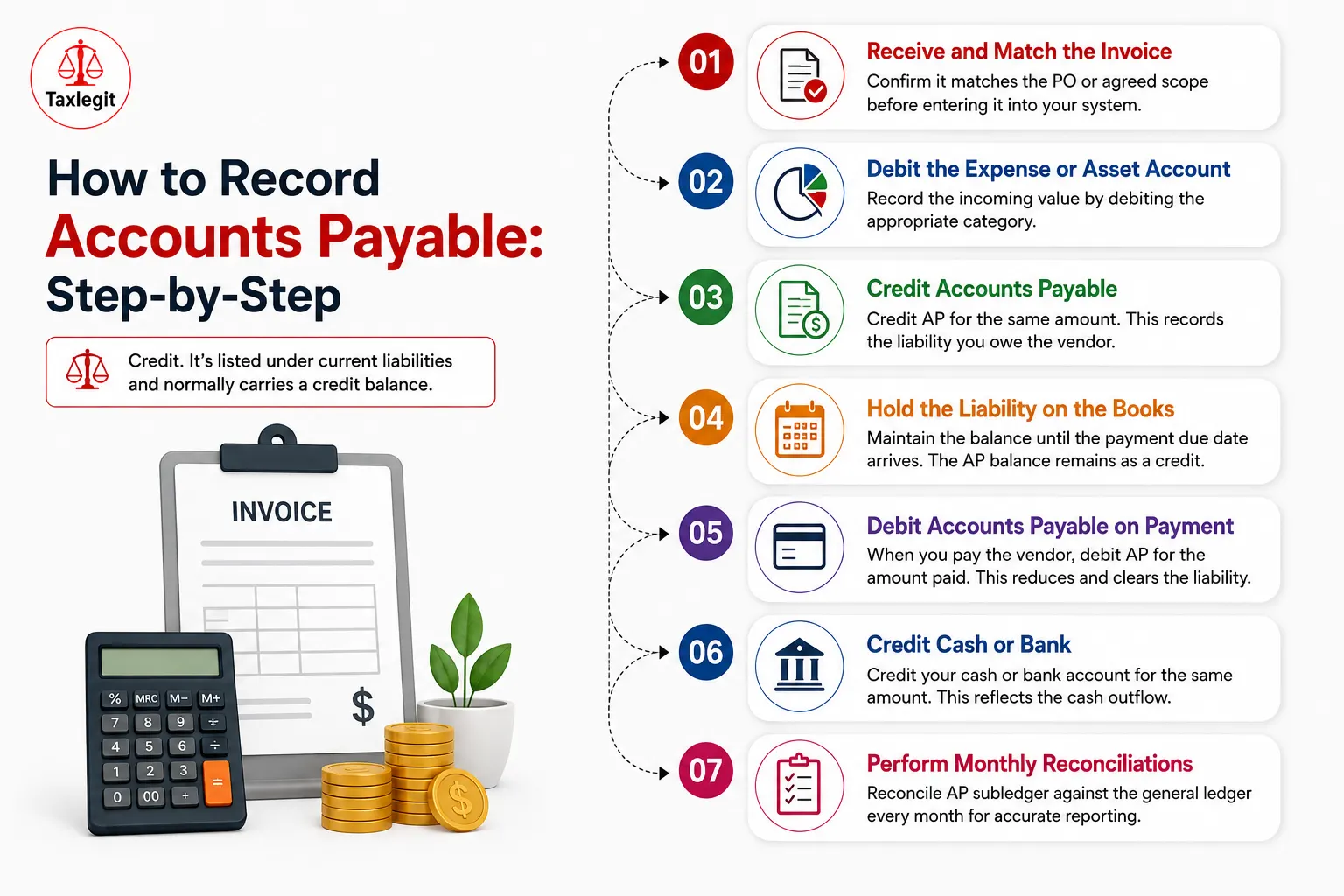
Is accounts payable a debit or credit on the balance sheet?
Credit. It's listed under current liabilities and normally carries a credit balance
Step 1: Receive and Match the Invoice:
- Action: Receive the vendor invoice.
- Control: Confirm it matches the corresponding purchase order (PO) or agreed scope of work before entering it into your system.
Step 2: Debit the Expense or Asset Account:
- Action: Record the incoming value by debiting the appropriate category.
- Example: If you bought office supplies, debit Office Supplies Expense; if you purchased goods for resale, debit Inventory.
Step 3: Credit Accounts Payable:
- Action: Credit Accounts Payable for the same amount.
- Result: This official entry records the liability reflecting what your business now owes the vendor.
Step 4: Hold the Liability on the Books:
- Action: Maintain the balance until the payment due date arrives.
- Result: The AP balance remains as an active credit on your balance sheet until settled.
Step 5: Debit Accounts Payable on Payment:
- Action: When you finally pay the vendor, debit Accounts Payable for the amount paid.
- Result: This action reduces and clears out the liability.
Step 6: Credit Cash or Bank:
- Action: Credit your cash or bank account for the same amount.
- Result: This reflects the actual outflow of money from your business.
Step 7: Perform Monthly Reconciliations:
- Action: Reconcile your AP subledger against the general ledger balance every month.
- Result: Ensures that all open and paid bills tie out perfectly for flawless financial reporting.
Common Mistakes to Avoid
- Debiting AP when a bill is received This is the single most common reversal error it understates your liabilities and can make cash flow look healthier than it is.
- Forgetting to reverse accrued expenses once the actual vendor bill arrives, which double-counts the liability.
- Recording the payment against the wrong vendor sub-ledger, which throws off individual vendor balances even when the total AP figure looks correct.
- Treating a credit memo or vendor refund as a new bill instead of a debit adjustment to the existing AP balance.
- Not reconciling AP monthly, which lets small misclassifications compound into a balance sheet that no longer reflects reality.
A Worked Example: Recording and Paying a Vendor Bill
Say your business receives a $4,000 invoice from a supplier for raw materials on 30-day payment terms.
Step 1 : Bill received:
| Account | Debit | Credit |
| Inventory | $4,000 | |
| Accounts Payable | $4,000 |
Step 2: Bill paid 30 days later:
| Account | Debit | Credit |
| Accounts Payable | $4,000 | |
| Cash | $4,000 |
Notice the AP balance nets to zero across the two entries that's the check you can run any time a vendor account looks off.
Accounts Payable vs. Accounts Receivable ( Comparison )
| Accounts Payable | Accounts Receivable | |
| What it represents | Money you owe others | Money owed to you |
| Balance sheet category | Current liability | Current asset |
| Normal balance | Credit | Debit |
| Increases with | Credit | Debit |
| Decreases with | Debit | Credit |
Get Your Books Reconciled the Right Way
Misclassified liabilities are one of the most common issues we catch when we take over bookkeeping for a growing business. TaxLegit's outsourced accounting team handles accounts payable processing, monthly reconciliation, and full-cycle bookkeeping for US businesses and NRIs, so your balance sheet reflects what you actually owe—not what a miscoded entry says you owe.
Frequently Asked Questions
Credit, It's listed under current liabilities and normally carries a credit balance
Yes, if you overpay a vendor or record a duplicate payment, the account temporarily shows a debit balance until it's corrected or refunded.
Debit the relevant expense or asset account, and credit accounts payable for the invoice amount.
Debit accounts payable and credit cash or bank for the amount paid.
No, Accounts payable are tied to a specific vendor invoice; accrued expenses are costs incurred but not yet billed and get reversed once the actual invoice arrives.
Usually an overpayment, a duplicate entry, or a credit memo posted incorrectly check the vendor sub-ledger against the original invoice and payment records.
About the Author

Srijita
Content Writer
Srijita is a legal and financial content specialist with 5+ years of experience in the Indian corporate sector. She simplifies MCA regulations and tax compliance into clear, actionable insights for entrepreneurs, working closely with Chartered Accountants and legal experts to ensure accuracy and compliance. Reviewed by Vipul Sharma, Co-Founder, Taxlegit.