
When you hear the word "outsourcing," your mind usually jumps to risk. You think about data breaches, identity theft, and rogue compliance errors that could trigger a brutal IRS audit.
But here is an unpopular opinion: Keeping your financial data entirely in-house is often far more dangerous than outsourcing it to a secure, professional agency. When you rely on a single local bookkeeper, you are one malicious email link, one weak password, or one disgruntled employee away from a catastrophic security event. Professional outsourcing isn't about giving up control, but it is about upgrading to a multi-layered fortress that protects your business.
The Tasks You Can Safely Outsource Today
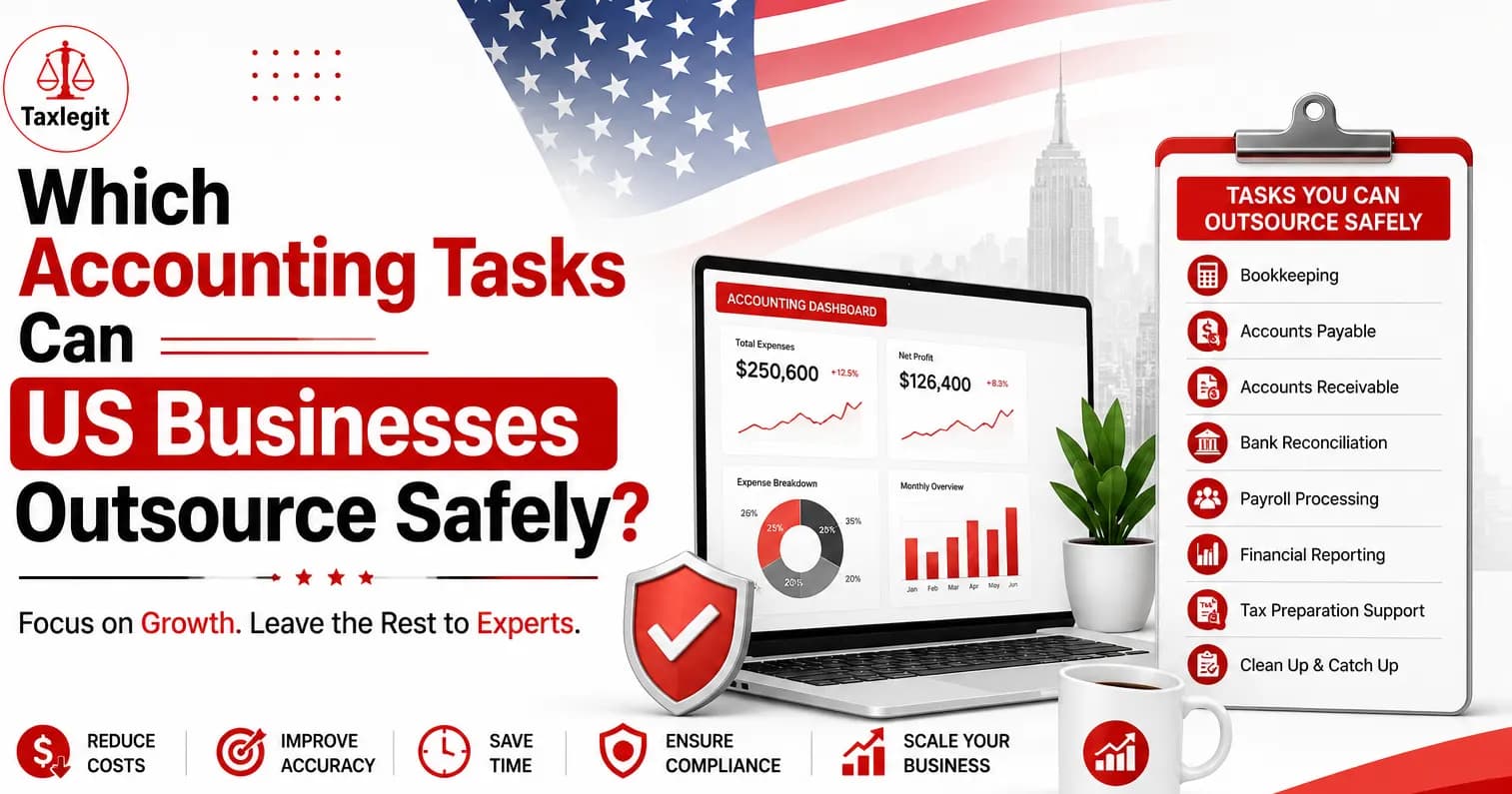
Not all accounting tasks are created equal. You don’t need to hand over total control of your company's treasury on day one. Safe outsourcing is built on modularity. Here are the core functions that can be seamlessly shifted offshore without compromising your security:
The 7 Core Safety Features Protecting Your Business
If you are outsourcing your financial backend to a premium agency, data security isn't an afterthought but its core infrastructure. Here are the 7 non-negotiable safety features that top-tier outsourcing models use to protect your business:
1. Multi-Factor Authentication (MFA) and Single Sign-On (SSO)
The days of emailing passwords or writing them on sticky notes are over. Premium outsourcing agencies utilize secure credential management platforms (like LastPass or Keeper). Your offshore team accesses your software via encrypted portals where credentials are obfuscated. Multi-factor authentication ensures that even if a password were leaked, it would be entirely useless without the secondary physical token.
2. Strict Role-Based Access Controls (RBAC)
In a flawed in-house system, one employee often has keys to the entire castle. Safe outsourcing relies on the principle of least privilege. A data entry clerk is restricted solely to the receipt ledger; a senior accountant can view the general ledger but cannot edit bank details. Limiting access strictly to what a specific role requires dramatically reduces your internal threat surface.
3. End-to-End Encryption (Data at Rest and in Transit)
Any financial data moving between your US headquarters and your offshore team is fully shielded. Agencies utilize military-grade 256-bit AES encryption for data at rest and Secure Sockets Layer (SSL)/Transport Layer Security (TLS) protocols for data in transit. If cybercriminals attempt to intercept your financial packets midstream, they receive nothing but unreadable code.
4. ISO 27001 Certified Secure Data Centers
The physical and digital environments where your data is processed must meet strict international standards. High-quality Indian agencies operate out of ISO/IEC 27001-certified facilities. This certification guarantees regular third-party audits, advanced firewalls, strict network intrusion detection systems, and zero localized data storage on individual employee machines.
5. Secure Virtual Desktop Infrastructures (VDI)
To prevent data leaks, offshore specialists work within closed Virtual Desktop Environments. This means your financial data never physically leaves your cloud environment.
6. Strict Segregation of Duties
A critical vulnerability for small businesses is having a single person manage invoices, execute payments, and reconcile the bank account. Outsourcing agencies eliminate this single point of failure by enforcing a structural wall between the team members preparing financial records and those verifying them.
7. Comprehensive Non-Disclosure Agreements (NDAs) and Legal Protections
Reputable outsourcing firms back up their technological infrastructure with ironclad legal frameworks. This includes binding corporate NDAs, comprehensive employee confidentiality agreements, and compliance protocols aligned directly with US privacy frameworks (such as GLBA for financial firms or HIPAA for healthcare clients).
Why Indian Outsourcing Agencies Are the Safest Choice
There is an outdated misconception that outsourcing offshore means compromising on quality or operating in a legal wild west. The reality of modern corporate infrastructure is exactly the opposite: India has built the safest, most sophisticated financial outsourcing ecosystem in the world
Here is why US businesses looking for maximum security choose India:
- Unmatched Professional Credentials: The scale of accounting expertise in India is exceptional. Indian outsourcing teams aren't comprised of general data entry clerks; they are staffed by Chartered Accountants (CAs), ACCAs, and professionals deeply trained in US GAAP standards. They possess a granular understanding of compliance risk that rivals local US firms.
- SOC 2 Type II and ISO Domination: Indian financial service enterprises treat international compliance as their primary product. The country boasts the highest concentration of SOC 2 Type II compliant delivery hubs outside the US. These facilities undergo continuous, rigorous third-party testing of their security, confidentiality, and processing integrity.
- A Tech-First Security Culture: Because India drives global IT infrastructure, its accounting firms utilize cutting-edge digital defenses. From biometric access control at physical facilities to continuous AI-driven network monitoring to catch anomalies, their security tech stack is often far superior to what an average US small or mid-sized business could afford to deploy internally.
Quick Tips for Safe Accounting Outsourcing
If you are ready to reclaim your time and scale your operations safely, use this checklist to audit any potential outsourcing partner:
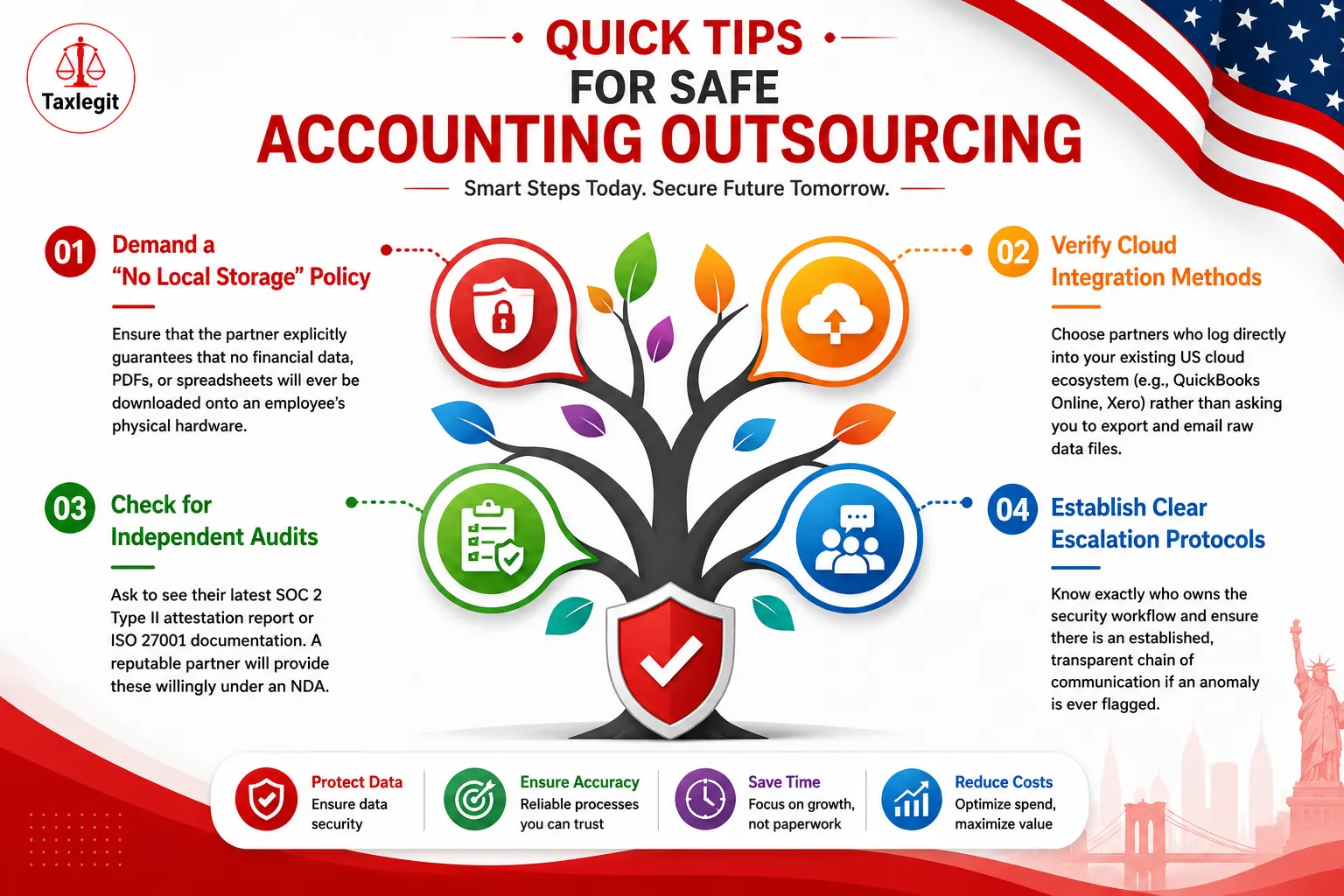
- Demand a "No Local Storage" Policy: Ensure that the partner explicitly guarantees that no financial data, PDFs, or spreadsheets will ever be downloaded onto an employee's physical hardware.
- Verify Cloud Integration Methods: Choose partners who log directly into your existing US cloud ecosystem (e.g., QuickBooks Online, Xero) rather than asking you to export and email raw data files.
- Check for Independent Audits: Ask to see their latest SOC 2 Type II attestation report or ISO 27001 documentation. A reputable partner will provide these willingly under an NDA.
- Establish Clear Escalation Protocols: Know exactly who owns the security workflow and ensure there is an established, transparent chain of communication if an anomaly is ever flagged.
How TaxLegit Protects Your Financial Integrity
At TaxLegit, we believe that scaling your business shouldn't require you to take risks with your data. We have engineered a premium, secure cross-border financial ecosystem specifically designed to give US small and mid-sized businesses elite accounting performance with absolute peace of mind. Here is how we keep your business safe and compliant:
- Ironclad Data Governance: We utilize highly secure, encrypted cloud connections and role-based access controls to ensure your financial data is viewed only by authorized specialists.
- US GAAP & IRS Precision: Our team is comprehensively trained in US tax codes and accounting standards, eliminating compliance errors and mitigating your audit exposure.
- Complete Operational Control: We optimize your workflows, manage your ledgers, and clean up your books, but you always maintain ultimate authorization over your accounts and capital.
- Comprehensive Visibility: We replace fragmented, insecure manual tracking with automated financial tech stacks, providing you with real-time financial dashboards accessible 24/7.
Stop losing your nights to chaotic spreadsheets and worrying about internal back-office vulnerabilities. Let the professionals handle the heavy lifting safely.
Ready to evaluate ACCOUNTING platforms the right way?
Click here to schedule your free accounting outsourcing readiness assessment] and get a custom feature-fit analysis within 48 hours.
Frequently Asked Questions
Yes, it is entirely legal. The IRS explicitly permits the use of offshore tax preparers and bookkeepers under Internal Revenue Code Section 7216. However, US tax law requires tax practitioners to obtain signed, written consent from the taxpayer (using a specific disclosure statement)
You maintain complete control by granting "Read-Only" or "Accountant-View" privileges within your bank portal and accounting software (like QuickBooks Online or Xero).
Ultimate legal responsibility for a tax filing always rests with the US business owner. However, top-tier Indian outsourcing firms mitigate this risk through a rigorous dual-review workflow: a dedicated associate prepares the books, and a senior reviewer or Chartered Accountant audits the work for accuracy.
Premium Indian outsourcing agencies build their digital infrastructure to align directly with US federal regulations. For healthcare clients, they sign Business Associate Agreements (BAAs) and use encrypted pipelines to ensure HIPAA compliance
No, The IRS does not select businesses for audits based on where their bookkeeping or tax preparation occurs; audits are triggered by statistical anomalies in your financial data, missing forms, or mismatched numbers.
About the Author

Srijita
Content Writer
Srijita is a legal and financial content specialist with 5+ years of experience in the Indian corporate sector. She simplifies MCA regulations and tax compliance into clear, actionable insights for entrepreneurs, working closely with Chartered Accountants and legal experts to ensure accuracy and compliance. Reviewed by Vipul Sharma, Co-Founder, Taxlegit.