
Who This Guide Is For
Meet Jordan, 42. He is the founder and CEO of a seven-figure e-commerce business in Dallas, Texas. He has been running his books through a part-time bookkeeper for three years and is finally ready to move to a full outsourced accounting model. He has already decided to outsource. What he has not figured out is what a fair price looks like, which billing model protects him from surprise invoices, and what the red flags are in a provider contract. He has a call with two outsourcing firms next week and does not want to walk in blind. This guide gives the exact numbers, pricing structures, and questions to ask before you sign.
Why Is Accounting Outsourcing Pricing So Hard to Figure Out?
Jordan asked three providers for a quote. He got three completely different numbers in three completely different formats one hourly rate, one flat fee, and one percentage of his revenue. None of them were directly comparable, and none included a clear breakdown of what was and was not covered. This is the most common frustration US business owners face when evaluating outsourced accounting. There is no single published rate card.
This guide breaks it down into the three things Jordan actually needs to know: what the tiers cost, which billing model protects him, and what hidden fees to look for in the contract.
What Does an In-House Accountant Actually Cost vs an Outsourced Team?
According to BLS Occupational Employment Statistics (May 2024), the median annual wage for US accountants and auditors is $81,680. Crucially, this is a general industry median, and it reflects compensation before employer FICA taxes, health benefits, 401(k) matching, office hardware, and software subscriptions. Furthermore, SHRM's Human Capital Benchmarking data puts the average recruitment and onboarding cost for a single hire at $4,683 a cost Jordan would pay again every time someone resigns.
In-House vs. Outsourced Cost Comparison (Annual)
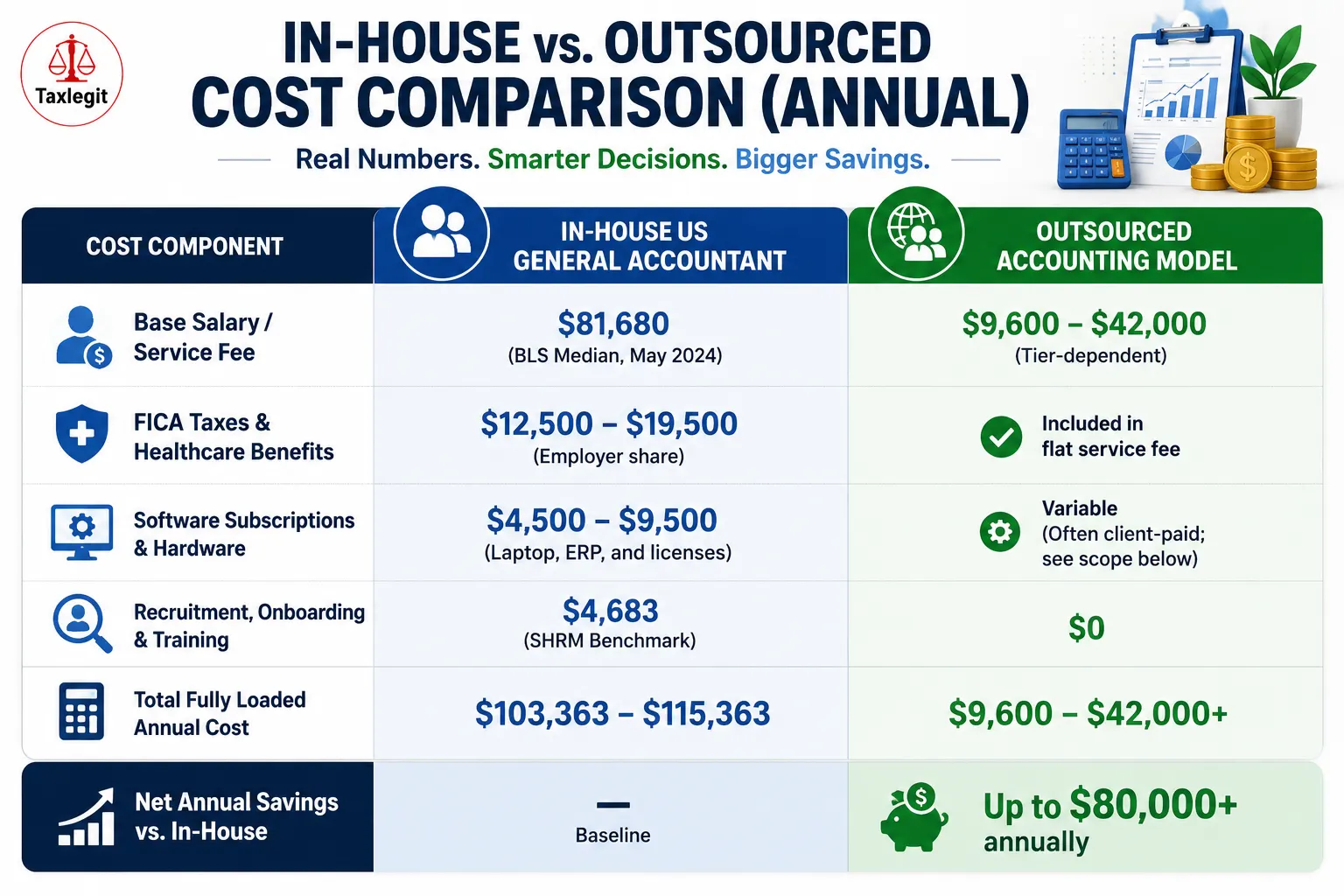
| Cost Component | In-House US General Accountant | Outsourced Accounting Model |
| Base Salary / Service Fee | $81,680 (BLS Median, May 2024) | $9,600 – $42,000 (Tier-dependent) |
| FICA Taxes & Healthcare Benefits | $12,500 – $19,500 (Employer share) | Included in flat service fee |
| Software Subscriptions & Hardware | $4,500 – $9,500 (Laptop, ERP, and licenses) | Variable (Often client-paid; see scope below) |
| Recruitment, Onboarding & Training | $4,683 (SHRM Benchmark) | $0 |
| Total Fully Loaded Annual Cost | $103,363 – $115,363 | $9,600 – $42,000+ |
| Net Annual Savings vs. In-House | Baseline | Up to $80,000+ annually |
The savings are real. But the exact number depends on which tier of service Jordan needs, which is what the section below answers directly.
What Are the Pricing Tiers for Outsourced Accounting in 2026?
Outsourced accounting is not a one-size-fits-all service. Pricing scales dynamically based on transaction volume, service complexity, and the level of strategic oversight required.
| Tier | Monthly Cost Range | Best For | What Is Included | Key Cost Drivers (Why ranges overlap) |
| Tier 1: Core Bookkeeping | $200 – $800/mo | Freelancers, early-stage startups, single-entity businesses under $500K revenue | Cash-basis bookkeeping, bank feed categorization, monthly bank reconciliations, basic P&L, and Balance Sheet | Transaction volume (number of bank accounts/cards, monthly transaction count). |
| Tier 2: Full-Service Accounting | $800 – $2,500/mo | Growth-stage LLCs, multi-channel e-commerce, professional services, seed-funded startups | Accrual accounting, AP/AR management, multi-state payroll administration | Complexity of operations |
| Tier 3: Controller-Level | $2,500 – $5,000/mo | Series A startups, multi-entity operations, businesses preparing for audits or investor due diligence | Everything in Tier 2, plus multi-entity consolidation, strict audit-readiness, advanced budgeting, department margin analysis | Process & Compliance: Focused on accuracy, GAAP compliance, and internal controls. Priced by volume of entities and audit complexity. |
| Tier 4: Fractional CFO | $3,500 – $8,000+/mo | Venture-backed companies, pre-exit businesses, fast-scaling companies requiring high-level advisory | Everything in Tier 3, plus cash flow forecasting, capital structure advisory, unit economic modeling, board meeting participation | Strategy & Seniority: Focused on future-looking strategy. High rates reflect a senior executive's time ($200–$450+/hr) for board work and capital raising. |
The $3,500 to $5,000 Overlap Explained:
A $4,000/mo controller engagement is execution-heavy focused on managing complex day-to-day accounting operations, multi-entity books, and strict GAAP compliance for a high-volume business.
Conversely, a $4,000/mo Fractional CFO engagement is highly strategic but low-volume providing limited monthly hours (e.g., 10–12 hours) dedicated purely to forward-looking financial modeling, cash runway expansion, and investor presentations.
Which Accounting Outsourcing Pricing Model Should You Choose?
This is the decision that matters most after the tier. The pricing model determines whether your bill is predictable or whether a busy quarter turns into an invoice you did not budget for. There are generally three models in the market.
Model 1: Hourly Billing Model ($25 to $150+ Per Hour)
Under this model, you pay only for active hours logged. Instead of treating geography as a simplistic proxy for pricing, modern outsourced rates are driven by a combination of staff seniority, real-time US-hours availability, data security infrastructure, and CPA oversight
The Problem: Your monthly bill is unpredictable. A busy quarter, a backlog cleanup, or extra questions from your CPA can trigger an invoice 30–40% above your expected spend. Jordan cannot budget accurately under this model, and neither can most business owners.
Model 2: Percentage of Revenue (1–2% of Gross Monthly Sales)
Some boutique firms price their services as a percentage of your gross monthly revenue typically 1–2%.
The Problem: This model penalizes you for growing. If Jordan's revenue doubles from $1M to $2M annually, his accounting fee also doubles even if the actual volume of work does not change. A growing business should not pay more for the same service.
Model 3: Fixed Monthly Subscription (Often the Best Fit for Recurring, Well-Scoped Work)
You pay a predictable flat fee based on transaction volume, bank accounts, and channels. While minor monthly swings won't affect your rate, mid-term adjustments can be triggered by volume spikes or extra tasks. To protect both parties, contracts include key safeguards:
- Volume Thresholds & Change Control: Triggers mid-term pricing adjustments if activity spikes.
- Written Out-of-Scope Schedule: Clearly defines flat rates for extra tasks.
- Cleanup Fees & Renewal Caps: Manages historical backlogs upfront and limits future rate increases.
Why this model wins: It gives Jordan complete budget predictability. He knows his accounting cost on January 1st the same as he knows it on December 31st. When his business grows, the fee adjusts at contract renewal not mid-month.
Our outsourced accounting service operates exclusively on a flat-fee subscription model no hourly overages, no revenue percentage.
What Are the Most Common Pricing Mistakes Businesses Make When Outsourcing?
Across 250+ US business onboardings, TaxLegit sees the same pricing errors repeatedly almost always from buyers who evaluated providers quickly rather than carefully.
- Comparing the wrong numbers: Comparing an outsourced monthly fee directly to a base salary instead of the fully loaded cost is the most expensive mistake. The correct comparison is service fee vs. loaded cost—which includes FICA, benefits, software, and recruitment.
- Focusing on price alone: The cheapest provider who misses a state payroll nexus filing or fails an investor due diligence request costs more to fix than the price difference justified.
- Not asking about the renewal pricing structure: Some providers offer low introductory rates that reset at the 12-month renewal.
- Signing without a defined SLA: A contract without a stated monthly close date, response time, and error-correction turnaround is not a fixed-fee agreement
- Underscoping the brief: Buyers who provide vague volume information while providers quote conservatively on vague briefs and adjust upward once they see the real volume.
What a Right-Sized Outsourcing Investment Looks Like
This anonymized composite case illustrates potential savings based on a 12-month engagement, though actual results vary by business complexity.
- Before ($112,000/year): One senior accountant and a part-time bookkeeper managed bookkeeping, AP, payroll, and tax prep. Month-end close took 21 days.
- After ($21,600/year): A three-person outsourced team took over bookkeeping, AP, payroll coordination, and monthly close for a flat $1,800/month. Tax prep was carved out to a separate CPA.
The Outcome: Accounting spend fell 81%, close time dropped to 5 days, and the owner saved 14 hours monthly.
The lesson: The savings were not primarily from cheaper labor. It was from removing the benefits, software, recruitment, and structural inefficiency of a single-person dependency
How Do You Know Which Pricing Tier and Model Is Right for Your Business?
Jordan's answer comes from three inputs: his transaction volume, his reporting requirements, and his growth timeline. These indicative ranges are based on an analysis of over 150 client quotes and onboardings reviewed between 2025 and 2026.
| Your Situation | Recommended Tier | Pricing Model | Typical Monthly Range | What's Included |
| Under $500K, single entity, clean books | Tier 1 : Core | Flat monthly | $200–$800 | Bank/credit card reconciliations, basic financial statements. |
| $500K–$3M, multi-state sales, growing team | Tier 2: Full-service | Flat monthly | $800–$2,500 | Tier 1 + sales tax filing, AP/AR, and payroll coordination. |
| $3M–$10M, multi-entity, lender reporting | Tier 3: Controller | Flat monthly | $2,500–$4,500 | Tier 2 + accrual accounting, KPI dashboards, and audit support. |
| Venture-backed, cash modeling, pre-exit | Tier 4: Fractional CFO | Flat monthly | $3,500–$8,000 | Tier 3 + strategic forecasting, board decks, and capital raising aid. |
| Books behind 6+ months, preparing for audit | Cleanup first | Project-based | $1,500–$5,000 (One-time) | Catch-up ledger entry, historical bank matching, and diagnostics. |
| Verdict: Quotes vary by provider overhead and complexity. Always secure three comparable flat-fee bids. |
How Does TaxLegit Price Its Outsourced Accounting Services?
TaxLegit works with US businesses in the $500K–$15M revenue range on flat-fee monthly subscriptions across outsourced bookkeeping and accounting, AP/AR management, multi-state US tax preparation, and fractional CFO services.
Every engagement starts with a financial workflow assessment we review your transaction volume, entity structure, software stack, and reporting requirements and return a scoped flat-fee proposal within 48 hours. No hourly overages. No revenue-percentage clauses. No onboarding surprise.
We have supported 250+ US businesses through the transition from in-house or hourly outsourced setups to flat-fee models. The median time-to-first-clean-deliverable across those engagements is 28 days.
| Ready to see your specific number?Schedule your free financial workflow assessment and get a flat-fee proposal within 48 hours. Call: +91 89292 18091 | Email: [email protected] |
Frequently Asked Questions
Many providers charge a one-time onboarding fee, typically $500–$2,000, or the equivalent of one month's service to cover system integration, historical data mapping, and SOP documentation. Some waive this for businesses with clean books and current records.
Yes, A flat-fee subscription model is built for this. If your transaction volume drops in a slow quarter or spikes after a growth round, you can adjust the scope at the next contract review. Most providers schedule quarterly or annual scope reviews.
Some firms bundle the core accounting platform QuickBooks Online, Xero, or a similar tool plus payroll and expense management software directly into the monthly fee. This difference can be $200–$600 per month in additional cost.
Most providers scope a historical cleanup as a separate, one-time project before your standard monthly engagement begins. The cleanup brings your books to a current baseline, after which your standard monthly fee applies.
About the Author

Srijita
Content Writer
Srijita is a legal and financial content specialist with 5+ years of experience in the Indian corporate sector. She simplifies MCA regulations and tax compliance into clear, actionable insights for entrepreneurs, working closely with Chartered Accountants and legal experts to ensure accuracy and compliance. Reviewed by Vipul Sharma, Co-Founder, Taxlegit.