
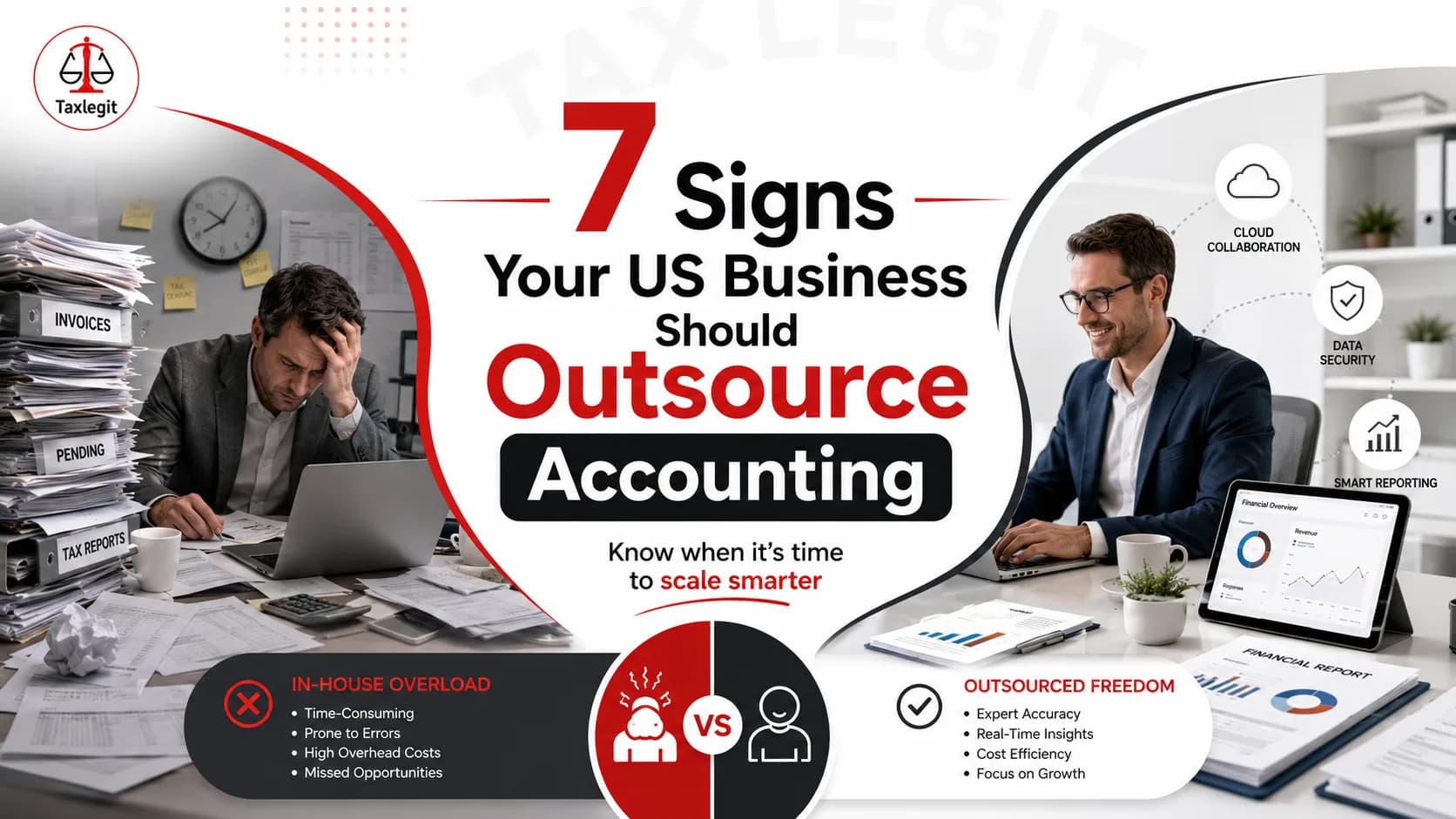
Should You Outsource?
Outsourcing your accounting is the right move when owner time, compliance complexity, or staff turnover begins draining your operational focus.
According to Clutch, 37% of US small businesses already outsource at least one accounting function, saving 40% to 60% compared to building an in-house team. If your business is generating $500K to $5M in revenue and you are personally spending more than a few hours a week on bookkeeping, that administrative overhead carries an opportunity cost your bottom line simply cannot afford to ignore.
Before We Dive In: Is This Article Written for You?
Meet Mike, 42, who runs a $2M e-commerce business out of Austin, Texas. He sells home goods on Shopify and Amazon, has seven employees, and manages his own books in QuickBooks. Every quarter, Mike dreads tax season. He's not sure if his deductions are correct, his payroll filings are always rushed, and he spent 22 hours last month on accounting tasks unrelated to business growth.
If you're nodding, then this article is for you. Every section that follows is written with Mike in mind, including the numbers to back it up.
What Does It Mean to Outsource Accounting?
Outsourcing accounting means handing your bookkeeping, payroll, tax preparation, financial reporting, or CFO-level strategy to a third-party firm that plugs directly into your existing tools QuickBooks, Xero, Shopify, or whatever you’re already using and delivers clean financials on a schedule you can count on.
If you are a US business owner generating $500K to $5M in revenue and still running your books the same way you did at $200K, there is a good chance your financial setup is holding you back. At this scale, clinging to a baseline in-house approach often costs significantly more in time and errors than partnering with a specialized, fractional team.
The seven signs below will help you determine exactly where your business stands. But first, consider the data behind modern small business accounting:
- The Savings: A Clutch Small Business Survey revealed that 37% of US small businesses outsource at least one accounting function, averaging cost savings of 40% to 60% over local hires.
- The Reality: According to the National Society of Accountants (NSA), the average salary for an in-house accountant tops $79,000 before benefits a steep overhead for a single point of failure.
- The question isn’t whether outsourced accounting works: The data proves it does. The question is whether your business is currently hitting the operational bottlenecks that mean it's time to make the switch.
Sign 1: Are You Wasting Too Many Hours on Bookkeeping Instead of Growing Your Business?
Now, think about last month. How many hours did you personally spend reviewing P&L statements or staring at bank reconciliation screens? If the honest answer is more than five hours, that’s revenue you’re not generating.
As a business owner, your time has a dollar value. Every hour you spend in the back office is an hour you’re not spending on sales, partnerships, or strategy. The finance function has a way of starting small and slowly eating your calendar until one day you realize you’re running an accounting department that also happens to sell home goods.
| Note: A 2024 Deloitte Global Outsourcing Survey found that 80% of executives planned to maintain or increase outsourcing investment, citing the ability to redirect leadership time to growth activities as the top benefit. (Source: Deloitte Global Outsourcing Survey 2024) |
When you outsource accounting, that workload moves to a dedicated team, and you’re free to focus on the work only you can do.
Sign 2: Why Does My In-House Accounting Team Fall Behind Every Month?
If your accounting team is regularly missing reporting deadlines, making errors on financial statements, or struggling to close the books each month, you may have a capacity problem.
As your business scales, transaction volumes and compliance requirements multiply fast. Most small, in-house teams simply aren’t built to handle that speed; as a result, you might get stuck in a 6–12 week hiring cycle every time you hit a new growth milestone, all while your books get further behind.
A professional outsourced accounting firm scales with you. So you get the right people and processes at every stage of growth without the recruiting headache.
Sign 3: Is Hiring an In-House Accountant Too Slow and Risky for My Business?
When an accountant leaves, Mike’s business takes a hit. He loses institutional knowledge the person who knew exactly how his Shopify inventory was categorized, how his sales tax was filed across three states, and which accounts were reconciled and which weren’t. It can take weeks or months to find a replacement and get them up to speed.
Outsourced bookkeeping services eliminate this cycle. Instead of relying on one or two in-house employees, you get a full bench of CPAs, bookkeepers, and controllers who show up every day. Think of it as a full finance department without the HR headaches.
| Note: The BLS projects about 124,200 accountant and auditor job openings annually through 2034 meaning skilled accounting talent is in constant demand and difficult to retain. (Source: BLS Occupational Outlook Handbook ) |
Sign 4: Why Don’t I Have a Clear Picture of My Financial Position Right Now?
To be honest, if someone asked you right now what your net margin was last month, could you answer confidently? If your books are two weeks behind, the answer is probably no, and that’s a competitive disadvantage.
Real-time financial visibility isn’t a luxury for businesses doing $2M in revenue, it’s a basic operating requirement.
Finance and accounting outsourcing solves this by replacing manual tracking with modern cloud-based tech stacks. What real-time visibility actually gives you:
- Early warning signals before a cash crunch hits
- Clarity on where your margins actually are, by product line and channel
- Data-backed confidence for every hiring and investment decision
Real-time financial data is a competitive weapon. If you’re a growing US business, it lets you outpace competitors who are flying blind.
Sign 5: Why Do Investor and Stakeholder Reports Always Feel Like a Last-Minute Crisis?
If you have outside investors, board members, or lenders, financial reporting should never feel like preparing for battle. When numbers are inconsistent or reports chronically arrive late, it actively erodes trust with the people whose capital is backing your growth.
That is the exact gap fractional CFO services are built to close. When you bring in an experienced outsourced partner, you gain a team that speaks fluent "investor." They already know which KPIs your VC or PE firm cares about because they have built board decks for dozens of companies at your exact stage.
| "Founders who outsource financial reporting to a qualified firm often close funding rounds faster. When your data room is clean, and your financial narrative is investor-ready from day one, you remove a massive layer of friction from the due diligence process." - Srijita, Senior Financial Analyst at TaxLegit |
Sign 6: Are My Spreadsheets and Disconnected Tools Creating Hidden Risks?
If Mike’s business still relies on manual spreadsheets or requires someone to manually re-key data from Shopify into QuickBooks, his technology is creating risk not just inconvenience.
In-house set-up vs. Outsourced Tech Stack
| Risk Area | In-House Setup | Outsourced Tech Stack |
| Data Errors | High manual entry creates typos, duplication, and mismatched balances | Low, automated syncs and dual review catch errors before they compound |
| Compliance Gaps | Easy to miss state tax deadlines, payroll filings, and regulatory changes | Built-in compliance calendars; dedicated team tracks multi-state obligations |
| Missed Deductions | Expenses scattered across platforms legitimate write-offs go unnoticed | Systematic categorization ensures every deductible expense is captured |
| Reporting Speed | The monthly close takes 10–15 days; reports arrive late | Cloud-based close completed in 3–5 business days with scheduled delivery |
A quality outsourced accounting solution not only does the work but also can modernize your entire finance stack within 30–90 days, eliminating the hidden risks that manual systems create.
Sign 7: Is Relying on One Person for All My Finances Too Risky?
Many business owners overlook this risk, but having a single employee handle your invoices, vendor payments, bank reconciliations, and payroll is a major structural flaw.
This baseline setup creates three direct vulnerabilities:
- Internal Fraud Risk: Without split duties or oversight, financial discrepancies or actual theft can easily go completely unnoticed for months or even years.
- Compounding Errors: Unintentional math or data-entry mistakes go unchecked, leaving no second set of eyes to catch them before they snowball into costly year-end reconciliation headaches.
- IRS Audit Triggers: Incomplete, round-numbered, or disorganized records are among the most common red flags that prompt the IRS to pull a business return for closer review. If your records cannot clearly substantiate your deductions during an inquiry, those deductions may get disallowed.
Once you hire an outsourced accounting firm, it quickly builds internal controls by default. Different team members handle different parts of the process; every transaction is reviewed, and every discrepancy is flagged before it becomes a problem.
| Real-World ExampleConsider this practical example based on the typical growth patterns and operational bottlenecks of digital agencies we onboard at TaxLegit:A fast-growing US creative agency scaled its operations to $3.5M in annual revenue. However, its rapid expansion left the founder personally trapped spending over 20 hours every single week manually managing multi-state contractor payouts and tracking client invoicing across three separate, disconnected platforms.By transitioning their financial operations to an outsourced, fractional accounting team in early 2025, the agency overhauled its workflow:- System Automation: The outsourced team integrated their core operations onto unified cloud accounting platforms, automating the entire invoicing lifecycle.- Drastic Turnaround Improvements: The agency's month-end closing cycle plummeted from a bloated 22 days down to just 4 days.- Direct ROI: Reclaiming those 20 hours a week allowed the founder to refocus entirely on high-value business development |
What Does Outsourced Accounting Cost in 2026?
Mike, this is probably the first number you want. Here’s an honest, sourced breakdown of what the US market looks like, including the offshore option that many US businesses use for significant cost savings.
| Service Level | US-Based Cost | Offshore Cost (India) | Your Savings |
| Bookkeeping (bank recs, ledger, data entry) | $500–$1,200/mo or $25–$50/hr | $200–$500/mo or $8–$12/hr | 40–60% |
| Full-Service Accounting & Tax (payroll, tax prep, monthly statements) | $1,500–$5,000/mo | $500–$1,500/mo | 50–70% |
| Virtual CFO / Controller (forecasting, board reporting, strategy) | $5,000–$15,000/mo (vs. $150K+ full-time hire) | $2,000–$6,000/mo | 60–80% |
( Source: SDO CPA Outsourced Accounting Cost Guide 2026; Wiss & Company Cost of Outsourcing Report )
You’re not just paying for hours. You’re paying for an entire team’s knowledge, technology stack, and accountability without the $100K+ annual salary, benefits, and recruiting overhead of a single in-house hire.
How TaxLegit Helps US Businesses Get Their Finances Right
At TaxLegit, we work specifically with US small and mid-sized business founders like Mike, doing $500K–$5M in revenue, who are ready to stop patching their finance function and start running it properly.
- Outsourced Bookkeeping Services: Clean books, bank reconciliations, and transaction categorization done accurately and on time, every month.
- Tax Preparation & IRS Compliance: Quarterly estimates, year-end filings, deduction optimization, and full IRS compliance. No surprises at tax time.
- Virtual CFO & Controller Services: Cash flow forecasting, financial modeling, and board-level reporting for businesses that need strategic financial leadership without the full-time hire.
- Cloud Accounting System Setup: We set up and manage QuickBooks, Xero, and other leading platforms so your data is accurate, integrated, and always accessible.
- IRS Representation & Audit Support: If you get a notice or face an audit, TaxLegit stands with you. We handle the IRS so you don’t have to.
Whether you’re a growing startup or an established business generating millions in revenue, we build a solution tailored to your specific situation, timeline, and budget.
What to Do Next
If you recognized even two or three of these signs in your own business, your current financial setup is costing you more than you think—in time, risk, and opportunity. Switching to outsourced accounting doesn’t have to be painful. The right partner handles the transition, gets your books clean, and lets you get back to running the business.
| 📅 Free 90-Day Financial RoadmapBook a 20-minute consultation today and get a clean 90-day financial roadmap no commitment required.👉 Click Here to Schedule Your Free Consultation |
Disclaimer: This article is for informational purposes only and does not constitute formal legal, accounting, or tax advice. Federal and state tax laws change frequently. Always consult a qualified CPA or professional tax advisor regarding your specific business situation.
About the Author

Srijita
Content Writer
Srijita is a legal and financial content specialist with 5+ years of experience in the Indian corporate sector. She simplifies MCA regulations and tax compliance into clear, actionable insights for entrepreneurs, working closely with Chartered Accountants and legal experts to ensure accuracy and compliance. Reviewed by Vipul Sharma, Co-Founder, Taxlegit.