
Accounting
10 Benefits of Accounting Outsourcing for US Businesses
May 27, 20268 Mins509 views
About the Author

Srijita
Srijita is a legal and financial content specialist with 5+ years of experience in the Indian corporate sector. She simplifies MCA regulations and tax compliance into clear, actionable insights for entrepreneurs, working closely with Chartered Accountants and legal experts to ensure accuracy and compliance. Reviewed by Vipul Sharma, Co-Founder, Taxlegit.
To be precise, running a business back office right now is tougher than ever. Finding and keeping a qualified, in-house accountant in the US has gone from a routine HR task to a massive operational headache.
Here are the evidential numbers that tell the true story:
- The Mass Exodus: Between 2019 and 2026, over 340,000 professional accountants walked away from their jobs.
- The Dwindling Pipeline: University accounting enrollments have plummeted by 30% over the last decade.
- The Unfilled Gap: The Bureau of Labor Statistics projects a staggering 124,000 vacant accounting roles every single year through the mid-2030s.
For US business owners, this talent shortage hits hard. It means dealing with skyrocketing salary demands, exhausting 70+ day hiring cycles, messy month-end closes, and unnecessary compliance risks. That is why accounting outsourcing services for US businesses are a critical strategy for survival.
The True Financial Math: In-House Employees vs. Outsourced Models
Many business owners mistakenly analyze staffing costs purely through base salaries. In reality, a full-time domestic accountant carries significant hidden overhead, including FICA taxes, health benefits, retirement matches, physical workspace provisions, and specialized enterprise software licenses (e.g., QuickBooks Enterprise, Xero, NetSuite ERP, CaseWare).
The table below breaks down the comprehensive loaded costs of a domestic internal hire compared to a modern, scalable outsourced framework.
| Cost Component | In-House US Senior Accountant (Annual) | Outsourced Accounting Model (Annual) |
| Median Base Salary / Base Service Fee | $81,680 (Latest BLS Data) | $9,600 – $36,000 (Tier-dependent) |
| Taxes & Mandatory Healthcare Benefits | $12,500 – $19,500 | Included in service fee |
| Software Subscriptions & Hardware Provisioning | $4,500 – $9,500 | Included in service fee |
| Recruitment, Onboarding, & Training Cost | $4,683 (SHRM Benchmark) | $0 |
| Average Total Loaded Cost | $103,363 – $115,363 | $9,600 – $36,000 |
| Net Financial Savings realized | Baseline | 40% to 70% Bottom-Line Reduction |
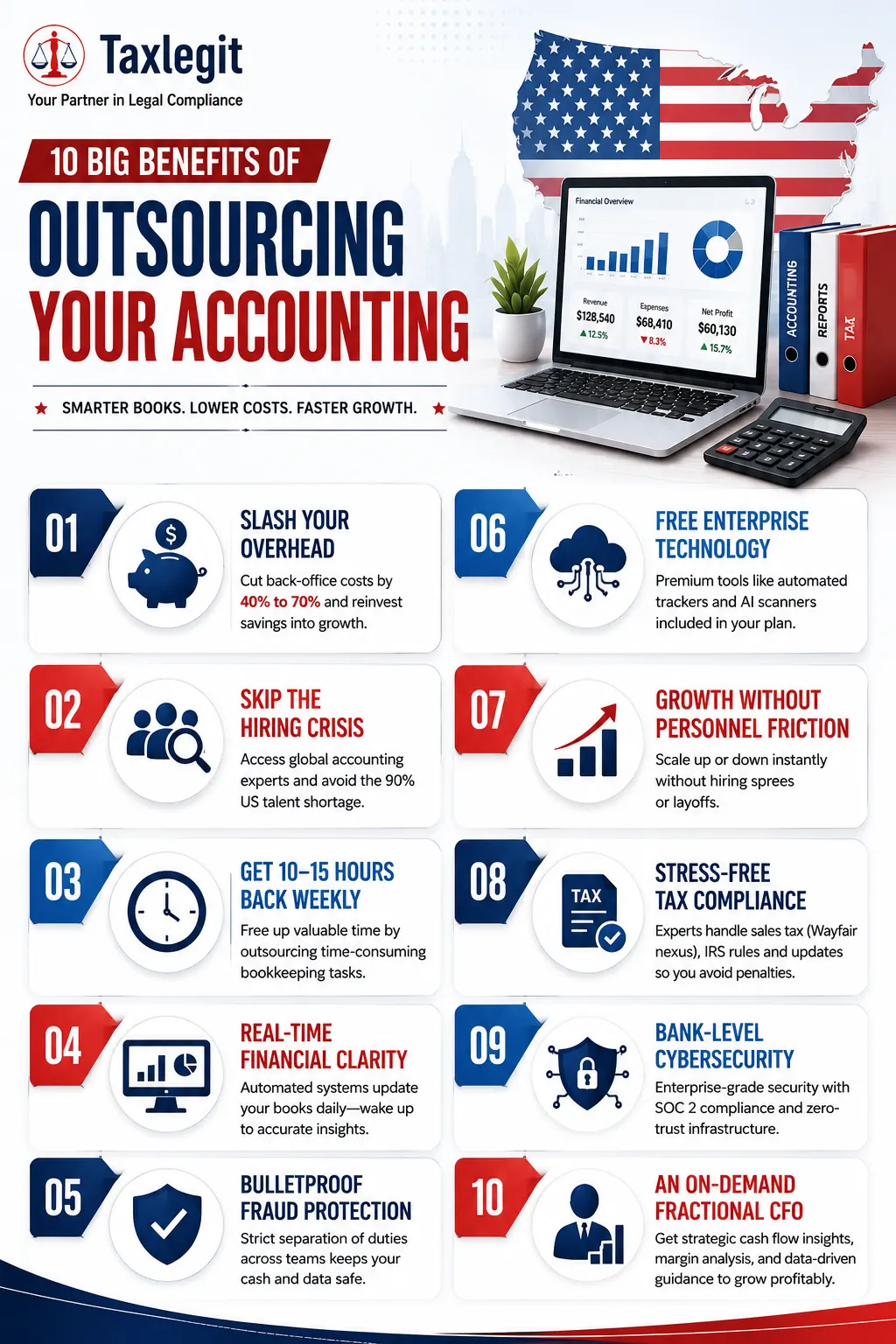
10 Big Benefits of Outsourcing Your Accounting
1. Slash Your Overhead
Shifting from a heavy full-time payroll to a flexible, pay-as-you-go subscription cuts back-office costs by 40% to 70%. You can instantly pump those savings back into your marketing and sales engines.
2. Skip the Hiring Crisis
Over 90% of US finance leaders can’t find qualified local talent. Outsourcing bypasses the domestic shortage entirely, giving you instant access to global experts fluent in US GAAP and IRS rules.
3. Get 10–15 Hours Back Weekly
C-suite executives waste hours chasing receipts and matching transactions. Handing off these tasks frees up your week to focus on closing high-value deals and driving growth.
4. Real-Time Financial Clarity
Forget waiting weeks after the month ends to see your numbers. Outsourcing partners use automation to update your books overnight, meaning you wake up to fresh, accurate dashboards every morning.
5. Bulletproof Fraud Protection
Letting one internal employee handle invoices, payments, and ledger entries is a huge security risk. External teams enforce a strict division of duties to keep your cash safe.
6. Free Enterprise Technology
Building a modern accounting tech stack is incredibly expensive. Outsourced firms bundle premium tools (like automated expense trackers and AI invoice scanners) directly into your service fee.
7. Growth without Personnel Friction
Business growth fluctuates. Instead of dealing with a costly hiring spree or painful layoffs, an outsourced model scales its support up or down instantly based on your transaction volume.
8. Stress-Free Tax Compliance
Navigating complex state-by-state sales taxes (like Wayfair nexus) and federal updates is a minefield. Dedicated compliance experts handle the details so you avoid surprise penalties.
9. Bank-Level Cybersecurity
Most small business networks are vulnerable to hacking. Reputable outsourcing firms protect your sensitive financial records with enterprise-grade SOC 2 certifications and zero-trust networks.
10. An On-Demand Fractional CFO
A great partner doesn’t just log old receipts; they help you look ahead. You get clear cash-flow forecasting, margin analysis, and data-driven insights to make profitable decisions.
Core Financial Functions Optimized for Outsourcing
US enterprises can delegate specific segments or the entirety of their back-office workflows based on operational needs:
- Procure-to-Pay (Accounts Payable): Automated invoice verification, digital expense tracking, and optimized vendor payment cycles.
- Order-to-Cash (Accounts Receivable): Prompt invoice creation, automated payment reminders, and proactive collections management to lower your Days Sales Outstanding (DSO).
- Record-to-Report (General Ledger): Monthly bank reconciliations, fixed asset management, and preparation of GAAP-compliant financial statements for investors or lenders.
Step-by-Step Partner Selection Framework
To maximize the impact of your outsourced accounting transition, your team must screen potential partners using three clear evaluation criteria:
Step 1: Evaluate the Technology Integration
Ensure the provider operates natively within modern cloud environments (e.g., QuickBooks Online, Xero, Sage Intacct) and supports API connections to your CRM and lead generation tools. Avoid vendors that rely on slow, manual email attachments or outdated file transfers.
Step 2: Verify Industry Specificity
An accounting team that specializes in e-commerce inventory management may not understand the revenue recognition rules required for a SaaS business or a medical practice. Choose a provider with a proven track record of managing compliance within your specific market segment.
Step 3: Confirm Communication Protocols
Vague SLA turnarounds can disrupt your operations. Your partner should provide clear, documented communication timelines, guaranteed response windows, and a dedicated account manager who understands your business goals.
Driving Growth with TaxLegit
Relying on overloaded internal staff often leads to reporting delays, compliance vulnerabilities, and missed growth opportunities.
At TaxLegit, we help US businesses modernize their back-office infrastructure. Our team combines advanced automation with experienced accounting professionals to handle your day-to-day bookkeeping, payroll, and compliance demands.
Ready to eliminate back-office stress and capture up to 70% in operational savings? Schedule your comprehensive financial workflow assessment with Taxlegit today!