

Accounting outsourcing is the strategic practice of transitioning daily bookkeeping, accounts payable/receivable, tax compliance, and financial reporting tasks to a specialized external firm.
Rather than handing over control, a properly structured engagement ensures your internal leadership retains 100% final approval authority over all disbursements and strategic decisions, while the external provider handles routine data entry, reconciliations, and draft reporting.
The Scope of Outsourced Financial Services
Outsourcing is not an all-or-nothing proposition. US businesses can delegate specific high-friction tasks or engage an end-to-end finance team. However, exact service availability depends on your contract scope, state regulations, and provider credentials.
Important Scope & Compliance Note:
Services vary by provider and jurisdiction Federal and state tax filings (such as annual IRS returns or complex multi-state tax strategies) must be handled by appropriately qualified professionals, such as a licensed US CPA or Enrolled Agent (EA). The business owner retains ultimate responsibility for approving transactions, signing tax documents, and maintaining internal oversight.
How Accounting Outsourcing Works for US Businesses
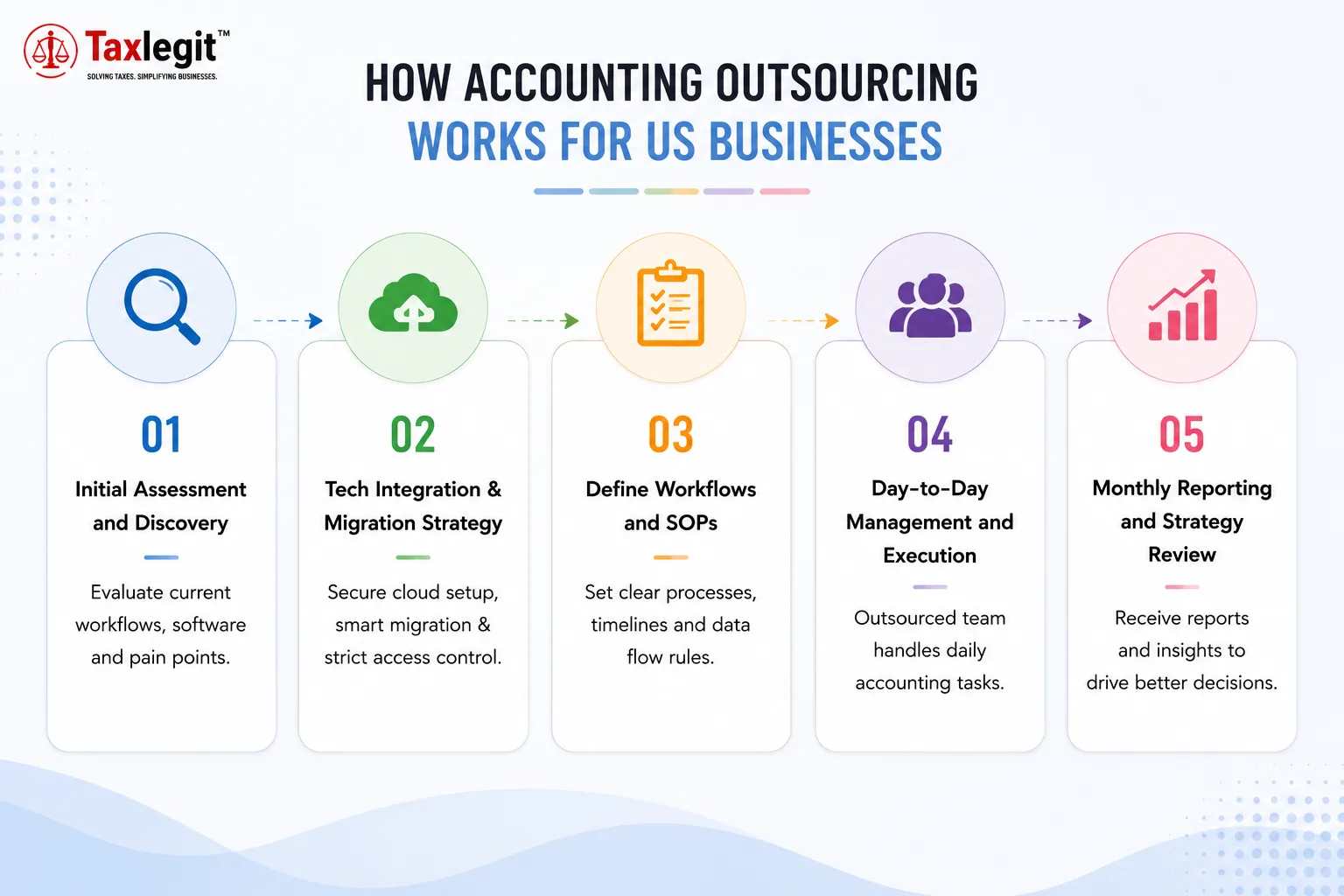
Transitioning to an outsourced model follows a structured process designed to integrate the external team seamlessly into your existing operations.
Step 1: Initial Assessment and Discovery
The process begins with an evaluation of your current financial workflows, software stack, and pain points. The service provider assesses your transaction volume and determines the level of oversight your business requires.
Step 2: Tech Integration & Migration Strategy
Modern accounting outsourcing leverages secure cloud platforms (QuickBooks, Xero, Sage Intacct) connected to specialized tools like Bill.com and Gusto.
- Migration Rule: Maintain your existing ledger whenever possible. Only migrate away from desktop software or corrupted systems if strictly necessary for integrations.
- Access & Security: Never share main logins. Assign dedicated, role-based user seats under a least-privilege model. Providers receive view-only bank access; owners retain exclusive payment release authority.
- Transition Protocol: Map historic data, test API connectors, and execute a 1-month parallel close to ensure zero variances before final handoff.
Step 3: Defining Workflows and Standard Operating Procedures (SOPs)
Clear boundaries and timelines are established. This phase determines exactly how invoices are approved, when payroll is run, and how data flows securely between your internal team and the external accountants.
Step 4: Day-to-Day Management and Execution
Once the systems are linked, the outsourced team takes over daily operations. They categorize expenses, reconcile accounts, and monitor cash flow in the background while you run your business.
Step 5: Monthly Reporting and Strategy Review
At the close of each month, the provider delivers accurate financial statements (balance sheet, income statement, and cash flow statement). High-tier providers include a review meeting to analyze performance and trends.
Why US Entrepreneurs and Investors Choose Outsourcing
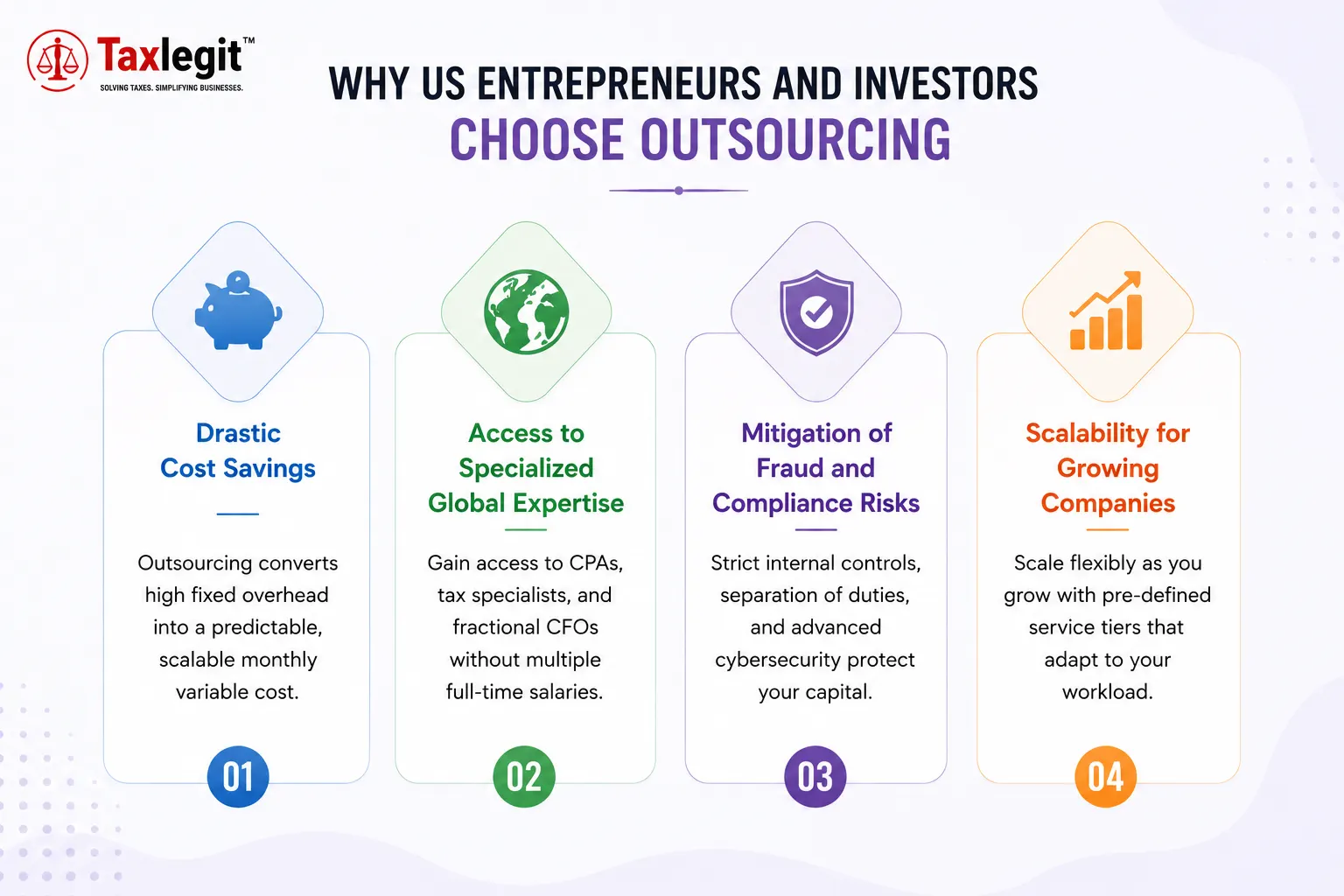
The traditional model of hiring local, full-time accounting staff is shifting. US business owners face unique economic pressures that make outsourcing a highly attractive alternative.
1. Drastic Cost Savings
Hiring a full-time, US-based accountant involves salaries, payroll taxes, health insurance, office space, and onboarding costs. Outsourcing converts a high fixed overhead into a predictable, scalable monthly variable cost.
2. Access to Specialized Global Expertise
A single in-house bookkeeper may lack the expertise required for complex state-by-state sales tax compliance or R&D tax credits. Outsourcing grants you access to a diverse team of CPAs, tax specialists, and fractional CFOs without paying multiple full-time salaries.
3. Mitigation of Fraud and Compliance Risks
Internal fraud often occurs when one person controls all financial touchpoints. External accounting firms implement strict internal controls, separation of duties, and advanced cybersecurity protocols to protect your capital.
4. Scalability for Growing Companies
As your business expands and transaction volume surges, an outsourced finance team can scale more flexibly than hiring a full-time, in-house employee. Rather than enduring a months-long recruitment cycle and paying fixed salary overhead during slow quarters, an external provider adapts to your changing workload through pre-defined service tiers.
Here is the revised In-House vs. Outsourced Accounting Comparison section, updated to replace generic adjectives with concrete cost ranges, clear assumptions, realistic timelines, and specific software ownership details.
Comparison: In-House vs. Outsourced Accounting
Selecting the right financial structure requires balancing direct labor costs, system overhead, and operational risk. Below is a breakdown based on typical market rates for US mid-market and small businesses.
Baseline Assumptions for Comparison:
Figures assume a business with $1M–$5M in annual revenue, ~150–300 monthly bank/credit card transactions, and standard payroll for 10–25 employees. All figures represent standard 2026 US market averages.
| Feature / Metric | Full-Time In-House Accountant | Outsourced Accounting Firm |
| Direct Annual Cost | $75,000 – $95,000/year (Base salary for a mid-level staff accountant) | $18,000 – $42,000/year ($1,500 – $3,500/month fixed retainer based on scope) |
| Benefits & Overhead | +$20,000 – $28,000/year (Taxes, health insurance, 401k, office space, hardware) | $0 (Covered entirely by the vendor) |
| Software Subscriptions | $3,000 – $6,000/year (Client pays directly for GL, AP/AR automation, and payroll tools) | Varied (Client pays GL licenses directly; vendor app stack discounts or bundled access may be included depending on the contract) |
| Depth of Expertise | Single Point of View (Limited to the individual’s specific background and skillset) | Multi-Tier Team (Access to bookkeepers, staff accountants, CPAs, and fractional CFOs) |
| Onboarding Timeline | 45 – 90 Days (Recruiting, interviewing, hiring, and internal training) | 14 – 30 Days (Initial data intake, tech integration, and parallel close validation) |
| Scalability & Capacity | Rigid (Overtime during peak periods; requires additional full-time hiring to scale) | Tier-Based (Adjusts via contract volume bands with 14–30 days notice) |
How to Choose the Right Outsourced Accounting Partner
Not all providers are created equal. To protect your business and investment, evaluate potential partners using these strict criteria:
Check for industry experience
An e-commerce business needs a firm that understands inventory accounting and sales tax nexus. A venture-backed startup needs a firm familiar with GAAP compliance and burn rate tracking. Choose a partner with a proven track record in your specific niche.
Understand Their Pricing Structure
Avoid hidden fees. Look for firms that offer transparent pricing models:
- Fixed Monthly Retainer: Best for predictable budgeting based on transaction volume.
- Hourly Rates: Ideal for clean-up projects or sporadic consulting.
Evaluate Their Tech Stack & Workflow
Platform certifications are a helpful starting signal, but they do not guarantee quality execution. Many accounting tools lack formal certification programs entirely.
Evaluation Framework:
- Credentials & References: Request platform-specific credentials alongside verified client references operating on your exact software stack.
- Workflow Demonstration: Require a live demonstration of your specific workflows (e.g., AP approval routing, inventory syncs).
- Integration Capability: Verify hands-on experience integrating your specialized software (e.g., POS, CRM, billing) into your core ledger to eliminate manual data entry errors.
Is Accounting Outsourcing Right for Your Business?
Accounting outsourcing is right for your business if your internal team spends more time fighting operational bottlenecks than analyzing financial growth, or if hiring full-time in-house talent exceeds your back-office budget. By delegating routine bookkeeping, reconciliations, and draft reporting to a specialized provider like TaxLegit, you protect your company from compliance errors while keeping full control over payment approvals and cash management.
Next Step: Audit your internal back-office costs this week. If you are spending over $1,500/month on manual data entry, software, or part-time staff without getting timely, month-end financial reports, schedule a discovery call with a qualified outsourcing provider to map out a tailored transition plan
How Does TaxLegit Help US Businesses Choose the Right Accounting Outsourcing Platform?
TaxLegit works with US businesses in the $1M–$15M revenue range to evaluate, implement, and configure accounting outsourcing software around what their invoice complexity actually requires not around whichever platform is easiest to demo.
For a broader look at how automation compares to outsourcing your accounting function entirely, see our guide in detail.
| Ready to evaluate accounting and bookkeeping platforms the right way?[Click here to schedule your free accounting outsourcing readiness assessment] and get a custom feature-fit analysis within 48 hours.🌐 Prefer to reach out directly? Email us: [email protected] OR call on WhatsApp: +91 89292 18091 (Available across all US time zones) |
Frequently Asked Questions
Accounting outsourcing is the practice of hiring a third-party service provider to manage your company's financial operations, such as bookkeeping, payroll, and tax compliance.
It works through secure, cloud-based software (like QuickBooks or Xero) where your business securely uploads financial data, and a dedicated team of remote experts processes transactions, reconciles accounts, and delivers regular financial reports.
Yes, reputable outsourcing firms use bank-grade encryption, multi-factor authentication, and comply with strict data security standards like SOC 2 to ensure your financial information is fully protected.
US businesses typically reduce their financial administrative overhead by 30% to 50% by eliminating expenses related to full-time employee salaries, benefits, onboarding, and internal software licenses.
Yes, professional providers employ specialists well-versed in US GAAP, federal tax codes, and multi-state compliance regulations to ensure your business avoids penalties and files accurately.
Outsourced accounting handles the day-to-day financial execution (like data entry, billing, and reporting), while a fractional CFO provides high-level, forward-looking strategic planning, budgeting, and fundraising guidance).
About the Author

Srijita
Content Writer
Srijita is a legal and financial content specialist with 5+ years of experience in the Indian corporate sector. She simplifies MCA regulations and tax compliance into clear, actionable insights for entrepreneurs, working closely with Chartered Accountants and legal experts to ensure accuracy and compliance. Reviewed by Vipul Sharma, Co-Founder, Taxlegit.